
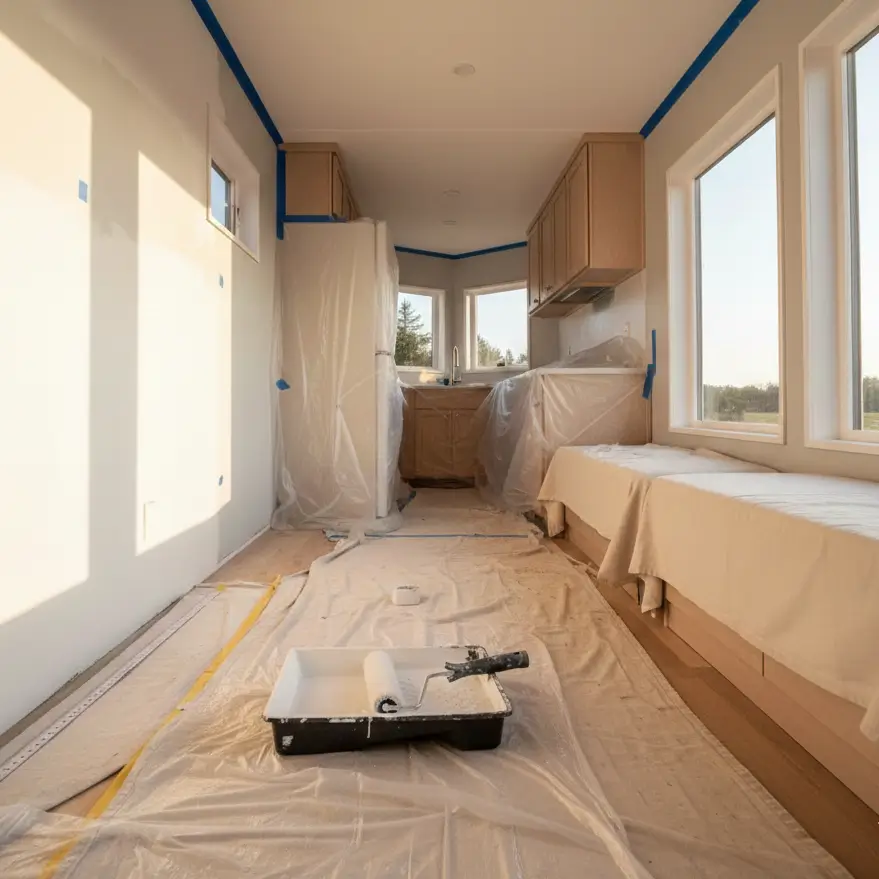
Skip the primer and your fresh paint job might peel within months. That’s frustrating anywhere, but in a 380 sq ft tiny house where every wall stares you in the face daily? It’s devastating.
Proper primer applications in small spaces actually matter more than in larger homes because you have zero room for flaws to hide, and a failed paint job means repainting your entire visible living area.
I learned this the hard way in my 450 sq ft apartment when I tried cutting corners on a bathroom ceiling. Three months later, moisture damage forced a complete redo. The “savings” from skipping primer cost me an extra $180 and two weekends.
The good news? Priming a tiny house or small apartment is faster, cheaper, and more forgiving than you’d think. Most spaces under 600 sq ft need just 1-2 gallons of primer ($25-80 depending on type). And the right primer can solve multiple problems at once, blocking stains, improving adhesion, and sealing odors.
This guide covers which primer types work for each surface, how to calculate exactly what you need, and how to apply primer safely when your living room, kitchen, and bedroom share 400 square feet of air. By the end, you’ll have a clear plan for your paint preparation project that protects your investment from the start.
Why Primer Matters More in Small Spaces
In compact living environments, primer creates the foundation for paint adhesion, stain blocking, and color accuracy across every visible surface. Since 80-90% of your walls are in your direct line of sight daily, imperfections that might hide in a 2,500 sq ft home become glaring focal points in a 400 sq ft space.
Think of primer as insurance you can actually afford. A gallon of quality primer runs $30-50 and covers 300-400 square feet. That’s roughly your entire tiny house wall area, exterior walls might total just 350 sq ft in a typical 8′ x 24′ tiny house on wheels.
Here’s what happens when you skip it:
Without primer, paint fails three ways
- Poor adhesion causes peeling, especially on slick surfaces like bathroom tiles or glossy cabinets
- Stains bleed through within weeks (water marks, smoke damage, marker from previous tenants)
- Multiple coats needed to achieve true color, meaning more fumes and longer project time in your small space
The small-space multiplier effect makes these problems worse. In a 2,000 sq ft house, a failed bathroom paint job is 5% of your walls. In a 400 sq ft apartment, that same bathroom represents 25-30% of your living environment.
When you’re planning your tiny house budget, primer isn’t where you cut costs. It’s where you protect the money you’re spending on quality paint.
The Cost Math Actually Favors Primer
Let me break this down with real numbers:
| Scenario | Primer Cost | Paint Cost | Total | Risk Level |
| 400 sq ft walls, WITH primer | $45 (1.5 gal) | $90 (2 gal quality paint) | $135 | Low |
| 400 sq ft walls, NO primer | $0 | $120 (3 gal for coverage) | $120 | High |
| Repaint after failure | $45 + $90 | $135 | $270+ | Guaranteed |
That “$15 savings” from skipping primer becomes $135+ in rework costs when things go wrong. And in tiny spaces, paint failure isn’t a “maybe”, it’s a “when” without proper prep.
Which Primer Type Do You Need? Surface-by-Surface Guide
Match your primer to your surface problem, not just the material. Bonding primers handle slick surfaces like laminate cabinets. Stain-blocking primers (shellac or oil-based) seal water damage and odors. PVA primers prep new drywall. For multi-surface tiny house projects, a quality bonding primer often handles 80% of your needs.
This is where small-space living gets interesting. In a traditional home, you might use different primers in different rooms over separate weekends. In a tiny house, you could be priming kitchen cabinets, bathroom walls, and bedroom trim in a single 6-hour session.
The Small-Space Primer Decision Chart
Start here: What’s your biggest challenge?
Slick, Non-Porous Surfaces (Laminate, Tile, Glossy Paint)
- Best choice: Bonding primer like INSL-X Stix or Zinsser Bulls Eye 1-2-3 Plus
- Coverage: 300-350 sq ft/gallon
- Drying time: 1 hour to touch, 3 hours to recoat
- Cost: $35-55/gallon
- Small-space tip: Handles cabinets, glossy bathroom walls, and old painted trim, one product for multiple surfaces
Stains, Water Damage, Smoke/Nicotine
- Best choice: Shellac-based (Zinsser B-I-N) or oil-based (Kilz Original, Zinsser Cover Stain)
- Coverage: 200-300 sq ft/gallon
- Drying time: 45 minutes to 1 hour
- Cost: $45-80/gallon
- Small-space warning: Strong fumes require maximum ventilation, open all windows, use fans, consider working in segments
New Drywall or Patches
- Best choice: PVA drywall primer (Kilz PVA, Sherwin-Williams PrimeRx PVA)
- Coverage: 300-400 sq ft/gallon
- Drying time: 30 minutes to 1 hour
- Cost: $15-25/gallon
- Small-space bonus: Cheapest option, low odor, perfect for tiny house wall materials prep
Color Changes (Dark to Light)
- Best choice: High-hide primer like Kilz Premium or Benjamin Moore Fresh Start
- Coverage: 300-400 sq ft/gallon
- Drying time: 1 hour
- Cost: $30-45/gallon
- Small-space reality: If you’re brightening a dark apartment with paint, tinted primer in gray reduces topcoat needs
How Much Primer Do You Actually Need for a Tiny House?
Most tiny houses under 400 sq ft need 1-2 gallons of primer total. A 200 sq ft micro-studio needs just 0.5-0.75 gallons. Calculate your actual wall area (height × perimeter, minus windows and doors) rather than guessing based on floor square footage.
Here’s a mistake I see constantly: people calculate primer needs based on floor space. A 400 sq ft tiny house doesn’t have 400 sq ft of walls, it might have 280-350 sq ft depending on ceiling height and window placement.
Quick Coverage Calculator for Common Small Spaces
| Space Type | Floor Sq Ft | Typical Wall Sq Ft | Primer Needed |
| Micro-studio | 150-200 | 180-240 | 0.5-0.75 gal |
| Studio apartment | 300-450 | 280-380 | 1-1.25 gal |
| Tiny house (8’×20′) | 160 | 260-320 | 0.75-1 gal |
| Tiny house (8.5’×24′) | 204 | 320-380 | 1-1.25 gal |
| Small 1BR apartment | 500-650 | 400-520 | 1.5-2 gal |
| Compact living (800) | 800 | 600-720 | 2-2.5 gal |
How I calculated this:
- 8′ ceiling height typical
- 15-20% subtracted for windows/doors
- Single coat coverage at 350 sq ft/gallon
For tiny houses on wheels, remember that lofted bedroom ceilings add wall area but are often lower height (4-5 feet). Factor in loft knee walls separately.
Pro tip: Buy slightly more than you calculate. That extra $15 for a cushion beats a mid-project store run when you’re 40 square feet short. Plus, leftover primer stores well for touch-ups, just seal it properly following paint storage best practices.
Low-VOC and Zero-VOC Primers for Tight Ventilation
Standard primers release 150-400 g/L of volatile organic compounds during application. Low-VOC formulas (under 50 g/L) and zero-VOC options reduce off-gassing significantly, critical when your bedroom is 12 feet from your painting zone. Quality low-VOC primers like Benjamin Moore Fresh Start or Sherwin-Williams Harmony primer now perform comparably to traditional formulas.
This is honestly the section that matters most for small-space dwellers. I cannot stress this enough: ventilation in a tiny house is not the same as ventilation in a traditional home.
When you’re priming in a 300 sq ft space, opening two windows doesn’t create the cross-ventilation you’d get in a 1,500 sq ft house with windows on four sides. Your exposure to primer fumes is concentrated.
Low-VOC Options Worth Considering
Under 50 g/L VOC:
- Benjamin Moore Fresh Start (all varieties): 37-50 g/L, $40-50/gallon
- Sherwin-Williams Harmony Primer: 0 g/L, $45/gallon
- Behr Premium Plus Interior Primer: 20 g/L, $25/gallon
- Zinsser Bulls Eye 1-2-3 Water-Based: 44 g/L, $35/gallon
Ventilation Strategies for Compact Spaces:
- Cross-ventilation setup: Open windows on opposite walls, place box fan in one blowing outward
- Work in segments: Prime one wall, let it cure 4 hours, move to next
- Time it right: Prime in morning when you can leave windows open all day
- Consider outdoors: For painting furniture and home decor pieces, take items outside to prime
When working with oil-based or shellac primers (sometimes necessary for severe stains), consider staying elsewhere overnight. These release fumes for 24-48 hours. For renters, this might mean a night on a friend’s couch, plan accordingly.
Following proper paint safety regulations isn’t optional in small spaces. It’s survival.
Step-by-Step Primer Application in Compact Spaces
In tight quarters, work in sections to maintain wet edges while managing fumes. Use a 4-6 inch roller for walls (faster than 9-inch in cramped rooms), cut in ceilings first, and plan your exit route so you’re not stepping over wet floors. Two thin coats beat one thick coat for adhesion and drying time.
Let’s walk through the actual process for a typical 350 sq ft tiny house or studio.
Before You Start
Gather materials:
- Primer (amount per calculator above)
- 4-6 inch roller with 3/8″ nap cover
- 2″ angled brush for cutting in
- Painter’s tape (FrogTape or 3M for clean lines)
- Drop cloths (canvas preferred, absorbs drips)
- Stir stick
- Paint tray
- Step stool (most tiny houses don’t need ladders)
Having the right painting tools for tight spaces makes the job significantly easier.
Application Sequence for Small Spaces
Step 1: Prep everything first (1-2 hours)
- Clean all surfaces with TSP or degreaser
- Fill holes with spackle, let dry, sand smooth
- Tape edges and cover floors
- Open windows and set up ventilation
Step 2: Cut in all ceiling edges (30-45 minutes)
Start at the farthest point from your exit. In a typical tiny house, this means beginning at the loft area or back bedroom.
Step 3: Roll ceilings (30-45 minutes)
Work in 3-4 foot sections. Keep a wet edge to avoid lap marks.
Step 4: Cut in wall edges and corners (45 minutes to 1 hour)
Top to bottom, maintaining your wet edge.
Step 5: Roll walls (45 minutes to 1 hour)
Start at the farthest corner, work toward your exit. In a 400 sq ft space, you’re covering roughly 350 sq ft of wall in under an hour with a 6″ roller.
Step 6: Let cure, then assess (2-4 hours)
Check for bleed-through, missed spots, or adhesion issues. Apply second coat to problem areas only, saves primer and time.
The Small-Space Drying Advantage
Here’s something that surprised me: primer actually dries faster in small spaces with good ventilation because airflow is more concentrated. In my 450 sq ft apartment, primer that claimed “1 hour to recoat” was ready in 40 minutes with two fans running.
This means a complete primer job, one coat on walls and ceiling of a 300-400 sq ft space, takes about 4-5 hours including prep and dry time. You can legitimately prime in the morning and apply your first paint coat by late afternoon.
Making Your Primer Work Harder
The real magic of primer in small spaces is maximizing what each gallon does. When you’re covering wood interior elements, drywall, and potentially even countertops and surfaces, a quality bonding primer becomes your multi-surface workhorse.
If you’re planning a complete tiny house color selection overhaul, having your primer tinted to a mid-gray (rather than white) can reduce the number of paint coats needed, especially for bold or dark colors. Most paint stores offer tinting for $2-4 per gallon.
Your tiny house or small apartment deserves the same prep work as a mansion, it just takes less time, less product, and delivers results you’ll see every single day. Start with primer, and the paint that follows will look better longer.
For your next project, consider how low-VOC paint options pair with your primer choice to create the healthiest possible living environment. At Veniola, we focus on making small spaces work beautifully, and that starts with getting the foundation right.