People often assume that simply living in a tiny house makes you sustainable. It’s an easy assumption to make, less square footage naturally means less heating, less cooling, and less stuff, right?
Well, partially.
In my experience designing layouts for spaces under 400 square feet, I’ve found that a tiny house is actually a high-performance machine. Because the volume of air is so small, everything is intensified. Poor insulation is noticed immediately. Off-gassing from cheap materials concentrates faster than in a traditional home.
True tiny house sustainability isn’t just about downsizing; it’s about intentional systems that work with your specific micro-climate. Whether you are building a $60,000 custom home on wheels or retrofitting a $500 DIY van conversion, the principles of physics and ecology remain the same.
In this guide, we will move beyond the buzzwords and look at the square-foot ROI (Return on Investment) of sustainable choices.
The Envelope: Insulation and Air Quality
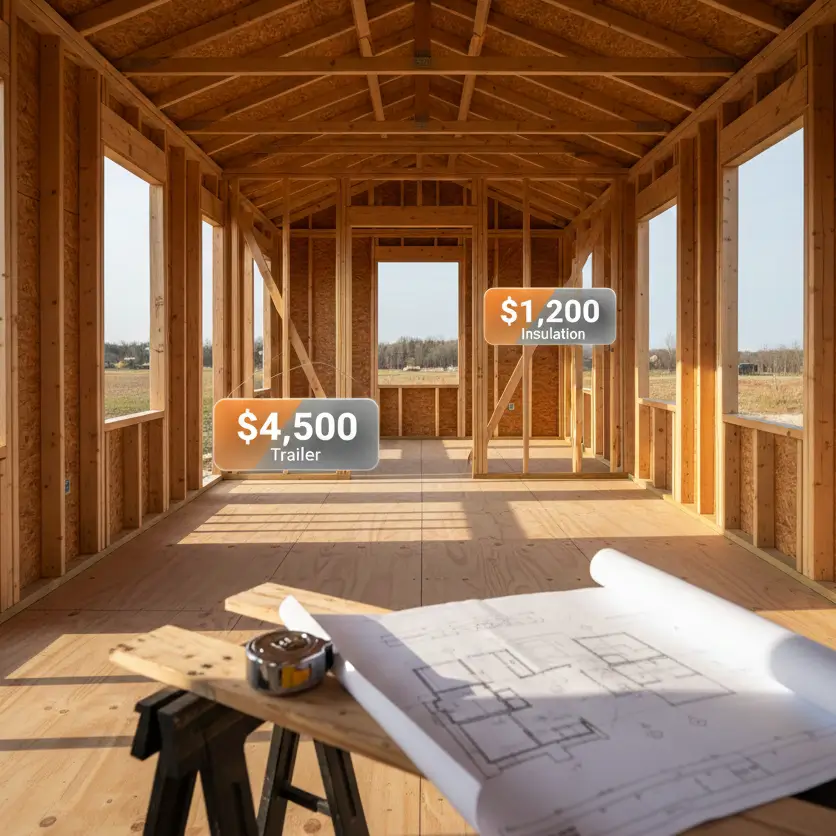
What is the Best Sustainable Insulation for Tiny Houses? For tiny houses, sheep’s wool and rigid foam board (polyiso) are top contenders. Sheep’s wool manages moisture naturally (critical in small volumes) and has an R-value of roughly R-3.5 per inch. Rigid foam offers high R-values (R-6 per inch) for thin walls but requires precise sealing. Expect to budget $1.50–$3.00 per sq ft for premium sustainable options.
Managing the “Thermos Effect”
In a standard 2,000-square-foot home, walls breathe a little easier. In a 200-square-foot tiny house on wheels (THOW), you are essentially living inside a sealed thermos.
If you seal it too tightly with synthetic materials, you trap moisture. If you don’t insulate enough, you bleed energy.
I highly recommend sheep’s wool insulation for tiny homes. Why? Because wool is hygroscopic. It can absorb up to 30% of its weight in moisture without losing insulating properties or growing mold. In a tiny space where cooking pasta can fog up windows in three minutes, this moisture management is vital.
However, if you are strictly watching the budget or wall thickness, closed-cell spray foam provides the highest R-value per inch (approx R-6.5), maximizing your interior width. If you go this route, you must install a mechanical ventilation system like an ERV (Energy Recovery Ventilator) to cycle fresh air.
Note: Check out our Tiny House Insulation Guide for a deep dive into R-values and installation techniques.
Non-Toxic Interiors
Because you are breathing in a much smaller volume of air, Volatile Organic Compounds (VOCs) from paints and glues concentrate quickly. That “new house smell” is actually off-gassing, and in a tiny house, it can lead to headaches and respiratory issues fast.
When painting your interior:
- Choose Zero-VOC paints (not just low-VOC).
- Look for GreenGuard Gold certification.
- For wood finishes, consider natural oils like linseed or tung oil.
For more on selecting safe finishes, read our guide on Low-VOC Paint for Tiny Houses.
Water Systems: The Off-Grid Equation
How Do Sustainable Water Systems Work in Small Spaces? Sustainable tiny house water systems separate waste streams to reduce impact. Composting toilets (costing $900-$1,500) eliminate blackwater tanks, saving roughly 15-20 gallons of water per person/day. Greywater systems filter sink/shower water for garden use. This approach reduces fresh water dependence by 30-50%.
The Compost Toilet Debate
For many, the composting toilet is the gatekeeper of the tiny house lifestyle. It forces you to confront your waste. However, from a sustainability standpoint, it is the single most effective change you can make.
A standard flush toilet uses potable water to transport waste to a treatment plant. A composting unit, like the Nature’s Head or Separett, uses zero water.
Space Impact:
- Standard RV Toilet: Requires a black water holding tank under the trailer (takes up vertical height or under-counter space).
- Composting Toilet: Self-contained. Requires about 20″ of depth and 16″ of width in the bathroom. No tank underneath means higher ground clearance for the trailer or more storage space.
If you are planning your bathroom layout, see our Tiny House Bathroom Fixtures guide for specific measurements of popular models.
Greywater Management
If you eliminate the toilet waste (blackwater), everything else down the drain is greywater (sinks and shower). Using biodegradable soaps allows you to filter this water and return it to the earth, depending on local zoning.
Simple DIY Greywater Filter:
- Surge Tank: A 5-gallon bucket to catch sudden flows.
- Mulch Basin: A dug-out area filled with wood chips where water is released.
- Plants: Thirsty plants like bananas or wetland grasses planted near the outlet.
This setup costs under $100 to build but requires maintenance. Always check Tiny House Plumbing Systems for legal compliance in your area.
Materials and Weight: The Hidden Carbon Cost
Which Building Materials are Most Sustainable for Tiny Homes? Weight equals fuel consumption for mobile tiny homes. Reclaimed wood (barn wood, pallet wood) is aesthetic and eco-friendly but heavy. Bamboo and cork are lightweight, rapidly renewable, and durable for flooring. FSC-certified plywood is lighter than drywall and resists cracking during transit.
The Weight vs. Sustainability Trade-off
If your tiny house is on wheels, weight is your enemy. A heavy house requires a heavy-duty truck to tow it, burning significantly more diesel.
- Reclaimed Wood: Beautiful and recycled, but often oak or maple (heavy). Use it for accents, not structural sheathing.
- Drywall: Heavy and prone to cracking.
- Plywood/Shiplap: Lighter, stronger, and adds shear strength to the frame.
I’ve seen builders use heavy reclaimed barn beams for ceilings, only to realize their trailer is overweight before they even add furniture. For lighter alternatives that still look warm and organic, explore Wood Materials for Tiny Houses.
Sustainable Flooring
In a space less than 400 sq ft, your floor takes a beating. You are walking on the same 10-foot path fifty times a day.
Cork Flooring:
- Pros: Antimicrobial, soft underfoot, insulates thermal bridging (keeps toes warm).
- Cons: Can fade in direct sun.
- Sustainability: Harvested from bark without killing the tree.
Bamboo Flooring:
- Pros: Harder than oak, moisture resistant.
- Cons: Ensure it is formaldehyde-free adhesive.
- Sustainability: Grows back in 3-5 years.
For installation tips in tight corners, refer to our guide on Tiny House Flooring Installation.
Energy: Solar and Passive Design
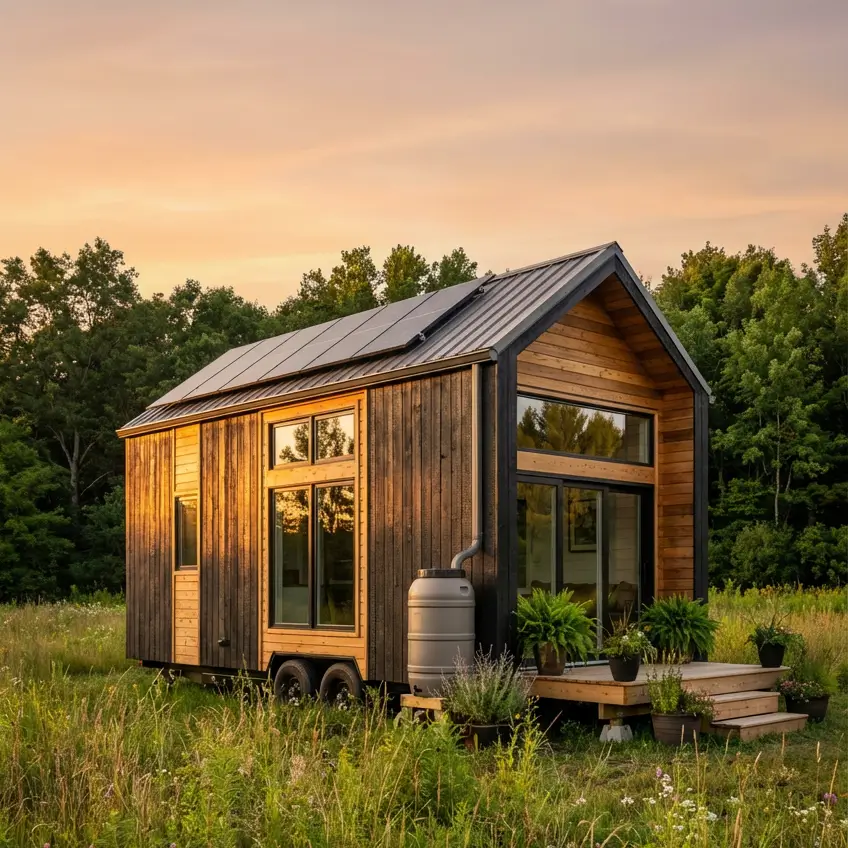
Is Solar Power Worth the Investment for a Tiny House? Yes, if designed correctly. A typical tiny house needs a 2kW to 4kW solar array, costing $5,000–$12,000 depending on battery storage (lithium vs. AGM). To reduce this cost, prioritize passive solar design, orienting windows South (in the northern hemisphere) to harvest free heat in winter.
Passive Solar: The Free Energy Source
Before you spend $10,000 on solar panels, spend time on window placement. This costs nothing extra during the design phase but saves money forever.
- South-Facing Windows: Maximize these. They let in winter sun to heat your thermal mass (floor/walls).
- North-Facing Windows: Minimize these. They lose heat in winter.
- Overhangs: crucial for blocking high summer sun while allowing low winter sun.
When designing your window package, consider the R-value of the glass. In a tiny house, windows are the biggest source of heat loss. Review Tiny House Windows and Doors for specs on double-pane vs. triple-pane options.
The All-Electric Tiny House
Getting off propane removes a fossil fuel source from your home. With the efficiency of modern induction cooktops and mini-split heat pumps, an all-electric tiny house is viable.
- Induction Cooktop: 90% efficient (gas is ~40%). Boils water in half the time, putting less heat and moisture into your tiny air volume.
- Mini-Split Heat Pump: The gold standard for Tiny House Heating and Cooling. It provides both heat and AC, is whisper quiet, and extremely efficient (SEER ratings of 20+).
Biophilic Design: bringing the Outdoors In
How to Integrate Plants into Small Living Spaces? Biophilic design connects occupants to nature. In tiny spaces, vertical gardens and hanging planters utilize “dead” air space. Plants like Snake Plants and Pothos filter indoor air toxins. Dedicate vertical wall space (approx 2-4 sq ft) near windows for a living wall to improve air quality and mental well-being.
The Mental Aspect of Sustainability
Sustainability isn’t just about carbon; it’s about the sustainability of living in the space. If you feel cramped and stressed, you won’t last in the tiny house.
Plants soften the harsh lines of a small rectangular box. They add humidity (good for winter) and oxygen.
Best Tiny House Plants:
- Snake Plant: Vertical growth (takes up little floor space), thrives on neglect.
- Spider Plant: Easy to propagate, hangs beautifully from ceilings or high shelves.
- English Ivy: Great for trailing along lofts.
For those struggling with placement in tight quarters, check our article on Vertical Gardening in Small Spaces and specifically Biophilic Design for Tiny Homes.
Grid-Tied vs. Off-Grid: Which is More Sustainable?
Grid-tied allows you to feed excess solar energy back to the community but keeps you dependent on infrastructure. Off-grid requires batteries (resource-intensive mining) but ensures autonomy. For most, a hybrid system is the most practical balance of cost and impact.
| Feature | Grid-Tied Tiny House | Off-Grid Tiny House | Small Space Impact |
| Power Source | Utility + Optional Solar | Solar/Wind + Generator | Off-grid needs ~15 sq ft for batteries/equipment. |
| Water | Hose/Main hookup | Rainwater/Tank | Off-grid needs space for pumps & filters. |
| Waste | Sewer/Septic | Compost/Greywater | Off-grid frees you from septic permits. |
| Initial Cost | Low ($500-$2k hookup) | High ($10k+ systems) | Budget for batteries dominates off-grid costs. |
| Sustainability | Dependent on grid mix | Self-reliant | Batteries have a carbon footprint too. |
Analysis:
If you park your tiny house in a backyard with an extension cord (Grid-Tied), you might actually have a lower carbon footprint than someone with a massive battery bank that requires lithium mining.
However, if you want true freedom and the ability to park on cheap, undeveloped land, off-grid is the only way. You can learn more about the components needed in our Off-Grid Tiny House Systems guide.
Final Thoughts
Tiny house sustainability is a game of inches and ounces. Every material you choose has to justify its weight, its space, and its chemical composition.
If you are just starting, don’t feel pressured to buy the most expensive solar system on day one. Start with the envelope, insulation and air sealing. That is where you get the best performance per dollar.
- If you are in a build, prioritize an ERV or proper ventilation.
- Can you switch to a low-flow showerhead (1.5 GPM or less) today?
- If you are mobile, park with your biggest windows facing South tomorrow.
For more details on keeping your lifestyle aligned with your eco-goals, read about Tiny House Minimalist Living.
Remember, the most sustainable home is the one that lasts. Build it right, keep it healthy, and enjoy the freedom of living light.
Explore more at veniola.com.