Working remotely is freedom. Living in a tiny house is freedom. But combining them? That can feel like a trap.
I tried working from my couch for exactly three days when I moved into my 380-square-foot space. My back hurt, my focus drifted to the dirty dishes in the sink four feet away, and worst of all, I never felt like I was “off the clock” because my laptop was always staring at me from the coffee table.
If you are trying to squeeze a career into a corridor, you aren’t alone. But the solution isn’t just buying a smaller desk. It’s about creating a “disappearing office”, a space that performs when you need it and vanishes when you don’t.
To successfully work from home in a tiny house, prioritize vertical wall-mounted desks (Murphy desks) that preserve floor space. Use monitor arms to save depth (requiring only 18-20″ desk depth vs standard 30″). Separate work zones visually using lighting or folding screens, and invest in an ergonomic chair that tucks fully under the desk or hangs on the wall. Budget ranges from $50 for DIY brackets to $1,500 for custom built-ins.
Whether you have a $100 budget for lumber or $2,000 for a custom install, here is how to reclaim your space and your sanity.
The “Zone” Concept: Mental Separation in Single-Room Living
In spaces under 400 sq ft, physical walls are rarely an option. Instead, create micro-zones. Use a rug (approx. 3×5 ft) to delineate the “office.” Orient your desk to face a window or blank wall, never the kitchen or bed. This visual blocking tricks the brain into entering “work mode.”
Why The Kitchen Table Doesn’t Work
It’s tempting to just use the multi-purpose table. I did. But in a tiny house, transition rituals are vital. If your dining table is covered in spreadsheets, where do you relax?
You need a dedicated surface, even if it’s only 30 inches wide.
When planning your layout, you have to think about “cubic feet,” not just square feet. A standard office setup eats up about 25 square feet. In a tiny house, that’s 10-15% of your total home. By using vertical space and folding mechanisms, we can shrink that footprint to 4 square feet when not in use.
For a deeper dive into arranging your space, check out our guide on tiny house layout and floor plans to see where a nook might fit.
The Fold-Down “Murphy” Desk: The Gold Standard
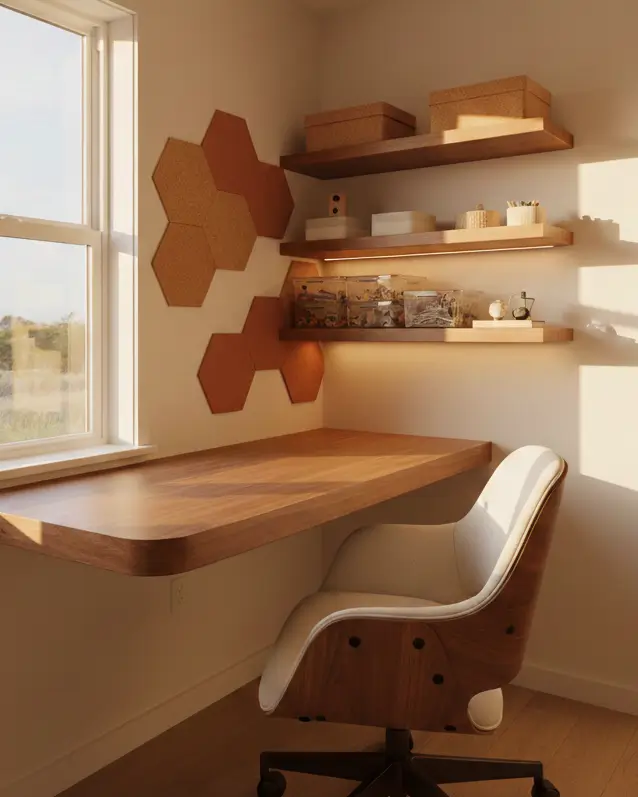
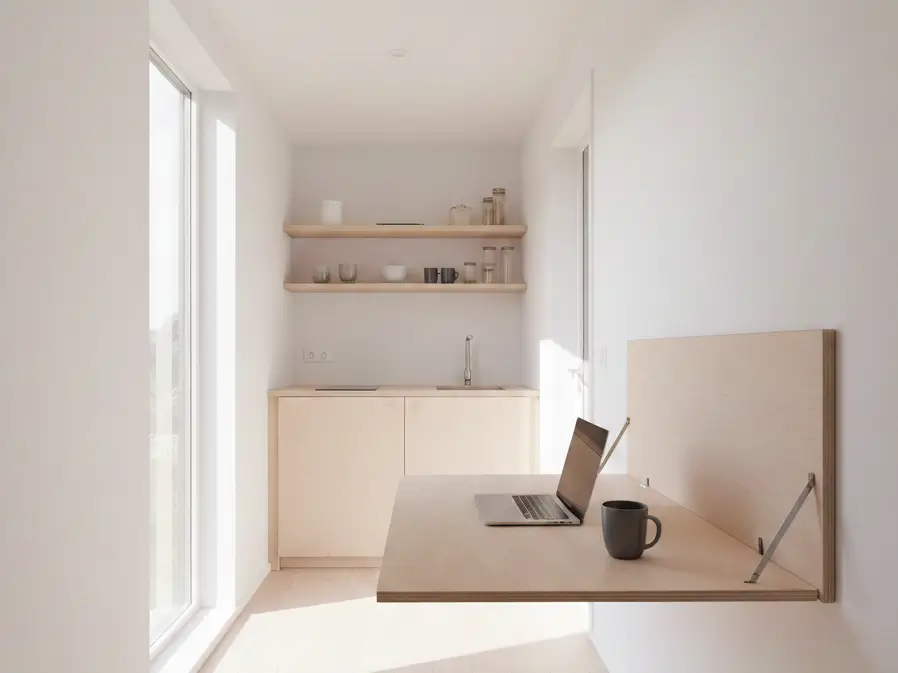
A Murphy desk is a wall-mounted surface that hinges flat against the wall. For a functional workspace, mount it at standard desk height (29-30 inches). Ensure the surface is at least 32″ wide x 20″ deep to accommodate a laptop and mouse. Use heavy-duty collapsible shelf brackets rated for at least 100 lbs to prevent wobbling while typing.
Building Your Own Disappearing Desk
This is my favorite solution for narrow spaces, specifically hallways or the space between the kitchen and living area.
The Dimensions You Need:
- Depth: Minimum 18 inches (for laptop), 22-24 inches (for external monitor).
- Width: Minimum 30 inches. 42 inches is luxury.
- Height: Standard is 29 inches off the floor.
The Budget Breakdown:
- DIY Version ($60-$100): A piece of butcher block scrap, sanding sealer, and two heavy-duty folding brackets from the hardware store.
- Retail Version ($150-$400): Pre-made wall desks with internal storage cubbies.
When the workday ends, you fold it down. The psychological effect is massive. The office is “closed.”
Pro Tip: If you are attaching this to standard tiny house wall materials like shiplap or thin plywood, you must find the studs. Toggle bolts aren’t enough for the leverage of leaning elbows.
The Chair Dilemma: Where Does It Go?
Standard office chairs are bulky (24×24″ footprint). For tiny house work from home setups, choose a “Capisco” style stool (small footprint, ergonomic), a high-quality folding chair (like the Meco Stakmore), or an exercise ball that can be deflated. If using a fixed desk, ensure the chair arms fit under the desk to maximize walkway clearance.
3 Small-Footprint Seating Solutions
In my first tiny apartment, my office chair blocked the bathroom door. It was a nightmare. Here is what actually works:
- The “Active” Stool: Brands like Vari or Hag Capisco allow you to perch. They have a tiny footprint (approx. 15 inches diameter) and slide completely under shallow desks.
- The High-End Folder: Forget metal party chairs. Look for solid wood folding chairs with upholstered seats. They hang on a wall peg when not in use.
- The Storage Ottoman: If you work short hours, a firm storage ottoman works as a seat and hides your files inside.
If you are looking for specific furniture pieces that serve dual purposes, read our tiny house furniture guide.
Lighting and Video Calls in Tight Quarters
Lighting in small spaces is often uneven. For video calls, avoid backlighting (windows behind you). Use a ring light or a clamp-on desk lamp with adjustable color temperature (3000K-4000K). To save surface space, install LED strip lighting under shelves above your desk or use wall sconces.
Controlling Your Environment
In a tiny house, you are likely close to a window. This is great for mental health but terrible for Zoom glare.
The Lighting Setup:
I recommend wall-mounted sconces rather than desk lamps. Desk real estate is too valuable to waste on a lamp base. An articulating arm sconce allows you to pull the light close for tasks and push it back against the wall later.
Check out tiny house lighting solutions for wiring tips, especially if you are 12V or off-grid.
The Background:
What’s behind you? In a 200 sq ft house, it’s probably your bed or the stove.
- The Virtual Background: The easiest fix.
- The Divider: A simple Japanese-style shoji screen or a ceiling-mounted roller shade can create a professional backdrop instantly.
- The Bookshelf: Position your desk so your back is to a storage unit.
Standing Desks: Vertical Freedom
Standing desks are ideal for tiny homes because they often have a smaller footprint than seated desks and eliminate the need for a bulky chair. A mobile standing desk (approx. 24″ wide) on casters can be rolled into a closet or corner. Alternatively, use a “converter” placed on a kitchen counter to switch between standing and sitting.
The Kitchen Counter Hack
If you have a breakfast bar or kitchen counter, you are halfway there. Most tiny house counters are 36 inches high.
I used a laptop riser on my kitchen counter for six months. It cost $40. The downside? You have to pack up your office to make dinner. This blurring of lines can get exhausting.
If you go this route, you need a strict “pack away” ritual. Use a dedicated bin or basket. Laptop, mouse, and notebook go in the bin; bin goes into the tiny house storage solutions area.
Connectivity & Tech Organization
Cable clutter makes small spaces look chaotic. Mount a surge protector to the underside of your desk or wall. Use velcro ties to bundle cords. If off-grid, ensure your solar setup can handle the load (laptop + monitor approx. 150W). Hardwire internet (Ethernet) during the build phase if possible, as Wi-Fi signals can struggle through metal tiny house framing.
Managing the “Rat’s Nest”
Nothing shrinks a room faster than visible wires.
- Monitor Arms: These are non-negotiable. They lift your screen off the desk, giving you back about 1 square foot of surface area.
- Undermount Power: Screw your power strip to the bottom of the desktop.
- Vertical Storage: Use the wall space above the monitor for floating shelves to hold routers, hard drives, and reference books.
If you are planning your build now, look at tiny house electrical systems to place outlets exactly where your desk will go. Extension cords are a trip hazard you cannot afford in a 4-foot wide room.
4 Layouts for Tiny House WFH
Here is a comparison of the most common layouts I see in the community.
| Layout Type | Best For | Space Impact | Budget | Cost Estimate |
| The Fold-Down | Hallways, Multi-use walls | Minimal (4″ depth when closed) | Low | $80 – $250 |
| The Loft Office | flexible yogis, calm focus | Uses “dead” sleeping space | Medium | $100 – $500 |
| The Closet Nook | visual privacy, clutter hiding | Uses existing storage footprint | Medium | $200 – $600 |
| The Mobile Cart | Renters, changing views | High (takes up floor space) | High | $300+ |
A Note on the Loft Office
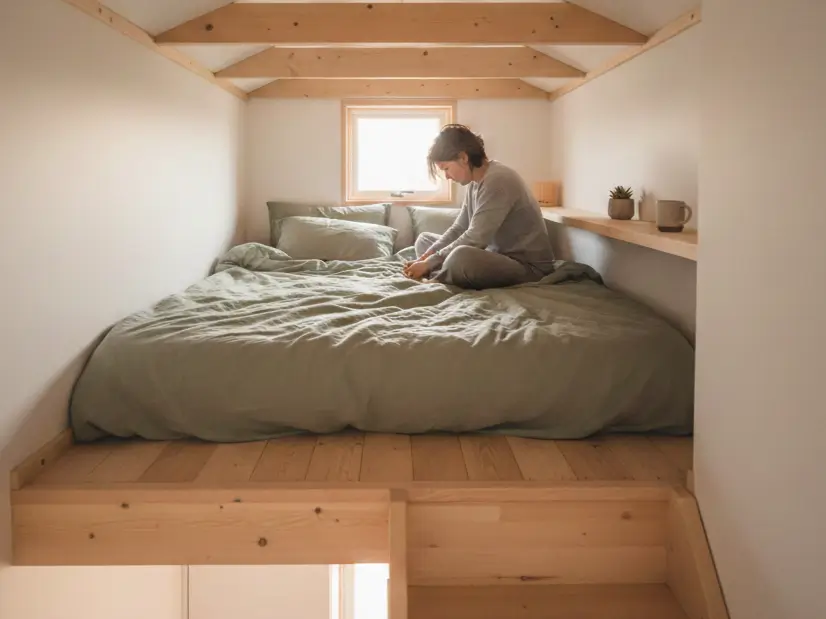
Be careful here. Most tiny house lofts have 3-4 feet of headroom. Unless you have a custom design with a “landing” for your legs (a dropped floor section), you will be sitting cross-legged. This is brutal on ergonomics for full-time work.
If you do choose the loft, you’ll need specialized tiny house flooring options like cork or carpet to make sitting on the floor comfortable.
Materials & Aesthetics
Your desk is going to be a major visual element in your home. A cheap white plastic table will stick out.
Match your desk material to your tiny house interior aesthetics.
- Wood: Adds warmth. Plywood with an exposed edge is modern and cheap.
- Metal: Industrial, thin, and strong.
- Painted: Paint it the same color as the wall to make it “disappear” visually.
If you are painting it yourself, ensure you use a durable enamel. Standard wall paint will chip under the friction of a mouse and keyboard. Check our guide on painting furniture and home decor for the right finish application.
Also, consider indoor plants for small apartments. A single small succulent or hanging Pothos above the desk adds life without stealing surface area.
Can You Really WFH in 300 Sq Ft?
Yes, but you have to be disciplined.
The biggest challenge isn’t the size of the desk; it’s the separation of life. The “Disappearing Office” method works because it forces a transition. When the desk folds up, work is over.
- Measure your available wall space. Look for a 32-inch span.
- Audit your gear. Do you really need two monitors, or can you use one ultrawide?
- Choose your chair first. It’s the hardest thing to store.
Start small. Maybe it’s just a shelf on a bracket today. But reclaim that space. Your back (and your boss) will thank you.
For more on managing the logistics of tiny living, read our tiny house budget planning guide to see how a home office fits into your overall build costs.