
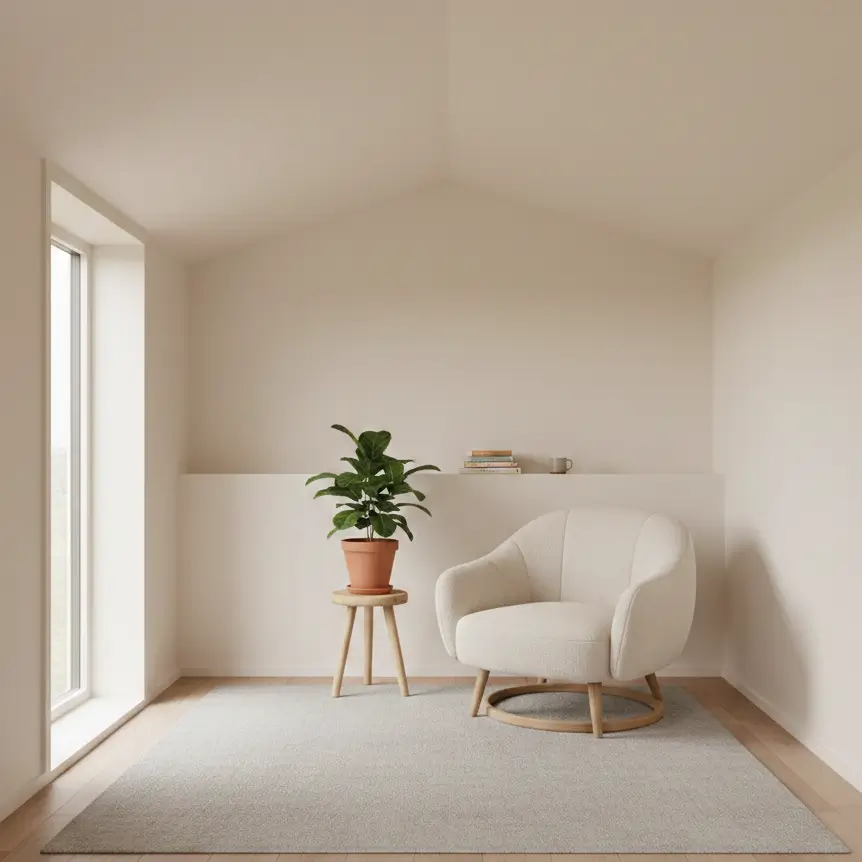
If you live in a tiny house loft with 4 feet of clearance or a garden apartment with standard 7-foot ceilings, you know the feeling. The “lid” feels tight. You might instinctively reach for a can of stark white paint, assuming it’s the only way to open things up.
Actually, scratch that. While white is safe, it’s not always the best tool for the job. In my experience testing finishes in spaces under 500 square feet, the technique matters more than the color itself. A white ceiling on a dark wall can actually create a harsh horizontal line that visually lowers the roof, exactly what you don’t want.
The most effective low ceiling paint solutions involve blurring the line between wall and ceiling. You can achieve this by painting the ceiling the same color as the walls (monochromatic), extending the wall color 3–6 inches onto the ceiling, or using a high-gloss finish on the ceiling to reflect light and create depth.
I’ll walk you through specific paint strategies that cost less than $100 in materials but add “vertical footage” to your perception. Whether you are dealing with a 6’8″ tiny house ceiling or a standard 8-foot rental, these tricks work.
Should You Paint the Ceiling the Same Color as the Walls?
Yes, especially in rooms under 400 sq ft. Painting walls and ceilings the same color eliminates the corner “horizon line,” making it harder for the eye to judge where the wall ends. This creates a seamless “infinity” effect. Stick to lighter shades (LRV 60+) for the best results.
The “Box” Effect
In a small bedroom, roughly 10×10 feet, your eye naturally seeks corners to define the space. If you paint the walls navy and the ceiling white, you create a high-contrast line running around the room. This effectively draws a box around you.
By using the same color (and often the same sheen) on both surfaces, that boundary disappears. I’ve seen this transform a 350 sq ft studio apartment. The space feels less like a box and more like a continuous envelope.
When to Avoid This
If your room has heavy crown molding (wider than 4 inches) or architectural beams, a single color might flatten the architectural details too much. In that case, you have to decide if you want to highlight the architecture or hide the low height. You usually can’t do both in a tiny footprint.
See also: Neutral Paint Colors for Small Apartments for specific shade recommendations.
The “Wall-to-Ceiling” Extension Trick
If you prefer a white ceiling, try “wrapping” the wall color up. Paint the top 3 to 6 inches of the wall onto the ceiling perimeter. Alternatively, bring the ceiling color down the wall 4 inches. This tricks the eye into perceiving the wall as taller than it physically is.
How It Works (The “Frieze” Method)
This is an old designer trick that works exceptionally well in rentals where you can’t tear down the ceiling.
- Measure: Mark a line 4 to 6 inches in from the wall on your ceiling.
- Tape: Apply painter’s tape along this line on the ceiling.
- Paint: Paint your wall color all the way up and past the corner, filling that 4-6 inch border on the ceiling.
This creates the illusion that your walls are taller. When you stand in the center of a 12×12 room, your peripheral vision registers the wall color extending higher than the structural corner.
Budget & Tools
This is a low-cost solution. You really just need:
- Standard 1.5-inch painter’s tape ($8)
- A steady hand or an edging tool
- No extra paint is usually required if you have leftover wall paint.
For tool recommendations, check out: Painting Tools for Tight Spaces.
Finish Matters: Matte vs. High-Gloss Ceilings
Standard advice says “flat paint for ceilings” to hide imperfections. However, for low ceilings in good condition, a semi-gloss or high-gloss finish creates a mirror effect. This reflection bounces light from lamps and windows, creating visual depth that feels like a skylight.
The Reflection Calculation
Think about a still lake. It reflects the sky, giving the illusion of depth. A high-gloss ceiling does the same. In a tiny house loft where the ceiling might be only 4 feet above the mattress, a gloss finish prevents that “coffin” feeling.
Pros of Gloss Ceilings:
- Reflects Artificial Lighting, doubling the brightness.
- Creates an illusion of “infinity” or openness.
- Adds a high-end, custom look for the cost of a quart of paint ($25-$30).
The Major Con:
Gloss highlights every bump, crack, and bad drywall seam. If you are renting an older apartment with textured ceilings (popcorn) or visible tape seams, avoid gloss. It will look messy. In that case, stick to the absolute flattest matte paint you can find to dissolve the ceiling visually.
Learn more about finishes here: Paint Finishes for Small Spaces.
Vertical Striping: The Optical Stretch
Vertical stripes are the most direct way to elongate walls. In a room with 7-foot ceilings, painting stripes that are 4–6 inches wide draws the eye upward. Low-contrast stripes (e.g., satin and matte of the same color) offer a subtle, sophisticated lift without visual clutter.
The Contrast Rule
In a small space (under 150 sq ft), high-contrast stripes (like black and white) can be overwhelming and make the room feel busy or smaller.
Instead, I recommend tone-on-tone striping.
- Base: Paint the whole wall a matte eggshell or cream.
- Stripe: Tape off vertical lines and paint them with a semi-gloss clear glaze or the same color in a semi-gloss finish.
This catches the light vertically, leading the eye up toward the ceiling without screaming “circus tent.”
Time Investment:
Striping is labor-intensive. Taping a 10-foot wide wall can take 2-3 hours. Measuring is critical; uneven stripes are obvious in small rooms.
Before starting, review: Paint Preparation for Small Apartments.
Dealing with Beams and Ductwork
In basements or converted lofts, bulkheads and ducts often drop the ceiling height to 6’5″ or lower. Paint these elements the exact same color as the ceiling. Do not highlight them with trim color. You want them to visually disappear into the ceiling plane.
The “Camouflage” Technique
I once worked on a basement renovation where a massive HVAC duct ran down the middle of the room. The owner initially painted it grey to make it “industrial.” It felt like the ceiling was crushing us.
We repainted the entire ceiling, and the duct, a flat, high-LRV (Light Reflectance Value) white. The duct didn’t vanish, but it stopped being a focal point.
Exception:
If you have beautiful raw wood beams in a tiny house, don’t paint them! Wood adds warmth. Instead, paint the ceiling between the beams a crisp, bright white to create contrast. This makes the white recess visually, making the ceiling plane look higher than the beams.
Check out: Painting Wood Guide for tips on handling exposed timber.
Brightening Dark Corners
Low ceilings often create shadows in corners, which shrinks the room. Use paint with a high LRV (Light Reflectance Value) of 70+. Additionally, ensure your painting is consistent. Shadows hide in patchy paint jobs.
The Role of LRV
When buying paint, look at the back of the color chip for the LRV number. It runs from 0 (black) to 100 (pure white).
- Small, low-ceiling room target: LRV 65–85.
- Effect: These colors bounce 65-85% of the light back into the room.
If you have a dark apartment, relying solely on paint won’t fix it, you need light to reflect. But high LRV paint maximizes whatever window light you do have.
Detailed guide: Brighten Dark Apartment Paint Solutions.
White vs. Color Drenching
White is the classic choice for “airiness,” but “Color Drenching” (painting walls, trim, and ceiling one medium-depth color) is trending for cozy spaces. Drenching works better for bedrooms/dens; White works better for kitchens/workspaces.
| Feature | Classic White Ceiling | Color Drenching (All One Color) | Small Space Impact |
| Visual Boundaries | Defines the ceiling height clearly. | Blurs all boundaries. | Drenching feels larger in very small rooms (<100 sq ft). |
| Light Reflection | Maximum reflection. | Absorbs more light (cozier). | White feels “higher”; Drenching feels “wider”. |
| Imperfections | Shows ceiling shadows/texture. | Hides uneven corners/angles. | Drenching is more forgiving in old buildings. |
| Vibe | Clean, crisp, traditional. | Modern, moody, enveloping. | Drenching is currently very popular in tiny home design. |
If you are nervous about drenching, try it in a bathroom first. It’s a low-risk area to test the “box” effect.
Relevant: Bathroom Paint Moisture Solutions.
Budget Breakdown: What Will This Cost?
One of the best things about painting a small space is the low material cost. You rarely need 5 gallons of anything.
- Average Tiny House Interior (300 sq ft walls/ceiling):
- 1.5 Gallons of high-quality paint: $60–$90
- Primer (if changing colors drasticallly): $25
- Supplies (rollers, tape, drop cloths): $40
- Total: ~$140
- Average Apartment Bedroom (12×12):
- 1 Gallon Wall Paint: $45
- 1 Quart Trim/Ceiling Accent: $25
- Total: ~$70 + supplies.
For a full breakdown, see: Paint Budget Cost Analysis.
Next Steps
Low ceilings don’t have to feel oppressive. By manipulating how light hits the surface (sheen) and where the color stops (wrapping), you can trick the brain into seeing more volume than actually exists.
- Is your ceiling smooth? Go for a semi-gloss to reflect light. Is it textured? Stick to flat matte.
- Decide if you will paint the ceiling to match the walls (easiest for height) or try the 4-inch wrap technique.
- Ensure your chosen color has an LRV above 60 if your goal is brightness.
Don’t let a 7-foot ceiling limit your design. With a single Saturday afternoon and less than $150, you can push the roof up, visually, at least.
For more on outfitting your space once the paint dries, visit Veniola.com.