Legally, a tiny house falls into one of three zones: an RV (temporary parking only), an ADU (permanent backyard cottage), or a Primary Dwelling (stand-alone foundation). Compliance usually relies on IRC Appendix Q, which allows for lower ceilings (6’4″ in lofts) and sleeping lofts under 70 sq ft.
There is a terrifying moment for many aspiring tiny house owners. It usually happens after you’ve picked out the layout and fell in love with a compost toilet design. It’s the realization that you might have nowhere to legally put it.
I’ve seen it happen. A couple invests $60,000 in a beautiful 24-foot tiny house on wheels (THOW), only to realize their local municipality considers it an “illegal camper” if someone sleeps in it for more than 30 days.
Navigating tiny house legal zoning isn’t just about following rules; it’s about defining what your house is in the eyes of the law. Is it a vehicle? A house? An accessory structure? The answer changes based on your square footage and whether you have wheels or a foundation.
This guide cuts through the confusion. We aren’t just looking at the “what”, we are looking at the “how” of getting legal, focusing specifically on structures under 400 square feet.
The Three Legal “Buckets” for Tiny Homes
To make your tiny house legal, you must pick a classification. 1. RV/Travel Trailer: Built to ANSI A119.5 standards, temporary living only. 2. ADU (Accessory Dwelling Unit): Foundation-built in a backyard, follows local building codes. 3. Primary Residence: Built on a foundation on its own land, must meet IRC Appendix Q standards.
Before you hammer a single nail or buy a trailer, you have to decide which bucket your home falls into. This decision dictates everything from your insulation thickness to where you can park.
1. The Recreational Vehicle (RV) Path
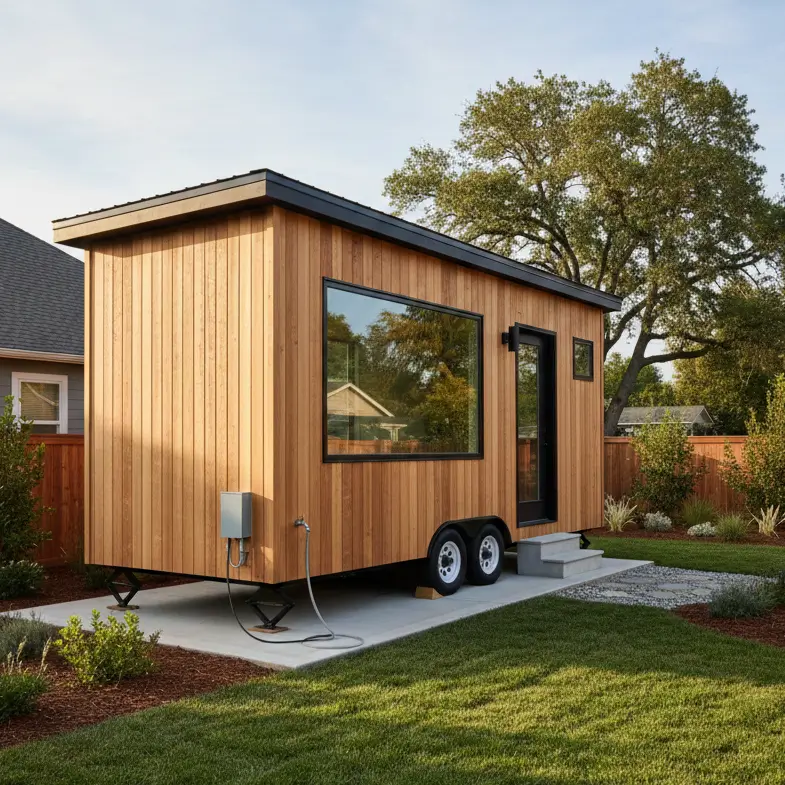
Most tiny houses on wheels (THOWs) technically fit here.
- Standard: ANSI A119.5.
- Pros: Easy to move, easier to insure (as an RV), no building permit needed for the land (usually).
- Cons: You generally cannot live in it full-time on private land. Most zoning laws prohibit living in an RV for more than 30 days at a time.
- Space context: These builds are strictly constrained by road limits (8.5 ft wide, 13.5 ft high).
2. The Accessory Dwelling Unit (ADU) Path
This is the “backyard cottage.” You build a small structure (usually 300-800 sq ft) on a property that already has a main house.
- Standard: International Residential Code (IRC).
- Pros: Fully legal for full-time living, increases property value, utility connections are easier.
- Cons: Expensive permits (often $5,000+), requires a permanent foundation.
3. The Primary Dwelling Path
This is buying a plot of land and building a tiny house on a foundation.
- Standard: IRC Appendix Q.
- Pros: Total ownership, appreciation of land value.
- Cons: Many towns have minimum square footage laws (e.g., “No houses under 1,000 sq ft”), making this the hardest zoning hurdle to clear.
If you are planning a build, understanding the specifications of your chassis is step one. You can read more about tiny house on wheels specifications to see if your trailer base meets legal road requirements.
IRC Appendix Q: The Tiny House Building Code
IRC Appendix Q is a section of the International Residential Code adopted by many states (like WA, OR, CA, ME) specifically for houses under 400 sq ft. It relaxes strict codes regarding stair geometry, ceiling heights, and emergency exits to make tiny living legal and safe.
For decades, building inspectors tried to apply mansion rules to micro-dwellings. It didn’t work. You can’t fit a standard 36-inch wide staircase in a 200 sq ft home without ruining the floor plan.
Enter Appendix Q. This code acknowledges the physics of small spaces. Here is how it changes the game for your layout:
Ceiling Heights
- Standard Code: Habitable rooms need 7-foot ceilings.
- Appendix Q: Allow ceiling heights as low as 6 feet 8 inches in common areas and bathrooms. In lofts, it gets even more lenient, allowing heights under 6 feet, provided there is specific egress.
Lofts
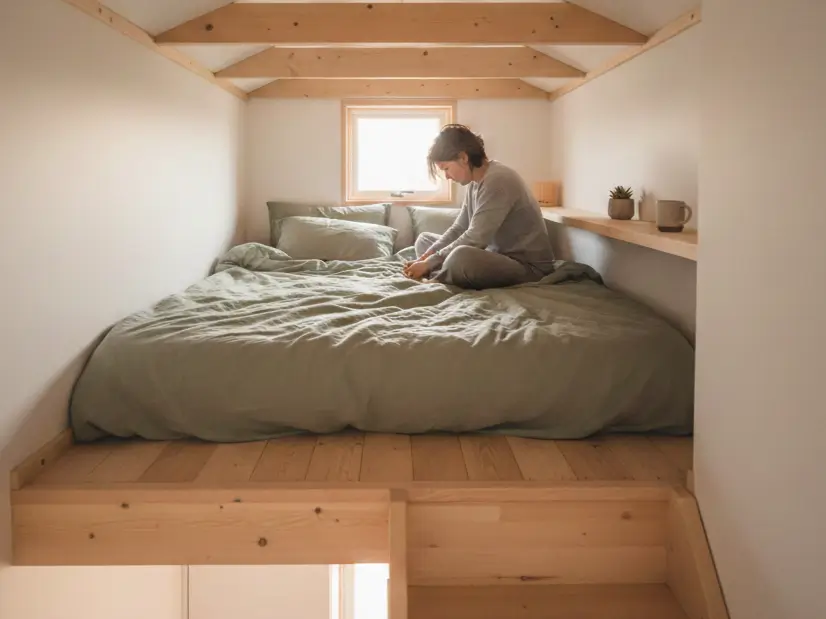
This is the big one. Under standard code, a sleeping loft often wasn’t considered a “room” because of the low ceiling. Appendix Q defines a loft as a floor area having a floor area of less than 70 sq ft and a ceiling height of less than 6 feet 8 inches.
- Access: You can use ladders or alternating tread devices (ship’s ladders) instead of full staircases.
- Guardrails: Must be at least 36 inches tall to prevent falls.
If you are struggling to design a floor plan that meets these specific dimensions, check out our guide on tiny house layout and floor plans for Appendix Q-compliant ideas.
Zoning vs. Building Codes: Understanding the Difference
Building Codes dictate how the house is built (framing, electrical, safety). Zoning Codes dictate where the house can sit and how the land is used. You can have a perfectly built tiny house (Building Code compliant) that is illegal to park on your land (Zoning violation).
This is where 90% of tiny house owners get stuck. You might buy a certified tiny home that meets every safety standard, but if the town zoning map says your plot is “R1 Residential – Minimum 1,000 sq ft structure,” you cannot legally live there.
Common Zoning Restrictions
- Minimum Square Footage: Many towns mandate homes must be at least 800 or 1,000 sq ft to “protect property values.”
- Camping Limits: If your tiny house is on wheels, zoning views it as “camping.” Most zones limit camping on private land to 14-30 days per year.
- Prohibitions on “Temporary Structures”: If it has wheels, it’s temporary. If you take the wheels off and put it on blocks, it’s a permanent structure, but then it needs a building permit.
The “Workarounds” (And Their Risks)
Some people fly under the radar. They park behind a tall fence or in a rural area.
- The Risk: Code enforcement operates on complaints. If a neighbor complains about your “shack,” the city inspector arrives. If you are in violation, you may have 30 days to move the house or face daily fines.
- The Solution: Look for properties zoned as “Agricultural” or specific “Tiny House Communities.” Or, focus on off-grid tiny house systems in unincorporated counties where zoning is lax.
Certification: The Golden Ticket for Insurance and Parking
Third-party certification (like NOAH or Pacific West) proves your tiny house meets safety standards. This costs $1,500 – $3,000 but is essential for getting insurance, financing, and entry into legal tiny house parking communities.
If you are building legally, you need a paper trail. A DIY build with no inspections is almost impossible to insure and very difficult to park legally in RV parks or tiny home villages.
Types of Certification
- NOAH (National Organization of Alternative Housing): Inspects builds at multiple stages via video. They check tiny house electrical systems and framing against safety standards.
- Pacific West Associates: Accredited agency that certifies THOWs as RVs.
- RVIA (Recreational Vehicle Industry Association): Usually only available to professional manufacturers, not DIYers.
Without this seal near your door, many RV parks will turn you away. They need assurance that your tiny house plumbing systems won’t leak sewage or that your electrical won’t start a fire.
State-by-State Zoning Highlights (2024 Edition)
California, Oregon, and Washington lead in tiny house friendliness, specifically regarding ADUs. Texas (outside city limits) and Florida are popular for freedom of placement, though hurricane codes in Florida are strict. Maine has adopted statewide tiny house definitions allowing them as primary dwellings.
While I can’t cover every county (there are over 3,000 in the US), here is a snapshot of where the tide is turning.
| State | Friendliness Score | Key Regulation | Best Strategy |
| California | High | State mandates cities allow ADUs. | Build a backyard ADU or movable tiny home (legal in LA, San Diego). |
| Oregon | High | Appendix Q adopted; “Reach Code”. | Portland allows THOWs on private property. |
| Texas | Medium | No state-wide zoning; rural is free. | Buy land outside city limits (ETJ areas). |
| Florida | Medium/Low | Strict wind/hurricane codes. | Look for designated Tiny House Communities. |
| Maine | High | State law defines tiny homes. | Primary residence on own land. |
Budget Note: Moving to a friendly state might save you thousands in legal battles. However, permit costs in places like California are significantly higher ($5k-$15k) compared to rural Texas ($500-$2k). Be sure to factor this into your tiny house budget planning.
DIY Legal Build vs. Buying Certified
Building your own legal tiny house saves labor costs but increases the difficulty of certification and financing. Buying a certified model costs 30-50% more upfront but guarantees insurance eligibility and easier zoning approval in RV parks.
Let’s look at the reality of the “DIY Route” versus the “Professional Route” regarding legality.
The DIY Route
I love the spirit of DIYers. But when it comes to the law, DIY is risky. If you are handling your own tiny house insulation and wiring, you must document everything.
- Challenge: Most cities require inspections before the walls are closed up. If you build it and then try to get a permit, they might make you tear down the drywall to prove the wiring is to code.
- Cost: Lower material cost, but potential for “do-over” costs if an inspector flags your work.
The Certified Manufacturer Route
- Benefit: comes with a VIN number (if on wheels) and a compliance certificate.
- Financing: Banks are much more likely to offer a loan for a certified build than a pile of receipts from Home Depot.
- Cost: Expect to pay $60k-$100k+ for a finished, legal unit.
If you go the DIY route, realize that simple mistakes, like not understanding tiny house measurements and standards, can render your home uninsurable.
Utility Connections: The Legal Gray Area
Zoning often dictates that a legal dwelling must be connected to grid water and sewer. “Dry cabins” or compost-only homes often violate local health codes for primary residences, even if the structure itself is sound.
Legal zoning isn’t just about the structure; it’s about the poop. (Sorry, but it’s true).
- Sewer: Most zoning laws require a connection to a septic tank or city sewer. Using a compost toilet as your only option is illegal in many urban zones, though specific “Eco-Villages” are changing this.
- Water: You usually need a potable water source. Rainwater collection is legal in some states for flushing toilets, but using it for drinking often requires expensive filtration systems approved by the county.
- Power: Off-grid solar is generally legal, but you may still be required to have a “grid-tie” capability depending on the certificate of occupancy requirements.
When planning your utilities, especially tiny house bathroom design, verify if your county Health Department allows for alternative waste systems. This is often a separate inspection from the Building Department.
How to Talk to Your Local Zoning Office
Never walk in and ask, “Can I build a tiny house?” The answer will likely be “No.” Instead, ask, “What are the requirements for an Accessory Dwelling Unit or a dwelling under 400 square feet?” Use the technical language of the code (IRC 2018, Appendix Q).
This is a soft skill that pays off. Zoning officials are bureaucrats; they operate on definitions.
- Bring a Sketch: Don’t just talk. Show a preliminary floor plan with dimensions.
- Ask for the Ordinance: Ask for the specific code number that dictates minimum square footage. Sometimes, the rule is outdated or has variance exceptions.
- Be Nice: These people hold the stamp that approves your home. Being the “angry sovereign citizen” rarely speeds up the process.
Also, be wary of buying land before you have this conversation. One of the biggest tiny house mistakes and regrets is purchasing a cheap plot of land only to find out it has “deed restrictions” banning anything smaller than 1,500 sq ft.
The Future of Tiny Zoning
The landscape is shifting. With the housing crisis in the US, cities are desperate for affordable housing. Los Angeles, San Diego, and Portland are paving the way by legalizing movable tiny homes as ADUs.
However, we aren’t at the finish line yet. For now, your best defense is education. Know the difference between a THOW and a foundation build. Understand Appendix Q. And never, ever assume you can just park in a field without checking the map.
If you are ready to start planning your compliant build, start with the basics of tiny house sustainability to ensure your materials meet modern energy codes.
Legality doesn’t limit creativity; it creates a framework for it. A legal tiny house is one you never have to worry about moving in the middle of the night. That peace of mind? It’s worth every permit fee.