
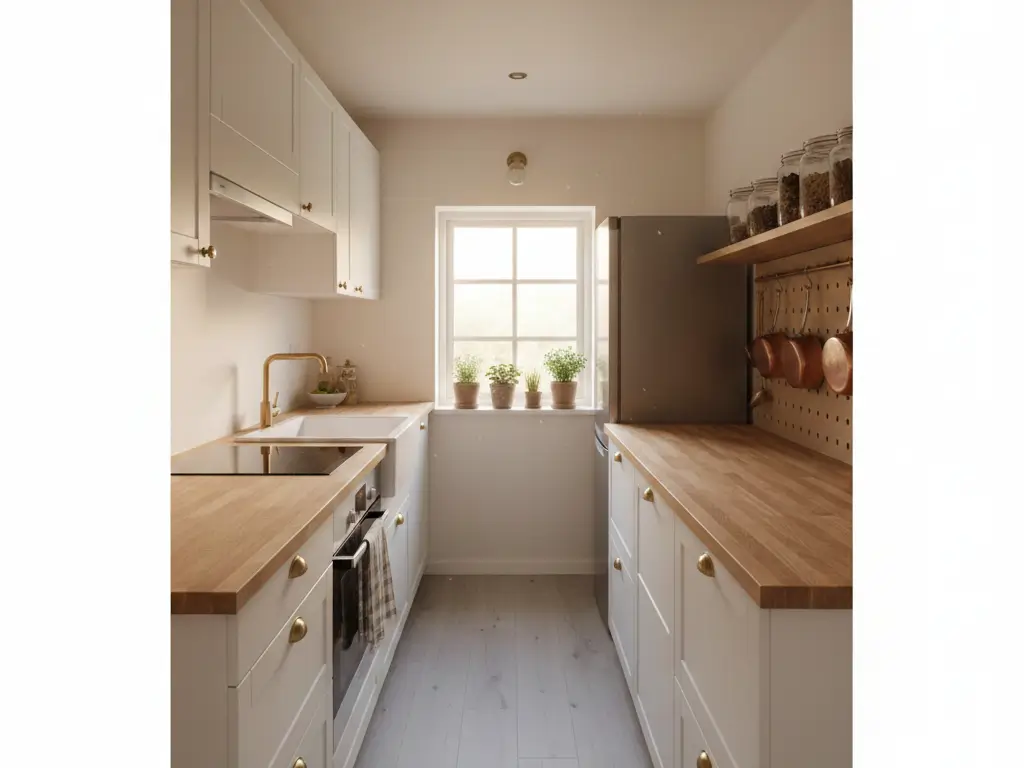
The average American kitchen spans 150 square feet. A tiny house kitchen? You’re working with 30 to 60 square feet, sometimes less.
A well-designed tiny kitchen can outperform a poorly planned full-size one. The secret isn’t cramming everything smaller. It’s rethinking what a kitchen actually needs to do.
I’ve spent the past eight years helping tiny house dwellers design kitchens that feel spacious despite measuring just 35 to 45 square feet. The biggest mistake I see? Copying traditional kitchen layouts that waste precious floor space.
This guide breaks down layouts, appliances, and storage solutions sized specifically for homes under 400 square feet. Whether you’re building from scratch on a $500 DIY budget or investing $8,000 in custom cabinetry, you’ll find actionable ideas with exact measurements.
How to Design a Functional Tiny House Kitchen in Under 50 Square Feet
A functional tiny house kitchen requires three zones, prep, cook, and clean, arranged within 4 to 6 feet of each other. Start with your largest appliance footprint (usually the refrigerator at 24 × 24 inches), then build your work triangle around remaining space. Budget $50 to $150 per square foot for materials and fixtures.
The work triangle concept still applies in tiny kitchens. But the measurements change dramatically.
In a standard kitchen, the triangle, connecting sink, stove, and refrigerator, spans 12 to 26 feet total. In a tiny house, you’re looking at 7 to 12 feet. Each leg should measure 2 to 4 feet, not the typical 4 to 9 feet.
What does this mean practically? Your refrigerator, cooktop, and sink should sit within two steps of each other. This isn’t a limitation, it’s actually more efficient.
Before selecting any fixtures, measure your total kitchen footprint. Most tiny houses allocate 30 to 60 square feet for kitchen functions. A 200-square-foot tiny house might dedicate 35 square feet. A 400-square-foot home could stretch to 55 square feet.
For guidance on overall space planning, the tiny house layout floor plan resource covers how kitchen placement affects your entire home flow.
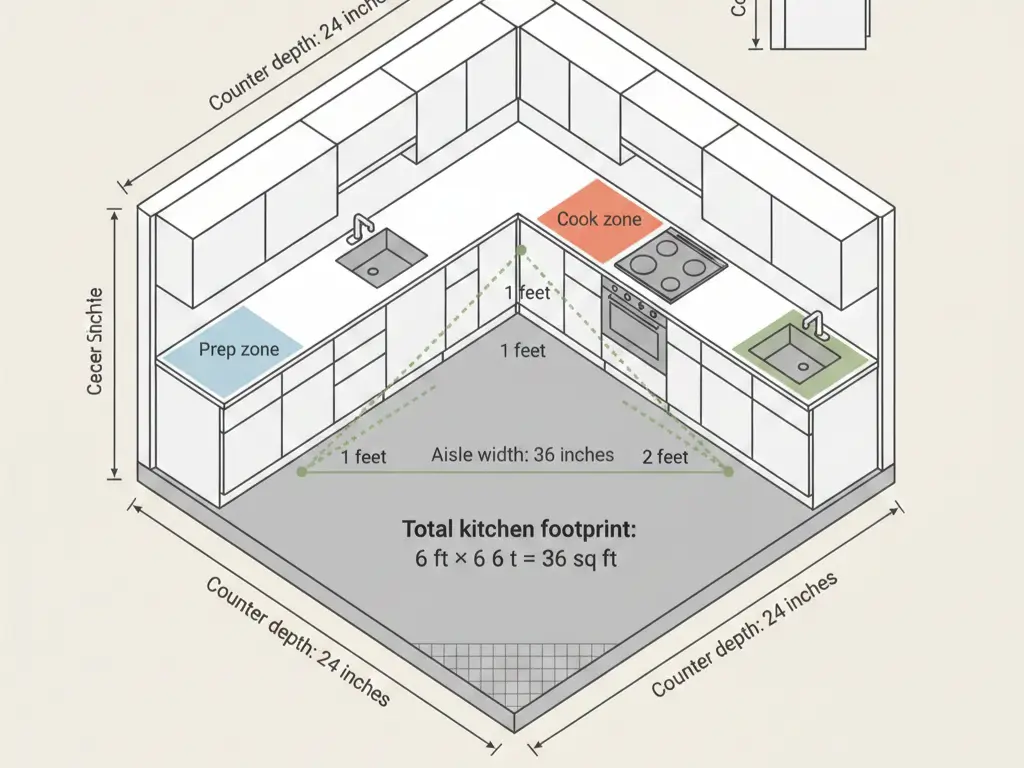
Key measurements to lock in first:
- Aisle width: 36 inches minimum (42 inches for accessibility)
- Counter depth: 12 to 24 inches (standard is 25 inches, too deep for most tiny builds)
- Upper cabinet depth: 12 inches maximum
- Counter height: 34 to 36 inches standard (30 to 32 inches for seated work)
One thing I’ve learned: don’t finalize your kitchen plan until you’ve lived in the space for a week. Tape out your proposed layout on the floor. Move through cooking motions. You’ll discover problems before spending money.
What Is the Best Layout for a Tiny House Kitchen?
The galley layout works best for tiny houses 8.5 feet wide or narrower, maximizing counter space in 25 to 40 square feet. L-shaped layouts suit corner placements in wider builds. Single-wall kitchens sacrifice storage but free up floor space for multi-use areas, ideal for homes under 250 square feet.
Choosing between layouts comes down to three factors: your home’s width, how you cook, and what else shares your kitchen zone.
Galley (Corridor) Layout: 25-40 Square Feet
Two parallel counters facing each other. This layout squeezes maximum storage and counter space into minimal floor area.
Works when:
- Home width is 8 to 10 feet
- You cook alone (tight two-person navigation)
- You want the most counter space possible
Typical dimensions: 6-foot length × 4-foot width (with 36-inch aisle)
The tiny house furniture guide includes fold-down table options that work alongside galley kitchens.
L-Shaped Layout: 35-55 Square Feet
Counters meet at a 90-degree angle. Frees up floor space and allows a small dining nook.
Works when:
- Home width exceeds 10 feet
- Kitchen shares space with living area
- Two people cook together
Typical dimensions: 6-foot × 6-foot L with 24-inch-deep counters
Single-Wall (One-Wall) Layout: 15-30 Square Feet
Everything lines up along one wall. The most compact option, but limited counter and storage space.
Works when:
- Home is under 250 square feet
- Kitchen doubles as passthrough
- Cooking is minimal (meal preppers, frequent dining-out types)
Typical dimensions: 8 to 10 linear feet × 24 inches deep
Consider your tiny house storage solutions before committing to a single-wall design, you’ll need to compensate with creative storage elsewhere.
| Layout | Best For | Sq Ft Range | Counter Space | Storage Capacity |
| Galley | Narrow builds, solo cooks | 25-40 | High | High |
| L-Shaped | Wider builds, couples | 35-55 | Medium-High | Medium-High |
| Single-Wall | Ultra-compact, minimal cooking | 15-30 | Low | Low |
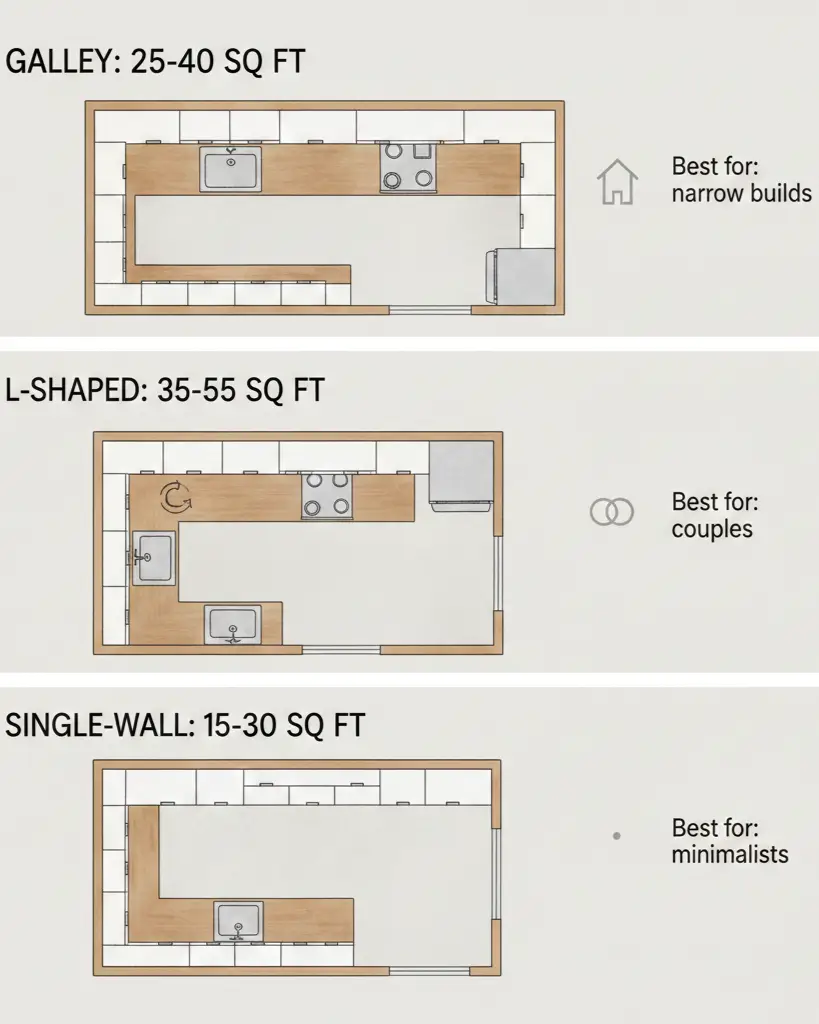
My honest take: galley layouts win for serious cooks. Single-wall wins for minimalists who prioritize living space over kitchen function.
Essential Appliances and Fixtures for Compact Kitchens
Standard appliances won’t fit. Look for apartment-size refrigerators (10 to 18 cubic feet, 24 inches wide), two-burner cooktops (12 to 21 inches), and bar sinks (15 to 22 inches). Expect to spend $800 to $2,500 on core appliances. Induction cooktops save space and improve safety in tight quarters.
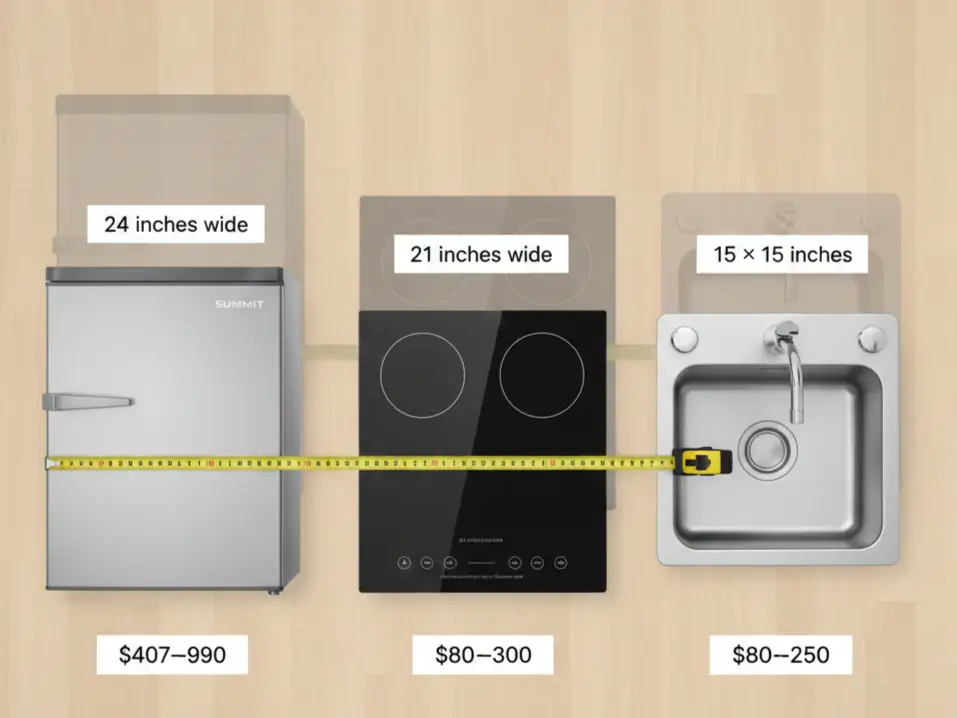
I tested four different compact refrigerator brands in a 380-square-foot tiny house last year. Size specs on paper don’t tell the whole story.
Refrigeration: The Space-Eater
Full-size refrigerators measure 30 to 36 inches wide. You need 24 inches maximum, possibly smaller.
Options by size:
- Under-counter refrigerator: 24 × 24 × 34 inches, 5-6 cubic feet, $250-$600
- Apartment-size refrigerator: 24 × 26 × 60 inches, 10-12 cubic feet, $400-$900
- Counter-depth refrigerator: 24 × 24 × 68 inches, 12-18 cubic feet, $600-$1,500
Brands to research: Summit Appliance, Danby, Haier, and Smeg. Summit specializes in compact appliances with proper freezer sections, critical if you meal prep.
The tiny house kitchen fixtures guide covers installation requirements for each type.
Cooking: Induction Changes Everything
Gas ranges demand ventilation complexity. Electric coils waste energy. Induction solves both problems.
A two-burner induction cooktop measures 12 to 21 inches wide. It fits almost anywhere, plugs into a standard 120V outlet, and produces less ambient heat, keeping your tiny space cooler.
Cost range: $70 to $300 for portable units, $300 to $800 for built-in
What I wish someone told me earlier: budget for induction-compatible cookware. Your existing pots might not work. Test with a magnet, if it sticks firmly, you’re good.
Sinks: Smaller Than You’d Expect
Standard kitchen sinks measure 22 × 30 inches. Too big.
Tiny house options:
- Bar sink: 15 × 15 inches, single bowl, $80-$250
- Prep sink: 18 × 20 inches, single bowl, $100-$400
- Small farmhouse: 24 × 18 inches, apron front, $250-$600
Undermount installation saves 2 to 3 inches of counter space compared to drop-in styles.
Consider integrated cutting boards that fit over the sink. This effectively adds 15 × 15 inches of prep space when you’re not using the basin.
Storage Solutions That Triple Your Tiny Kitchen Capacity
Vertical storage, not more cabinets, maximizes tiny kitchen capacity. Magnetic knife strips, pegboard walls, and under-cabinet organizers add 40 to 60 cubic feet of storage without claiming floor space. Wall-mounted solutions cost $50 to $300 and install in an afternoon.
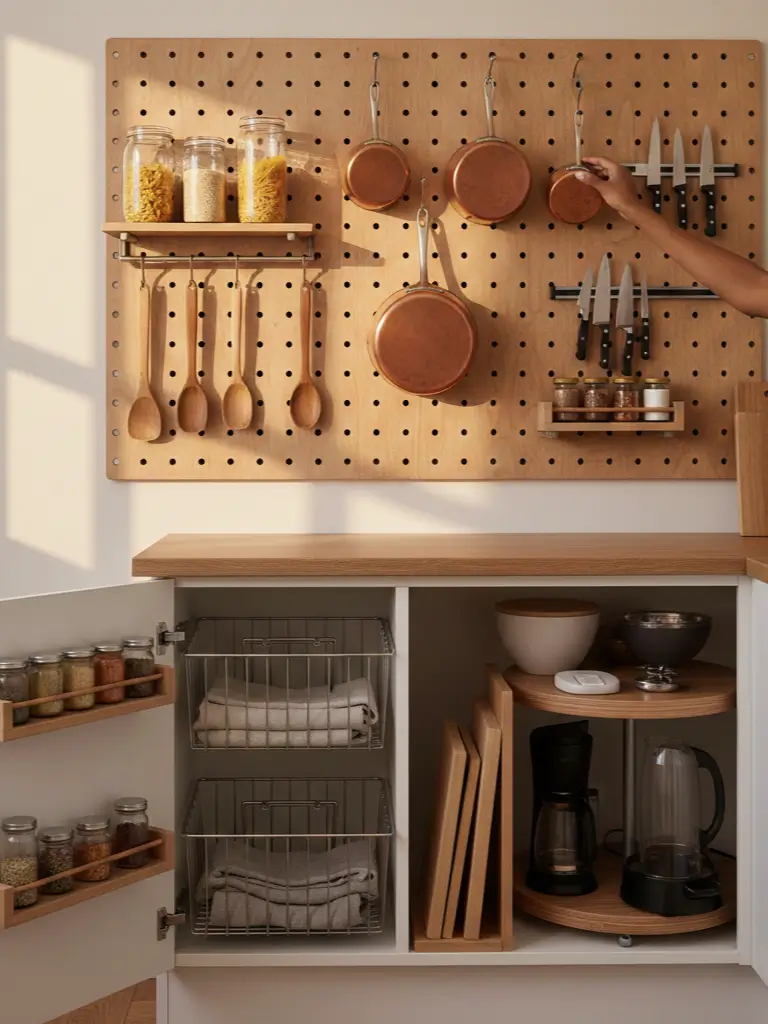
Floor space is too valuable for storage. Go vertical instead.
Wall-Mounted Systems
Pegboard remains the most versatile option. A 24 × 48-inch pegboard holds pots, pans, utensils, and small shelves. Installation cost: $30 to $80 including hardware.
Magnetic knife strips save drawer space and keep knives accessible. An 18-inch strip holds 6 to 10 knives securely. Cost: $15 to $50.
For spices and small containers, narrow floating shelves (3 to 4 inches deep) use wall space that’s otherwise wasted. The tiny house wall materials guide helps you choose mounting surfaces that support weight.
Cabinet Interior Upgrades
Stock cabinets waste 30 to 40% of interior space. These fixes help:
- Pull-out drawers: Convert 24-inch-deep cabinets into accessible storage, $40-$150 each
- Door-mounted racks: Add 50% capacity to under-sink cabinets, $20-$60
- Lazy Susans: Rescue corner cabinet dead space, $25-$80
- Vertical dividers: Store baking sheets and cutting boards upright, $15-$40
I installed Rev-A-Shelf pull-out baskets in a 420-square-foot tiny house last fall. Total cost: $320 for four units. The owner gained what felt like an extra cabinet without adding any new structures.
Multi-Functional Fixtures
The best tiny kitchen storage does double duty:
- Cutting board sink covers (prep surface + drainer)
- Fold-down tables (dining + extra counter)
- Magnetic spice jars on refrigerator sides
- Hanging pot racks with S-hooks
- Toe-kick drawers (hidden base cabinet storage)
Proper lighting makes storage functional. If you can’t see what you’ve stored, you won’t use it. Check the tiny house lighting solutions for under-cabinet LED options that cost $30 to $100.
Tiny House Kitchen Design on a Budget: DIY to Custom
Expect $50 to $150 per square foot for a functional tiny kitchen, $1,500 to $6,000 for a 40-square-foot space. DIY approaches can cut costs 40 to 60%, but require 80+ hours of labor. Custom builds cost $200+ per square foot but maximize every inch. Budget 20% extra for unexpected expenses.
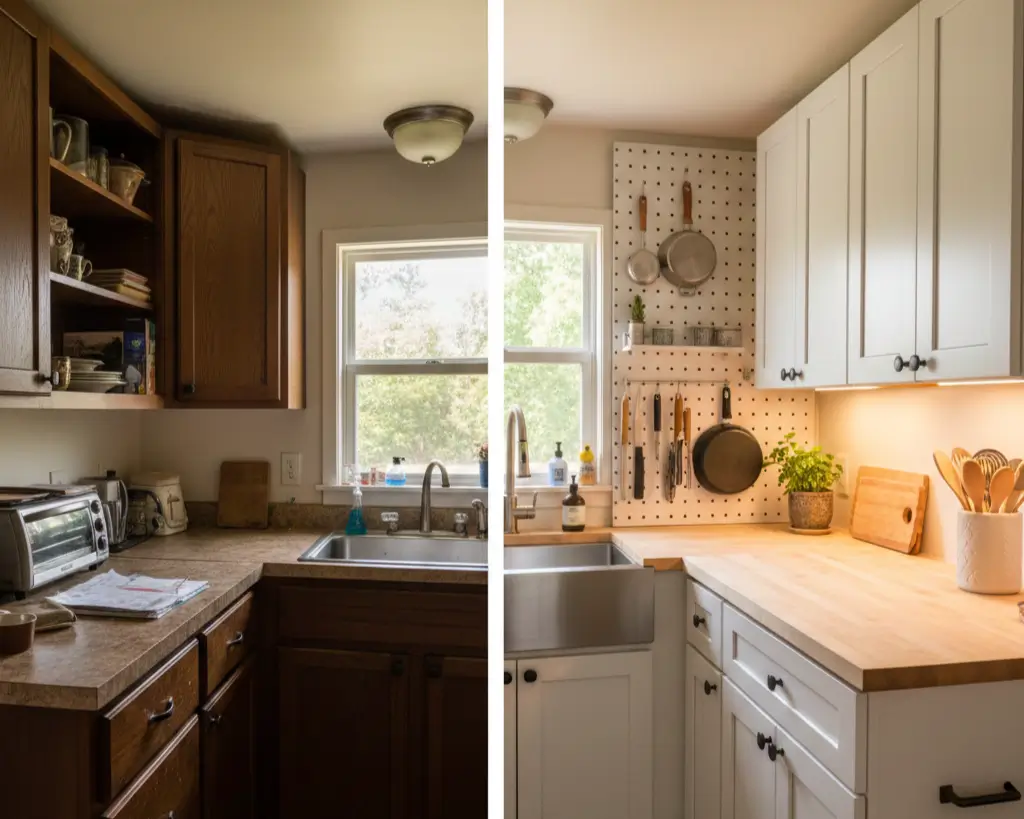
Let’s break down real costs across three budget tiers.
DIY Budget: $500-$2,000
What it covers:
- IKEA METOD base cabinets (modified): $200-$600
- Butcher block countertops: $100-$300
- Bar sink with faucet: $120-$250
- Two-burner induction cooktop: $80-$200
- Used compact refrigerator: $100-$300
- Hardware and installation: $100-$200
This tier requires significant sweat equity. Expect 80 to 120 hours of planning, modifying, and installing. Cabinet modifications need basic woodworking skills.
For surface options, tiny house countertops surfaces compares butcher block, laminate, and solid surface costs.
Mid-Range: $2,000-$8,000
What it covers:
- Semi-custom cabinets with soft-close: $800-$2,500
- Quartz or solid surface countertops: $400-$1,200
- Quality undermount sink: $200-$500
- Built-in two-burner cooktop: $300-$600
- New compact refrigerator: $400-$900
- Professional installation: $500-$1,500
This tier balances cost and quality. You’re getting proper materials without fully custom pricing.
Investment Tier: $8,000-$20,000+
What it covers:
- Fully custom cabinetry: $3,000-$8,000
- Premium countertops with integrated features: $1,000-$3,000
- High-end compact appliances: $1,500-$4,000
- Professional design consultation: $500-$1,500
- Complete installation: $1,500-$4,000
This tier makes sense when every inch must be optimized and you’re building long-term.
| Category | DIY Budget | Mid-Range | Investment |
| Cabinets | $200-$600 | $800-$2,500 | $3,000-$8,000 |
| Counters | $100-$300 | $400-$1,200 | $1,000-$3,000 |
| Appliances | $300-$700 | $900-$2,000 | $1,500-$4,000 |
| Fixtures | $120-$250 | $200-$500 | $400-$1,000 |
| Labor | DIY | $500-$1,500 | $1,500-$4,000 |
| Total | $500-$2,000 | $2,000-$8,000 | $8,000-$20,000+ |
The tiny house budget planning resource includes spreadsheet templates for tracking kitchen project costs.
Bringing Your Tiny Kitchen Together
Designing a kitchen under 50 square feet forces clarity. Every fixture earns its place or gets cut.
Start with your cooking habits, not someone else’s Pinterest board. If you bake weekly, prioritize counter space. If you meal prep, invest in refrigerator capacity. If you barely cook, shrink the kitchen and reclaim floor space for living.
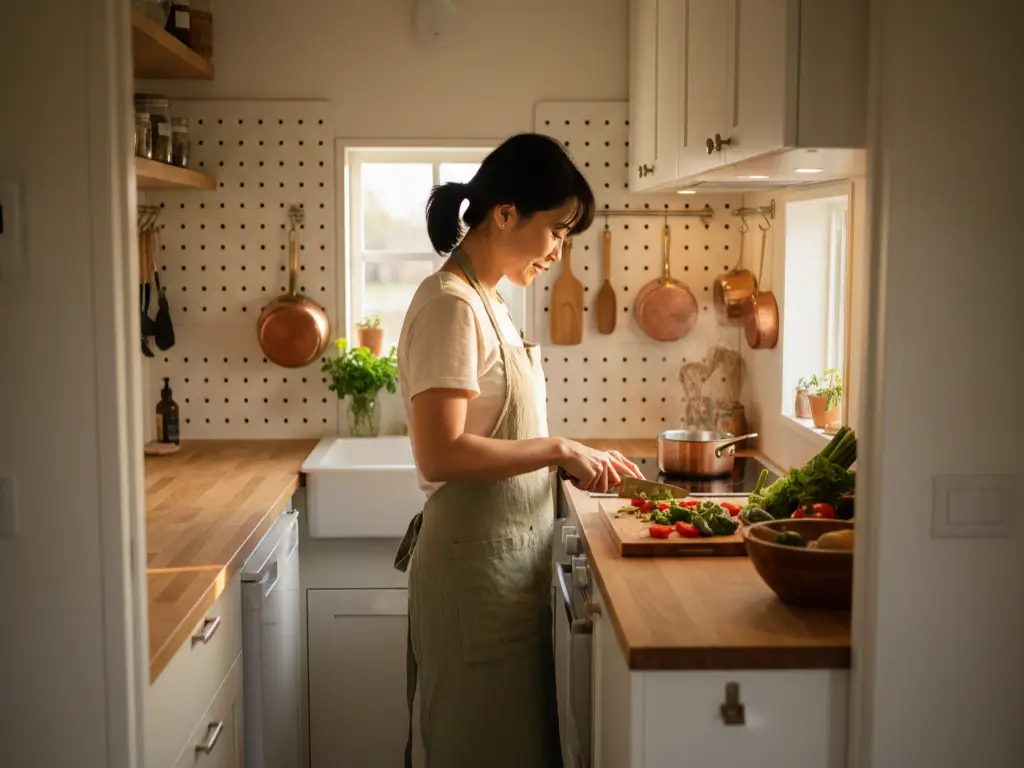
The single most important decision? Your layout. Get that wrong, and no amount of clever storage will fix daily frustration. Tape it out. Walk through it. Cook an imaginary meal.
- Measure your available kitchen footprint and aisle clearances. Write them down.
- Choose a layout based on your width and cooking style. Review the tiny house decorating basics for style inspiration that complements your chosen layout.
- Consult a tiny house designer. A one-hour session ($75-$150) often saves thousands in avoided mistakes.
Your 40 square feet can cook circles around a cramped 150-square-foot kitchen. It just takes intentional design, and now you know where to start.
For more small-space solutions across every room, explore Veniola for guides tailored to homes under 1,200 square feet.