I once lived in a 350-square-foot accessory dwelling unit (ADU) where the landlord strictly forbade nails in the walls. “Not even a thumbtack,” he said. It felt like living in a sterile white box. I panicked, thinking I couldn’t make it feel like home without forfeiting my $1,200 deposit.
I was wrong.
Most guides tell you to knock down walls or install custom built-ins. That’s useless when you don’t own the property. When you are renting a tiny house or a micro-apartment, the rules of engagement change. You need density, packing function into every square inch, without permanence.
Whether you have a $100 DIY budget or $1,000 to invest in furniture you can take with you, this guide covers how to reclaim your space. We focus on the “vertical inch” and reversible engineering that adds personality and storage to spaces under 600 square feet.
How can I decorate rental walls without painting?
In a rental under 400 sq ft, use peel-and-stick wallpaper (ensure it’s “removable” grade), heavyweight tension fabric, or vinyl decals. These add depth without chemical bonding. For a 10×10 ft wall, high-quality removable wallpaper costs $150–$250 and takes 2-3 hours to install.
The Peel-and-Stick Revolution
Ten years ago, wallpaper meant steaming, scraping, and crying. Today, removable wallpaper is a renter’s best friend. I’ve used this in three different apartments. The key for small spaces is scale.
In a tiny house, giant patterns can overwhelm the room. Look for micro-prints or textured solids (like faux linen or grasscloth).
- Cost: Approx. $1.50 – $3.00 per sq ft.
- Time: A Saturday afternoon.
- Risk: Low (test a patch in a closet first).
If your landlord allows painting, you’re lucky. But remember, you’ll likely have to paint it back. If you go this route, check our guide on rental apartment painting to ensure you pick colors that cover easily when you move out.
The “Fabric Wall” Technique
If wallpaper feels too risky, try starching fabric. You soak lightweight fabric in liquid starch and smooth it onto the wall. It dries hard but peels off instantly with water, leaving zero residue.
Pro Tip: In a narrow hallway (common in tiny houses), apply this treatment only to the end wall. It draws the eye through the space, making the hallway feel longer rather than tighter.
What are the best no-drill storage solutions for small spaces?
Utilize tension rod systems (floor-to-ceiling) and over-the-door organizers. A high-quality tension shelf system (width: 24-30 inches) can hold 40+ lbs per shelf and utilizes vertical airspace up to 10 feet. Cost ranges from $80 (DIY) to $400 (designer systems).
[IMAGE #2: DIAGRAM OF TENSION SYSTEM]
Tension Rods Are Not Just for Shower Curtains
When you can’t drill into studs, you have to use compression. Industrial-strength tension rods can span nooks and create instant closets.
In my last 400 sq ft rental, I had an awkward 3-foot alcove. I installed two heavy-duty tension rods:
- High rod (80 inches): For hanging coats.
- Low rod (40 inches): For hanging pants.
- Result: A full double-tier closet for $45.
The Over-the-Door Economy
In a tiny house, the back of a door is prime real estate. Standard doors are 80 inches tall. A standard over-the-door rack gives you roughly 10 square feet of vertical storage.
However, standard organizers often bang against the door. Look for “tight-mount” systems or use command strips at the bottom to secure the organizer to the door face. This prevents the rattle that drives everyone crazy in small spaces.
For more permanent-feeling options that you can still dismantle, explore tiny house storage solutions that stand independently without wall anchoring.
Benefits of Plug-in Sconces and Battery Lighting for Renters
Lighting defines volume. In small spaces, overhead lighting creates harsh shadows that shrink the room. Plug-in wall sconces and rechargeable LED puck lights allow you to layer light at eye level (60-66 inches off the floor), creating warmth and perceived depth without electrical work.
The Sconce Hack
Wall sconces used to require an electrician and a hole in the drywall. Now, you have two renter-friendly options:
- Plug-in Sconces: Mount with a small nail or Command hook, let the cord hang (cord covers are paintable!), and plug it in.
- The “Magic Bulb” Trick: Mount a regular sconce (non-wired) to the wall. Instead of wiring it, glue a remote-controlled battery LED puck light inside the shade. No wires, total style.
Why Color Temperature Matters
In a space under 500 sq ft, your kitchen lights might also be your living room lights. If you can, swap your landlord’s bulbs for “warm white” (2700K-3000K). Cold daylight bulbs (5000K+) can make a small apartment feel like a hospital examination room.
Check out tiny house lighting solutions for specific fixture recommendations that fit tight corners.
Open Layout vs. Zoned Living in 400 Sq Ft
An open layout feels larger but can be chaotic. Zoned living uses dividers (bookshelves, rugs, curtains) to separate functions (sleep vs. work). For renters, open shelving units perpendicular to the wall are the best non-permanent dividers, offering storage and separation simultaneously.
| Feature | Open Layout | Zoned Layout | Renter Impact |
| Visual Space | Feels larger, airier | Feels cozier, organized | Zoning hides clutter better |
| Light Flow | Maximized | Can be blocked | Use open-back shelves |
| Privacy | Zero | Moderate | Critical for couples |
| Cost | $0 | $100 – $500 | Furniture investment moves with you |
The Bookshelf Wall
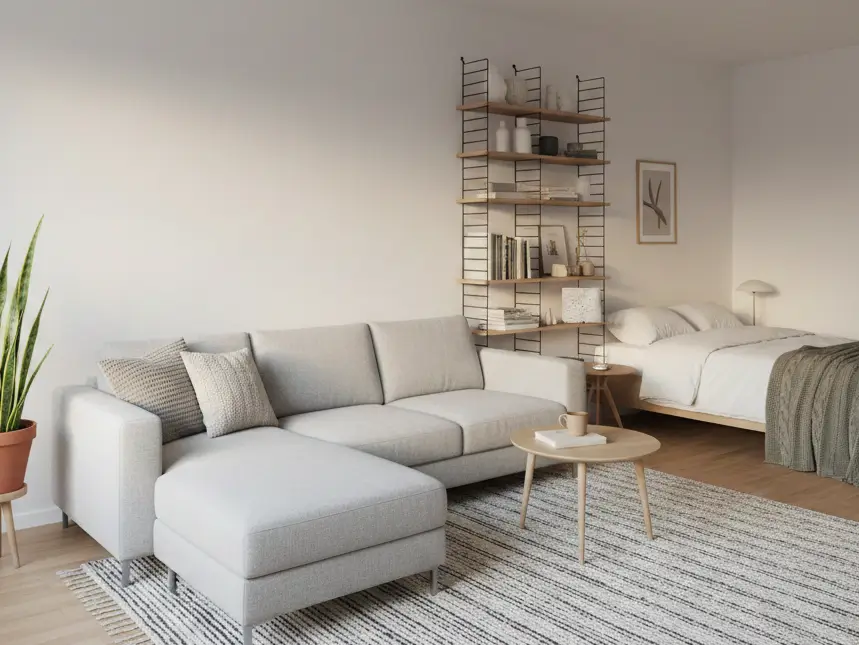
A sturdy, open-back bookshelf (like the IKEA Kallax or similar) placed perpendicular to a wall defines a “bedroom” in a studio.
Measurements that matter:
- Walkway width: Leave at least 30 inches (standard door width) to walk past your divider. Anything less than 24 inches will feel claustrophobic.
- Height: A unit 4-5 feet tall provides visual separation while seated but lets light pass over the top, keeping the room feeling connected.
If you are dealing with a weird floor plan, review our guide on tiny house layout and floor plans to see how to arrange furniture to mimic built-in walls.
Choosing Renter-Friendly Furniture for Tiny Homes
Select furniture that is freestanding, modular, and multi-functional. Avoid massive sectionals. Look for sofas with hidden storage (adds ~4-6 cubic feet), lift-top coffee tables (creates a desk), and dining tables that fold flat (gateleg).
Invest in What You Keep
When you rent, you don’t want to invest in custom cabinets you have to leave behind. Spend your money on high-quality furniture that fits this apartment but will also fit the next one.
- The “Click-Clack” Sofa: If you have guests, a sleeper sofa is non-negotiable. Measure the “open” footprint. I’ve seen renters buy sleepers that can’t fully unfold because they hit the kitchen island.
- Legs Matter: In small spaces, choose furniture with visible legs. Seeing the floor continue underneath the sofa tricks the brain into thinking the room is larger.
If you love the warmth of natural materials, wood furniture for small spaces creates a grounded, high-end look that cheap particle board can’t match.
Don’t Forget the Plants
Plants are the ultimate renter decor. They add life and improve air quality without a lease violation. However, floor space is premium.
- Use verticality: Macrame hangers or wall-mounted planters (using Command hooks) keep pots off the floor.
- Light levels: If your tiny house has few windows, choose snake plants or pothos. See our guide on indoor plants for small apartments.
Reversible Upgrades for Tiny Kitchens and Bathrooms
You can’t rip out the cabinets, but you can change the hardware. Swapping cabinet handles (keep the old ones in a bag!) instantly modernizes a space. Use adhesive hooks inside cabinet doors for lids and over-the-toilet storage ladders for bathrooms. Budget: $50-$150.
The Kitchen “Expansion”
Most tiny house rentals have limited counter space.
- Burner Covers: Buy or make wooden covers for your stove burners. This adds 2-3 square feet of prep space when you aren’t cooking.
- Rolling Cart: A slim rolling island (10-15 inches wide) can slide into awkward gaps and serve as extra pantry space.
For more organization hacks, check tiny house kitchen design.
The Bathroom Spa
Rental bathrooms are often drab.
- Shower Head: Change it. It costs $30, takes 5 minutes with a wrench, and changes your daily life. Just keep the original.
- Textiles: Since you can’t paint the tiles, rely on a bold shower curtain and high-quality towels to inject color.
- Storage: If you have a pedestal sink (zero storage), use a curved under-sink organizer or a skirt.
See tiny house bathroom design for specific layout ideas.
Essential Decorating Rules for Small Rentals
Stick to a 60-30-10 color rule (60% dominant neutral, 30% secondary, 10% accent). Use large mirrors to bounce light and double visual depth. Avoid “clutter-core”; in a 400 sq ft space, every object needs a home.
The Mirror Trick
A large mirror leaning against a wall (secured with an anti-tip strap!) acts like a window. Place it opposite your actual window to maximize natural light.
Rugs Cover Ugly Floors
If your rental has questionable laminate or cold tile, a large area rug anchors the room. In a small space, go big. A rug that is too small (floating in the middle of the room) makes the room look like a postage stamp. All furniture legs should ideally sit on the rug.
For a deep dive on aesthetic choices, read tiny house decorating basics.
Final Thoughts
Living in a tiny rental doesn’t mean living in a temporary holding cell. By focusing on reversible connectivity, tension, adhesion, and gravity, you can build a space that serves you perfectly right now.
Measure everything twice. In a small space, a 2-inch error means your bathroom door won’t close.
- Buy a new shower head and swap it out. It’s the highest ROI upgrade you can make.
- Measure your vertical nooks and order a tension rod system for that awkward corner.
- Start curating modular furniture that you love enough to move to your next home.
You don’t need a mortgage to have a home that feels designed, functional, and uniquely yours.