The kitchen counter in a tiny house or studio apartment isn’t just a place to chop carrots. It’s your home office, your dining table, your laundry folding station, and occasionally, a storage shelf. In a standard American home, you might have 30 to 40 square feet of counter space. In a 250-square-foot tiny house, you are likely working with 8 to 12 square feet.
This scarcity changes the rules completely.
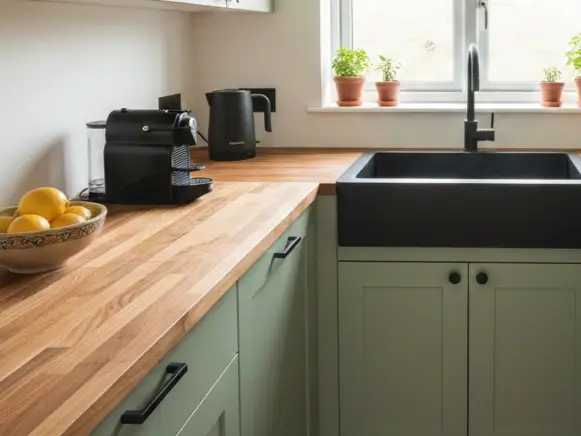
The best tiny house countertops balance weight (crucial for towing) with multi-functionality. Butcher block is the top choice for DIYers (approx. $15-$40/sq ft, 4-5 lbs/sq ft). Laminate is the lightest and cheapest ($10-$25/sq ft). For luxury without the full cost, utilize stone remnants (quartz/granite scraps) which offer high durability but add significant weight (18+ lbs/sq ft).
When I designed my first compact kitchen layout, I made the mistake of treating it like a shrunken version of a suburban kitchen. I almost installed heavy granite in a house meant to travel down the highway. That’s a recipe for popped tires and cracked stone.
Whether you are building a movable Tiny House on Wheels (THOW) or renovating a 400-square-foot apartment, your surface choice defines the functionality of your kitchen. Here is how to choose a surface that handles the heat without weighing you down.
How Much Do Tiny House Countertops Weigh?
Weight varies drastically by material. Laminate is lightest at ~1.5 lbs/sq ft. Solid wood/Butcher block averages 4-5 lbs/sq ft. Concrete and Granite are heaviest, ranging from 18 to 25 lbs/sq ft. For a typical 10-foot tiny house counter run, granite adds ~350 lbs, while laminate adds only ~30 lbs.
Why Weight Matters
If you are renting a ground-floor apartment, weight is irrelevant. Feel free to pour concrete. However, for tiny house on wheels specifications, every pound counts toward your Gross Vehicle Weight Rating (GVWR).
Road vibration is the other factor. Heavy, rigid materials like slab granite or concrete are prone to cracking when a tiny house hits a pothole at 55 MPH. If you choose stone, you must use flexible adhesives and robust cabinetry reinforcement.
The “Sizable” Advantage
There is a silver lining to small spaces. Because you need so little material (often just one 8-foot slab or less), you can afford higher quality per square foot.
- Standard Kitchen: 50 sq ft of Quartz @ $80/sq ft = $4,000.
- Tiny Kitchen: 10 sq ft of Quartz @ $80/sq ft = $800.
This math allows many tiny dwellers to access luxury materials by visiting local stone yards and asking for “remnants” or “off-cuts” left over from massive mansion projects.
Best Countertop Materials for Small Spaces Ranked
- Butcher Block: Best overall value, warmth, and repairability.
- Laminate: Best for tight budgets and strict weight limits.
- Quartz Remnants: Best for durability and resale value (if weight allows).
- Stainless Steel: Best for hygiene and industrial aesthetics.
- Recycled Paper/Glass: Best for sustainability.
1. Wood and Butcher Block
This is the gold standard for tiny house kitchen design. It brings warmth to small spaces that might otherwise feel sterile.
- Pros: You can cut and install it yourself (DIY friendly). It’s relatively lightweight. Scratches can be sanded out.
- Cons: Requires sealing (oil or poly). Susceptible to water damage around sinks.
- Tiny Tip: Use a food-safe oil finish so you can chop directly on the surface, eliminating the need to store a bulky cutting board.
2. High-Pressure Laminate
Forget the peeling countertops from your 1990s rental. Modern high-pressure laminates mimic wood, stone, and concrete convincingly.
- Pros: Extremely light. Inexpensive. Waterproof.
- Cons: Not heat resistant (hot pans will melt it). Difficult to repair chips.
- Tiny Tip: Look for “solid core” laminates to avoid the ugly dark line at the edge.
3. Stainless Steel
Often overlooked, stainless steel is fantastic for tiny house sustainability because it is 100% recyclable and hygienic.
- Pros: Indestructible. Heat proof. Reflects light (making the room look bigger).
- Cons: Scratches easily (develops a patina). Can be noisy.
- Tiny Tip: You can wrap stainless steel sheets over lightweight plywood for a surface that weighs almost nothing but acts like a pro kitchen.
Installing and Finishing Wood Countertops
DIY wood counters usually cost $200-$500 total. Buy pre-made slabs (Birch or Acacia are common) from hardware stores. Cut to size using a circular saw with a fine-finish blade (60+ teeth). Sand to 220 grit. Seal with Waterlox (waterproof, durable) or Mineral Oil (food safe, high maintenance).
Sourcing Your Wood
You don’t need to glue up 2x4s (unless you really want that rustic look). Prefabricated “island tops” are sold in standard dimensions, usually 74″ x 39″ or 96″ x 25″.
- Acacia: Hard, rot-resistant, beautiful grain contrast.
- Birch: Affordable, light color (good for dyeing), softer.
- Bamboo: Extremely hard, sustainable, very stable.
The Finish Debate
For a tiny house, moisture is the enemy. Humidity fluctuates rapidly in small volumes.
- Tung Oil / Mineral Oil: requires re-application monthly. Good if you want a matte, natural feel.
- Polyurethane / Waterlox: forms a hard plastic-like shell. Best for wood treatment and finishing near sinks where splashing occurs.
Check out our guide on wood materials for tiny houses for more on selecting the right species.
Countertop Depth and Layout for Tiny Homes
Standard kitchen counters are 25.5 inches deep. In a tiny house or narrow apartment, reducing depth to 20-22 inches saves valuable floor space, increasing the aisle width. Ensure your cooktop and sink fit these reduced dimensions before cutting.
The “Aisle Width” Factor
In a tiny house layout, the aisle is often the only walking space. Standard building code prefers 36 inches of clearance, but tiny homes often push this to 30 or even 28 inches.
- Reducing counter depth by 4 inches makes the room feel significantly larger.
- Warning: Most standard kitchen sinks won’t fit a 20-inch counter. You need “bar sinks” or RV-specific fixtures. See our notes on tiny house kitchen fixtures for sizing help.
Vertical Space Utilization
Since you have less horizontal surface, you must use the vertical wall.
- Magnetic strips: For knives.
- Rail systems: For hanging spice baskets and utensil cups.
- Undershelf baskets: Slide onto the cabinet shelf above.
Cost Comparison: 10 Linear Feet of Countertop
For a typical 10-foot run (approx 21 sq ft standard depth, or 17 sq ft tiny depth):
- Laminate: $150 – $300
- DIY Butcher Block: $250 – $450
- Quartz Remnant: $600 – $1,200 (Highly variable based on fabrication)
- Recycled Glass/Paper: $900 – $1,500
- Epoxy Pour (DIY): $200 – $400
| Material | Weight (lbs/sq ft) | Durability | DIY Friendly? | Cost Tier |
| Laminate | 1.5 | Moderate | Yes | Low |
| Butcher Block | 4-5 | High (Repairable) | Yes | Low-Mid |
| Stainless Steel | 2-3 (w/ ply) | Very High | No (Fabrication) | Mid |
| Quartz | 18-22 | Very High | No | High |
| Recycled Paper | 4-6 | High | Moderate | High |
If you are budget planning for your tiny house, remember that the installation labor for stone often costs more than the material itself.
The “Epoxy” Option
A rising trend in the DIY tiny house building projects community is epoxy. You can build a lightweight countertop out of MDF or plywood and pour a metallic or faux-marble epoxy finish over it.
- Pros: Looks like luxury stone, weighs like wood, costs very little.
- Cons: Messy to install (fumes), sensitive to heat, can yellow over time if cheap epoxy is used.
Eco-Friendly Surfaces for Healthy Tiny Living
In a small volume of air, off-gassing from materials is concentrated. Look for Low-VOC sealants and Greenguard Gold certified laminates. PaperStone and Richlite are durable, stone-like surfaces made from recycled paper and resin, offering a great balance of weight and eco-friendliness.
Concentrated Air Quality
In a 4000 sq ft house, the smell of new glue dissipates. In 200 sq ft, you are breathing it intensely.
- Avoid standard particle board that uses formaldehyde glues.
- Choose solid wood with natural oil finishes.
- If using stone, ensure the sealing chemicals are non-toxic.
Consider how your countertop interacts with your tiny house plumbing systems. Undermount sinks are harder to seal perfectly against wood counters (risk of rot), making drop-in sinks a safer bet for DIY wood installs.
Conclusion
Your tiny house countertop is the workhorse of your home. It needs to be tough enough for daily cooking, smooth enough for laptop work, and light enough (if you’re on wheels) to keep your house road-legal.
For most people, Butcher Block hits the sweet spot of price, weight, and aesthetics. If you need bulletproof durability and aren’t moving the house often, hunt for a Quartz remnant. If budget is tight, Laminate has come a long way and offers the lowest weight penalty.
- Measure your aisle width, can you afford a standard 25.5″ depth, or should you shrink to 22″?
- Calculate your weight budget if building on a trailer.
- Visit a local stone yard and ask to see the “boneyard” (remnant section) just to see what’s possible.
Don’t let the small footprint limit your style. In fact, use the small square footage to justify that one beautiful slab of Acacia or that unique piece of recycled glass you’ve been eyeing.