When you commit to living in 250 square feet, you realize quickly that construction isn’t just about design, it’s about mathematics. A standard home is built to code; a tiny house on wheels (THOW) is built to code and Department of Transportation (DOT) road limits.
Most people assume “tiny” just means small. But in the world of THOWs, there is a hard, non-negotiable envelope you must stay within to avoid special hauling permits or dangerous towing situations. I’ve seen builders accidentally exceed the maximum width by two inches because they forgot to account for the roof overhang, turning a standard move into a logistical nightmare costing thousands in wide-load permits.
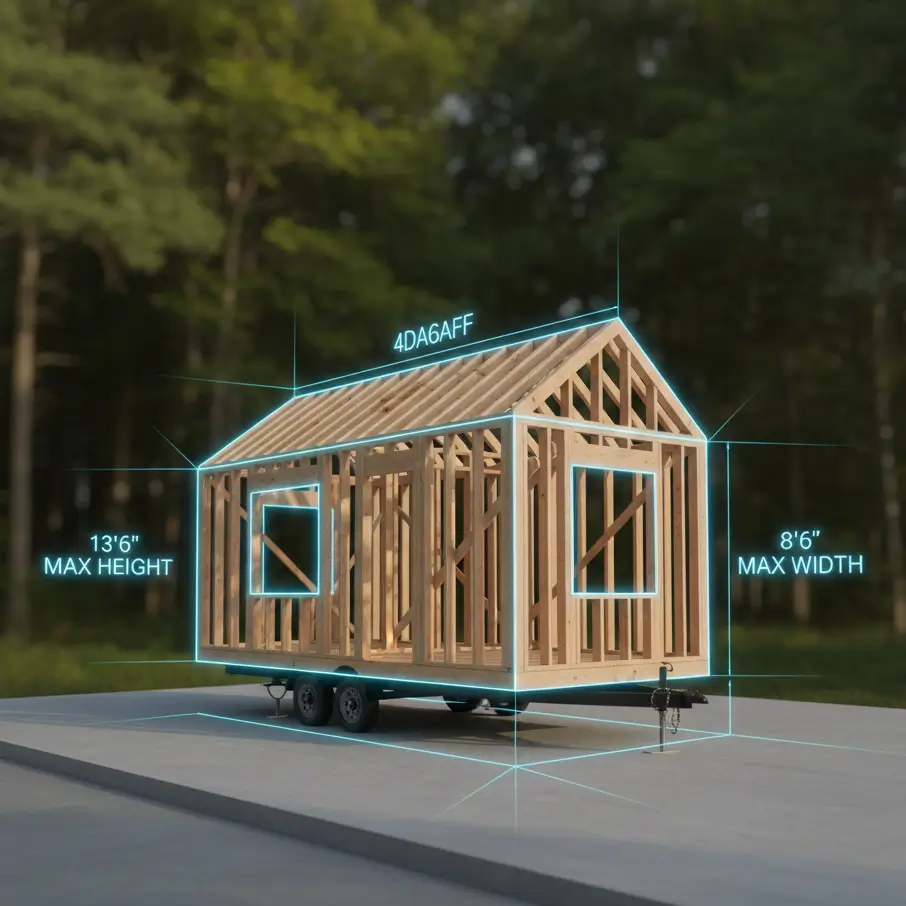
Standard tiny house on wheels specifications in the US are strictly defined by road legality. Without a permit, your build must not exceed 8 feet 6 inches in width (102 inches), 13 feet 6 inches in height, and typically 40 feet in length (though 20-28 feet is standard). The maximum weight depends on your trailer’s Gross Vehicle Weight Rating (GVWR), usually between 7,000 and 21,000 lbs.
We aren’t just looking at the shell. We are breaking down the critical numbers: the tongue weight percentages that prevent trailer sway, the wheel well clearances that impact your floor plan, and the insulation thickness that steals your interior width. Whether you are budgeting $15,000 for a DIY shell or $80,000 for a turnkey model, these numbers remain the same.
The “Road Legal” Box: External Dimensions
To tow without a Commercial Driver’s License (CDL) or oversized load permits in most US states, your max dimensions are 13’6″ high, 8’6″ wide, and usually 65′ total length (truck + trailer). The sweet spot for towability is 13’4″ high (to account for bounce) and 24-28 feet long.
The Width Restriction (102 Inches)
The most critical number in tiny house on wheels specifications is 102 inches (8.5 feet). This is the maximum legal width for vehicles on US highways.
However, here is where many first-time builders get trapped: 102 inches includes everything.
- Siding thickness
- Window trim
- Roof overhangs/drip edges
- Exterior lights
- Fenders
If you frame your floor to be exactly 8.5 feet wide, adding 1/2-inch siding and roof trim will push you over the legal limit.
The Safe Calculation:
I always recommend framing the subfloor to 98 or 100 inches maximum. This leaves you 1-2 inches per side for sheathing (approx 0.5″), rain screen/siding (approx 0.75″), and trim.
The Height Limit (13 Feet 6 Inches)
The federal bridge height standard is generally higher, but many older overpasses and rural routes are capped at 13’6″.
Pro Tip: Build to 13 feet 4 inches. Why? Tire pressure and suspension bounce. If you are exactly at the limit and hit a bump under a low bridge, the dynamic height could cause a collision.
When planning your tiny house layout and floor plan, this vertical limit dictates your loft headroom. If your trailer deck is 24 inches off the ground, you only have 11 feet of buildable vertical space left.
Trailer Specifications: The Foundation
Tiny house trailers are not standard car haulers. You need a custom trailer with a GVWR matching your estimated house weight. A 24-foot tiny house typically requires a 14,000 lb GVWR trailer (two 7k axles). Expect to pay $4,500 to $8,000 for a high-quality foundation.
Deck-Over vs. Drop-Axle (Between the Fenders)
Your choice of trailer changes your interior specifications drastically.
Option A: Between the Fenders (Drop-Axle)
This is the most common choice for THOWs. The floor sits between the wheels, lower to the ground.
- Deck Height: Approx 20-24 inches off the ground.
- Pros: Maximizes vertical space (more headroom for lofts).
- Cons: You lose floor width at the wheel wells. You must build boxes over the wheels or design your cabinetry/furniture to hide them.
- Interior Width: Approx 92-96 inches (except at wheel wells).
Option B: Deck-Over
The floor sits above the wheels.
- Deck Height: Approx 32-36 inches off the ground.
- Pros: Flat floor with no wheel well obstructions.
- Cons: You lose ~12 inches of vertical headroom. This makes standing lofts nearly impossible.
- Interior Width: Full 98-100 inches possible.
If you are focusing on tiny house accessibility design, a deck-over is harder to access due to the steeper entry stairs required, but the flat interior floor is easier to navigate once inside.
Weight Distribution and Tongue Weight
A safe THOW must have 10% to 15% of its total weight on the tongue (the hitch point). For a 10,000 lb house, that is 1,000-1,500 lbs on the truck. Too little tongue weight causes fatal trailer sway; too much lifts the truck’s front steering wheels.
Calculating Your Dry Weight
A common mistake is estimating weight based on standard house logic. Tiny houses vibrate and move; they need structural sheathing, hurricane clips, and often heavier framing.
- Average weight per linear foot: 450 – 650 lbs.
- 20 ft Tiny House: ~9,000 – 11,000 lbs.
- 28 ft Tiny House: ~13,000 – 16,000 lbs.
The Pivot Point
Because the axles on a tiny house trailer are usually set back (about 60/40 split rather than 50/50), the weight naturally shifts forward. However, placing heavy items like tiny house kitchen fixtures or a cast-iron wood stove at the very rear of the trailer acts as a counter-lever, reducing tongue weight dangerously.
I learned this the hard way on a 24-foot build. We placed a heavy utility closet with batteries and water tanks behind the axles. We had to relocate the batteries to the tongue box to regain stability.
Internal Dimensions: The “Real” Living Space
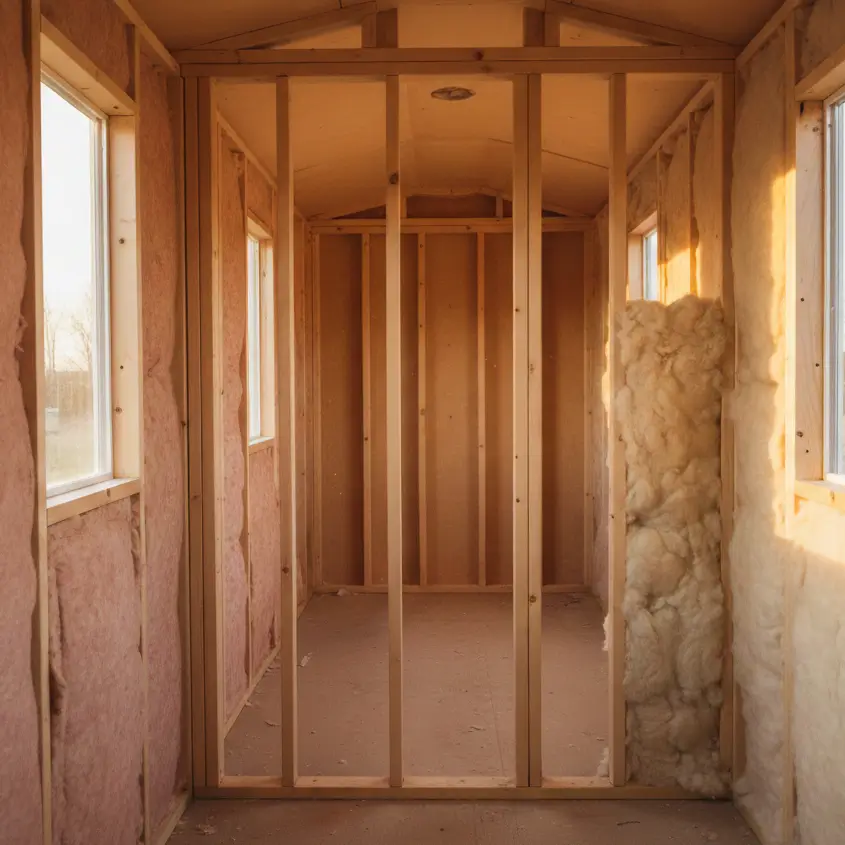
After accounting for framing (3.5″), sheathing (0.5″), and interior wall paneling (0.5″), a standard 8.5′ wide tiny house has an interior liveable width of roughly 7 feet 6 inches (90 inches).
Wall Thickness vs. Insulation Value
In a stationary home, you might use 2×6 walls for insulation. In a tiny house, that eats too much space.
- Standard Framing: 2×4 wood studs or metal framing.
- Depth: 3.5 inches.
- Space Loss: 7 inches total (3.5″ x 2 walls).
If you use closed-cell spray foam, you can achieve R-21 in a 2×4 wall, which is excellent for tiny house heating and cooling efficiency without sacrificing space. If you choose SIPs (Structural Insulated Panels), you might save an inch of thickness for the same R-value, but costs increase significantly.
The Loft Specs
Loft heights are the biggest complaint in tiny living.
- Standard Loft Headroom: 36 to 42 inches (at peak).
- Mattress Thickness: 6 to 10 inches.
- Actual Space: You will likely be crawling, not standing.
When selecting tiny house bedroom design elements, keep the mattress directly on the floor or on thin slats to maximize every inch of headroom.
Utility Rough-In Specifications
Standard RV hookup specs are required for most parking spots. Electrical: 50-amp or 30-amp twist-lock inlet. Water: Standard hose bib connection. Sewer: 3-inch PVC drain located on the driver’s side (road side), rear of the axles.
Electrical Service
Most THOWs run on 50-amp service (240 volts). This allows you to run an electric water heater, induction cooktop, and mini-split AC simultaneously.
- Inlet Location: Driver’s side, usually near the rear third of the trailer.
- Panel Location: Interior, accessible, often hidden in a cabinet near the wheel well.
- See more on tiny house electrical systems.
Plumbing Drops
Unlike a house on a slab, your pipes are exposed under the trailer. They must be insulated and tucked up into the floor joists (the “belly”).
- Drain Outlet: Must drop below the trailer frame rail for gravity flow but stay high enough to avoid hitting speed bumps.
- Grey vs. Black Water: Plan to plumb them together into one 3-inch outlet with slide valves, unless you are using a composting toilet, which changes your tiny house plumbing systems requirements entirely.
Sizing Your Components
Standard residential appliances often don’t fit or weigh too much. Stick to apartment-sized or RV-specific sizes. Doors should be 24-28 inches wide (interior) to save swing space.
Windows and Doors
You can use residential windows, but they must be tempered glass (safety glass) because the house moves down the highway.
- Rough Opening (RO): Always add 0.5 to 1 inch to the window unit size.
- Egress: You must have at least one egress window (min 5.7 sq ft opening) in the sleeping loft for fire safety.
- Check tiny house windows and doors for safety codes.
Cabinetry Depth
Standard kitchen counters are 24-25 inches deep. In a 7.5-foot wide room, two standard counters leave a hallway of only 3.5 feet.
- THOW Hack: Use 18-20 inch deep cabinets for the “galley” side or storage areas to widen the walkway.
- Storage: Prioritize tiny house storage solutions that utilize the vertical height (toe-kick drawers, over-window shelves) rather than floor footprint.
Summary of Critical Specs
| Feature | Specification | Notes |
| Max Legal Width | 8′ 6″ (102 inches) | Includes roof overhangs & fenders |
| Max Legal Height | 13′ 6″ | Target 13′ 4″ for safety |
| Max Length | Varies (typ. 40′ max) | 20-28′ is easiest to tow/park |
| Trailer GVWR | 10,000 – 21,000 lbs | Must exceed total house weight |
| Tongue Weight | 10% – 15% of total | Prevents sway; safety critical |
| Tire Pressure | typically 80 PSI | Check specific tire loading rating |
| Framing Members | 2×4 (standard) | 2×3 or metal stud for weight savings |
| Electrical | 30A (120V) or 50A (240V) | 50A recommended for full-time living |
Final Thoughts
The specifications of a tiny house on wheels are unforgiving. In a traditional home renovation, if a wall is an inch off, you shim it. In a tiny house, if you are an inch off on the exterior width, you might be illegal to tow.
Focus your energy on the trailer foundation and the framing envelope. These are the elements you cannot change later. Once the shell is built to these strict dimensions, you can get creative with your tiny house interior aesthetics.
If this is your first build, don’t guess the weight. Go to a CAT scale (truck stop scale) once your framing and sheathing are done to see where you stand. It costs about $12 and gives you the peace of mind that your home is safe for the road.
Ready to start planning the interior now that you know the boundaries? Start with our guide on tiny house wood materials to choose lightweight, durable finishes.