
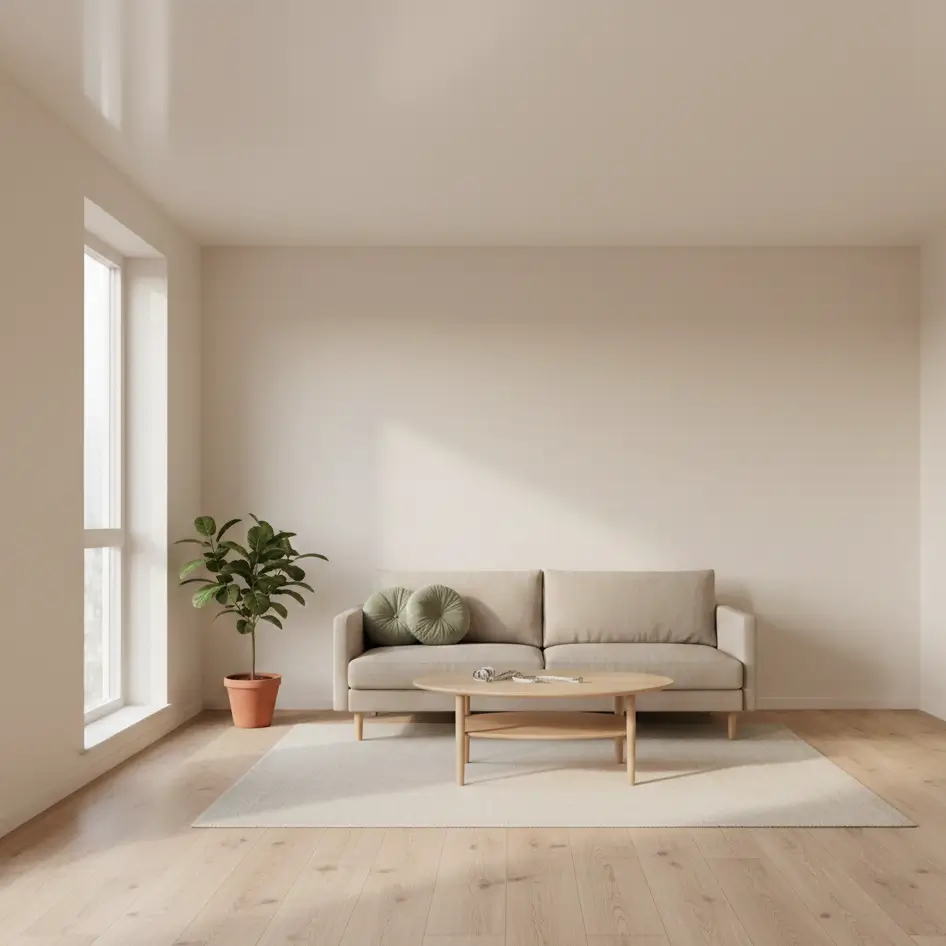
There is a specific kind of frustration that comes with living in a “cave.” You know the feeling, it’s 2:00 PM on a sunny day, but inside your 500 sq ft apartment, you still need the lamps on.
I used to think the solution was simple: buy the brightest, starkest white paint available and blast every wall with it. Actually, scratch that. That was my biggest mistake. In a low-light small space, pure white doesn’t brighten; it turns gray and shadowy, making the corners feel even tighter.
If you are trying to brighten dark apartment paint schemes, you need to stop looking at color and start looking at science, specifically, Light Reflectance Value (LRV) and finish sequencing.
To brighten a dark small space, choose paint with an LRV (Light Reflectance Value) between 60 and 75. Avoid stark white in north-facing rooms; use warm off-whites or pale greiges to counteract blue shadows. Use a satin or semi-gloss finish on the ceiling to bounce light downward, effectively “lifting” the room.
Whether you are a renter looking for a temporary fix or a tiny house owner ready to invest, this guide covers how to manipulate light in tight quarters. We’re talking budgets from a $60 gallon of paint to a $400 full-room transformation.
The Science of “Expanding” Space: Understanding LRV
LRV (Light Reflectance Value) measures the percentage of light a paint color reflects. For dark, small apartments (<800 sq ft), select colors with an LRV of 60-75. Anything higher (85+) can look clinical in low light; anything lower (<50) will absorb what little natural light you have.
Why White Fails in Dark Corners
In a large home with massive windows, stark white looks crisp. In a 12×12 living room with a single north-facing window, stark white creates “dead shadows.”
When I helped a friend repaint her garden-level studio (420 sq ft), we ignored the “just paint it white” advice. Instead, we looked for high-LRV colors with specific undertones.
- North-Facing Rooms: The light is blue and weak. Pure white looks gray here. You need warm undertones (creamy white, pale beige) to fake sunlight.
- South-Facing Rooms: The light is warm and intense. You can get away with cool undertones (pale blue, cool gray) to balance the heat, but keep the LRV high.
- No Windows/Interior Rooms: You need artificial light assistance. Here, the finish matters more than the color (more on that in the next section).
If you are struggling to pick a specific brand or base, check our guide on paint brands for small spaces to see which lines offer the best coverage for high-LRV pigments.
Note: Most paint cans have the LRV printed on the back label or the color strip. If you see a number like “LRV 68,” you are in the sweet spot for a small living room.
The “Fifth Wall” Hack: Ceiling Finishes
In spaces with low ceilings (standard 8ft or lower), paint the ceiling a shade lighter than the walls using a satin or semi-gloss finish. This reflects window light downward into the room, increasing ambient brightness by roughly 15-20% compared to standard flat ceiling paint.
Gloss vs. Matte in Tight Quarters
Standard advice says “paint ceilings flat white.” In a tiny house or small apartment, standard advice is often wrong.
Flat paint absorbs light. If you have low ceilings, common in basement apartments or lofted tiny house bedrooms, a flat ceiling feels like a lid on a box. By switching to a satin finish, you turn that lid into a reflector.
My Rule of Thumb for Small Spaces:
- Walls: Eggshell (hides bumps, reflects some light).
- Ceiling: Satin (reflects light, easy to clean).
- Trim: Semi-Gloss (frames the space).
I recently tested this in a 90 sq ft tiny house bedroom. We painted the ceiling in a high-gloss white (LRV 82). The result? The single window’s light bounced off the ceiling and illuminated the dark corners of the room that the direct sun couldn’t reach. It felt like we added a skylight.
However, glossy paint shows every imperfection. If your ceiling has cracks or bad texture, you might need to prep heavily first. See our breakdown on paint preparation for small apartments before you buy that high-gloss can.
Also, if your ceiling is physically low (under 7 feet), check out low ceiling paint solutions for specific color combinations that push the visual height upward.
Strategic Undertones: Warm vs. Cool
Undertones alter perception of depth. Cool colors (greens, blues, violets) are “receding,” meaning they make walls look further away. Warm colors (reds, yellows, oranges) are “advancing,” making walls feel closer. To brighten dark apartment paint effectively, use pale cool colors to expand the space, or warm whites to simulate sunlight.
The Recession Effect
In a narrow hallway or a cramped bathroom, physical space is the limiting factor. You can’t knock down a wall, but you can push it back visually.
A pale, silvery blue (LRV ~70) works incredibly well in narrow spaces. Because blue is a receding color, the eye perceives the wall as being slightly further away than it actually is.
The “Sunshine” Simulation
If your apartment feels like a dungeon because it lacks windows, receding colors might feel too cold. In this case, you sacrifice a bit of perceived depth for perceived warmth.
- The Mix: Look for a “greige” (gray-beige). It keeps the modern, clean look of gray but adds the warmth of beige.
- The Caution: Avoid yellow-based creams in small bathrooms. Without natural light, artificial yellow bulbs on yellow paint can make the room look dingy or dirty.
For a deep dive on specific codes, look at our list of neutral paint colors for a small apartment. We list the exact LRV for each recommendation there.
The “Reverse Accent” Wall
In dark rooms, avoid dark accent walls which absorb light. Instead, use a “Reverse Accent”: Paint the wall with the window the lightest color (or pure white), and the adjacent walls a slightly deeper hue. This blurs the edges of the window, reducing contrast glare and making the window opening feel larger.
Why Dark Accents Fail in <600 Sq Ft
I love a moody dark wall, but in a 500 sq ft apartment with one window, a navy blue wall is a light sponge. It can reduce the ambient light in the room significantly.
If you absolutely crave color, keep it to:
- Below the chair rail: Paint the bottom 3 feet dark, keep the top 5 feet light.
- Doors and Trim: Paint the door a fun color, keep walls high-LRV.
- Furniture: Let your sofa be the accent, not the wall.
Renter-Friendly Note:
If you can’t paint the walls because of a strict lease, consider painting furniture or using temporary wall coverings. Read more in our guide to rental apartment painting to see what landlords typically approve.
Budget & Coverage: The Small Space Advantage
Painting a small apartment is cheap. A 12×12 room usually requires just 1.5 to 2 gallons of paint for two coats. Budget $100-$150 for premium paint and tools. Don’t skimp on quality; premium paints have better titanium dioxide levels (better coverage and light reflection).
Cost Breakdown (Estimated 2024 Prices)
I crunched the numbers for a standard 10×12 bedroom repaint.
| Item | Budget Option | Premium Option | Impact on Light |
| Paint (2 Gallons) | $60 (Economy) | $140 (top-tier) | Premium has better light-reflecting pigments. |
| Primer | $20 | $40 (High hide) | Essential for covering old dark colors. |
| Rollers/Brushes | $15 (Kit) | $45 (Pro tools) | Better rollers leave less texture (smoother walls reflect more light). |
| Total | ~$95 | ~$225 |
The “Texture Tax”
In small spaces, you are physically closer to the walls. You see the brush strokes. You see the roller lint.
- Use a microfiber roller cover (3/8 inch nap) for smooth walls.
- Sand the walls lightly before painting.
- Smoother walls = better light reflection. Rough walls trap micro-shadows.
If you are calculating exactly how much you need so you don’t have to store leftover cans in your tiny closet, use our paint coverage calculation tool.
Need to verify your budget? Check our paint budget cost analysis for a line-item breakdown.
The Brightening Framework
If you are staring at your dark walls right now, feeling overwhelmed, here is your cheat sheet.
- Check the Compass: North facing? Go Warm. South facing? Go Cool.
- Check the LRV: Aim for 60-75.
- Check the Ceiling: Can you use satin or semi-gloss to bounce light?
- Check the Texture: Sand bumps down to maximize reflection.
Painting is the highest ROI (Return on Investment) project you can do in a small space. For $200, you can completely alter how big your home feels.
Don’t buy a gallon yet. Go to the store and buy samples. Paint a 12×12 inch square on your darkest wall and look at it at 8:00 PM and 10:00 AM.
If the paint looks muddy or gray, go lighter or warmer. If it looks too sterile, go slightly darker or deeper.
Once you have the paint sorted, you might realize your lighting fixtures are actually the problem. If painting doesn’t fix it entirely, hop over to tiny house lighting solutions to fix the source of the light itself.
And finally, if you decide to go with a different finish or technique, make sure you have the right paint finishes for small spaces selected before you open the can.
Visit veniola.com for more guides on optimizing your compact life.