When you live in a standard 2,000-square-foot home, the climate outside is a distant suggestion. You bump the thermostat, the HVAC rumbles, and the temperature stabilizes. But in a tiny house, the relationship with the weather is intimate, and sometimes aggressive.
A tiny house behaves less like a building and more like a parked car. Without proper design, it becomes a freezer in the winter and a sweatbox in the summer within minutes of the sun shifting.
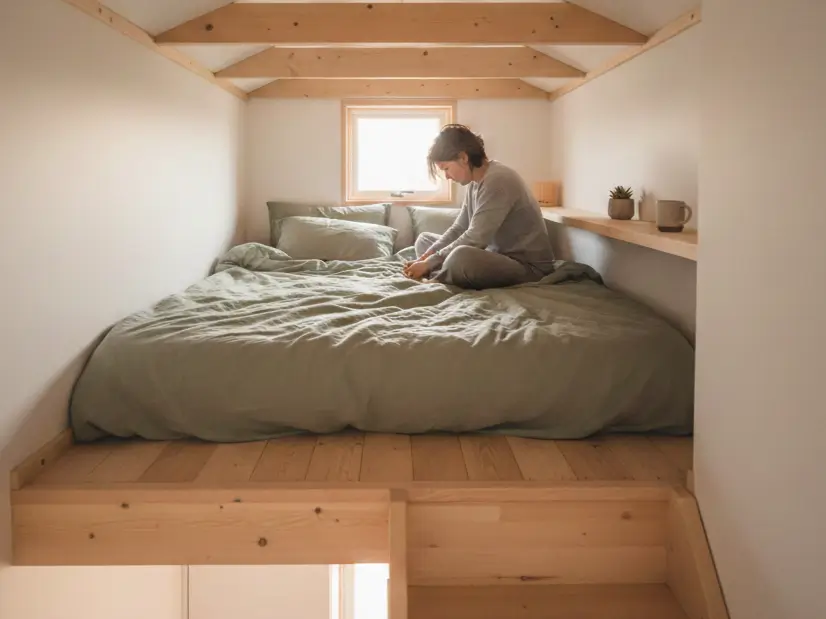
I learned this the hard way. Early in my design career, I focused entirely on aesthetics. I didn’t account for the fact that 300 square feet of air volume heats up four times faster than a standard room. The result? A beautiful loft that was unlivable by 10 AM in July.
Climate specific tiny house design isn’t just about comfort; it’s about survival and structural integrity. Whether you are parking in the humid South or the freezing North, your design choices regarding wall thickness, window placement, and airflow will dictate your daily quality of life.
From DIY retrofits costing $300 to professional $5,000 HVAC installations, let’s look at how to build a home that works with your environment, not against it.
The “Volume Penalty”: Understanding Insulation vs. Space
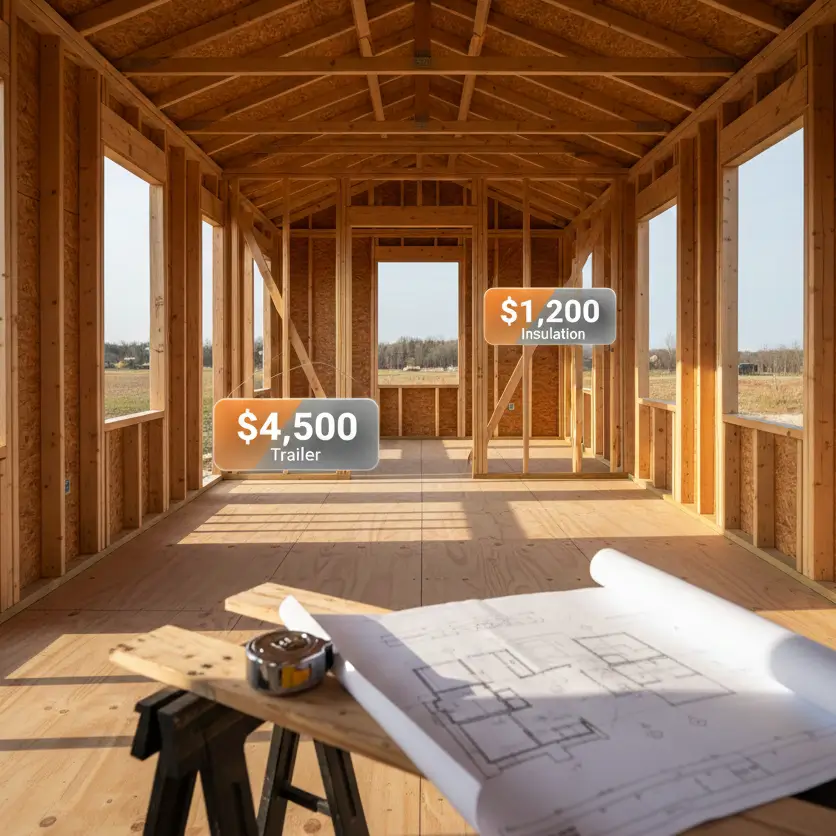
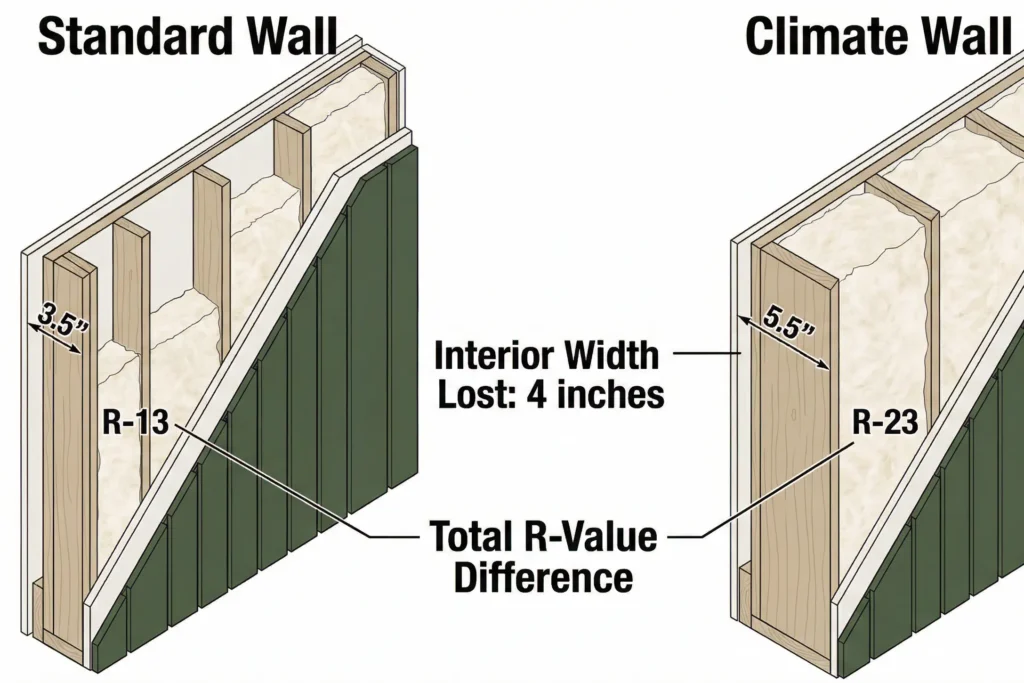
In tiny houses, insulation competes with living space. Increasing wall insulation from R-13 (standard 2×4) to R-23 (2×6 or spray foam) consumes about 4-6 inches of interior width. In an 8.5-foot wide trailer, this reduces usable interior width from ~93 inches to ~89 inches. Balance thermal needs with spatial loss.
The Physics of Small Spaces
In climate specific tiny house design, we have to talk about the building envelope. The “envelope” is the barrier between you and the outdoors, your walls, roof, and floor.
In cold climates (Zones 5-7), you need thick insulation. Standard fiberglass batts in 2×4 framing give you roughly R-13. That is often insufficient for a tiny house on wheels (THOW) because air circulates under the floor, sapping heat faster than a slab foundation would.
If you move to 2×6 framing to get R-19 or R-23, you lose 2 inches on every wall. In a 24-foot long tiny house, that’s roughly 4 square feet of floor space gone. It doesn’t sound like much, but that’s the size of a utility closet or a small pantry.
The Solution: Closed-cell spray foam.
I recommend closed-cell foam for almost every tiny build. It offers the highest R-value per inch (roughly R-6.5 per inch).
- 2×4 Wall with Fiberglass: ~R-13 (Costs ~$0.80/sq ft)
- 2×4 Wall with Closed Cell Foam: ~R-23 (Costs ~$3.00/sq ft)
By using better materials, you keep the thinner walls (saving space) while hitting the thermal performance of a much thicker wall. For a deep dive on these materials, check our tiny house insulation guide.
Note on Bridges: Wood studs conduct cold. If you are building in extreme cold (Alaska, Minnesota), consider a “thermal break”, a layer of continuous rigid foam over the studs before siding. It adds thickness but stops the “zebra striping” of cold spots on your walls.
Managing Moisture in Humid Climates
Small spaces accumulate humidity rapidly from breathing, cooking, and showering. In humid climates, prioritize a Mini-Split with a “Dry Mode” and an Energy Recovery Ventilator (ERV). Aim to keep indoor humidity between 30-50%. Budget $150-$400 for a quality ERV system.
The Mold Equation
If you are designing for the Pacific Northwest or the humid South, moisture is your enemy. In a 300 sq ft house, boiling a pot of pasta can raise the relative humidity by 15% in ten minutes.
If your walls are well-insulated but your ventilation is poor, that moisture condenses on the coldest surface, usually your windows or the corners of the loft. Over time, this rots your framing from the inside out.
Ventilation Systems
You cannot rely on cracking a window.
- Spot Ventilation: High-CFM fans in the tiny house kitchen design and bathroom are mandatory. Look for fans rated at least 50 CFM (Cubic Feet per Minute) that are quiet (under 1.5 sones) so you actually use them.
- Whole House Exchange: For tight builds, install a Lunos e2 or similar through-wall ERV. These systems swap stale indoor air for fresh outdoor air while transferring the heat (or cool) energy, so you don’t lose your climate conditioning.
Specific Recommendation:
If you are in a hot/humid zone, avoid vinyl wallpaper or impermeable interior paints. Your walls need to “breathe” slightly to release trapped vapor. See our guide on bathroom paint moisture solutions for the right products to seal drywall without trapping rot.
Passive Solar and Window Placement
Passive solar design uses window placement to heat your home for free. South-facing windows capture winter sun; overhangs block summer sun. In a tiny house, keep total glazing under 15% of floor area to prevent overheating. Budget: $0 (design phase) to $300 (exterior shades).
Orientation Matters
If your tiny house is on wheels, you have a superpower: you can rotate your house.
- Winter: Point your largest windows South. The low winter sun penetrates deep into the room, warming your floor.
- Summer: Park under deciduous trees or deploy awnings.
However, glass is a terrible insulator (even the expensive stuff). A generic double-pane window is roughly R-3. A solid wall is R-20.
The Goldilocks Ratio:
In small spaces, massive walls of glass look amazing on Instagram but feel terrible in January. I suggest limiting large windows to one primary wall and using smaller, strategic windows for cross-ventilation elsewhere.
Check out our tiny house windows and doors guide for U-factor ratings (the measurement of how well a window keeps heat in). In cold climates, you want a U-factor of 0.30 or lower.
Heating and Cooling Systems: What Fits?
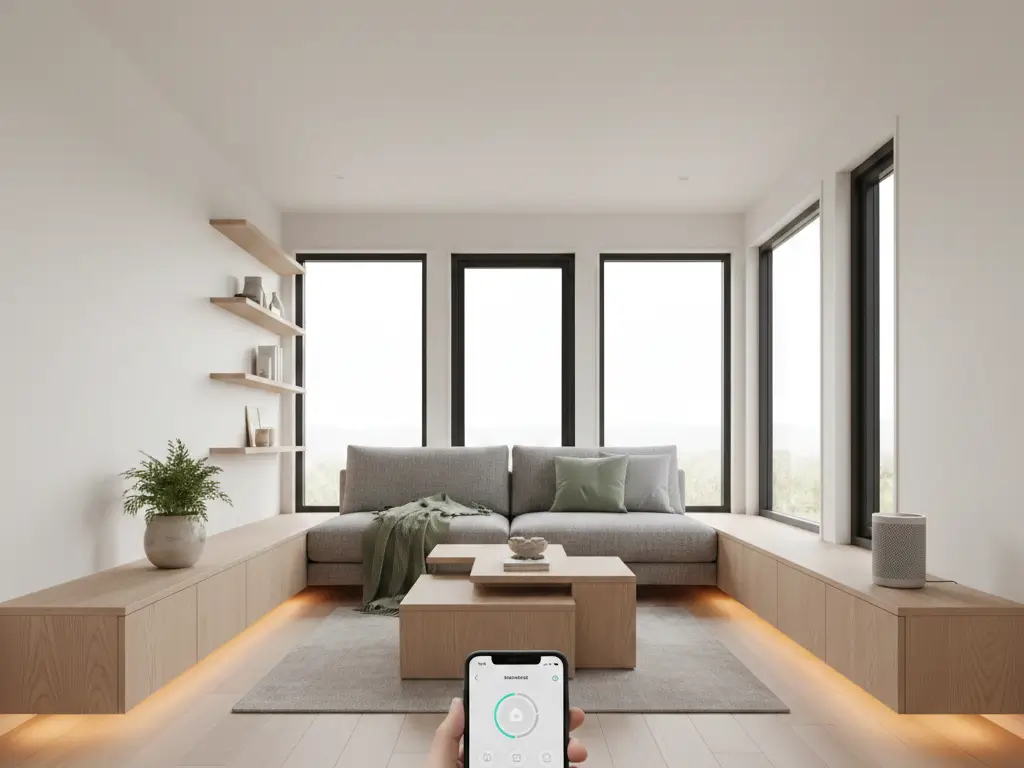
A 9,000 BTU mini-split is the standard for <400 sq ft, handling both heating and cooling efficiently (SEER 20+). For off-grid or extreme cold, add a backup cubic mini wood stove (3kW output). Budget: Mini-split ($800 DIY – $2,500 Pro); Wood stove ($800 – $1,500).
Option A: Mini-Splits (The Standard)
The ductless mini-split is the king of tiny house heating and cooling. It sits high on the wall, saving floor space.
- Pros: High efficiency, controls humidity, acts as AC and Heater.
- Cons: Requires electricity (hard for off-grid), looks plastic/bulky.
- Sizing: Do not oversize. A 12,000 BTU unit in a 200 sq ft house will “short cycle”, turning on and off rapidly, which fails to dehumidify the air and wears out the compressor. A 6,000 or 9,000 BTU unit is usually perfect.
Option B: Wood Stoves (The Romance)
Small cubic wood stoves are popular for aesthetics and dry heat.
- Pros: excellent for drying out damp clothes, off-grid friendly, cozy.
- Cons: Requires clearances (combustible zones) that eat up floor space. You need about 3×3 feet of clearance zone, even with heat shields.
- Space Tip: If you choose wood, integrate the wood storage into the hearth design. Vertical storage niches keep the floor clear.
Option C: Radiant Floor Heating
Electric radiant mats under the floor are luxurious but inefficient as a primary heat source in poorly insulated homes. They are best used in the tiny house bathroom design to keep toes warm, rather than to heat the air volume.
Flooring and Thermal Mass
Thermal mass (stone, tile, concrete) absorbs heat during the day and releases it at night. In tiny houses, weight is a concern. Use lightweight slate tile or dense engineered wood near south-facing windows to act as a heat battery without overloading the trailer axles.
The Weight vs. Warmth Debate
In a stationary foundation home, a concrete floor is a perfect heat battery. In a THOW (Tiny House on Wheels), concrete is too heavy.
If you are stationary, pouring a slab is smart. If you are mobile, you have to be clever.
- Cork Flooring: Excellent insulator, warm to the touch, lightweight. It doesn’t store heat well, but it stops the cold from seeping up from the trailer chassis.
- Engineered Hardwood: Stable in fluctuating humidity. Solid wood can warp drastically in the intense climate swings of a tiny house.
Refer to our tiny house flooring options for weight calculations. Remember, every pound of flooring counts against your towing limit.
Exterior Colors and Roofing
Roof color significantly impacts internal temperature. In hot climates, a white or “cool roof” (high reflectivity) can lower roof surface temperature by 50°F. In cold climates, dark metal roofs assist snow melt. Cost difference is negligible; choice is aesthetic and functional.
The “Cool Roof” Strategy
I once measured the ceiling temperature of two identical sheds in Texas. One had a black shingle roof; the other had a white metal roof. The interior ceiling of the black-roofed shed was 18°F hotter.
In a tiny house where your head is often 12 inches from the ceiling in a loft bedroom, that heat transfer is brutal.
- Hot Climates (AZ, FL, TX): Use Galvalume (silver) or white painted metal roofing. It reflects solar radiation.
- Cold Climates (VT, CO, MT): Darker colors (Matte Black, Charcoal) help absorb winter sun to melt snow loads, reducing weight on the structure.
For painting the exterior siding, consider durability. Tiny houses endure hurricane-force winds (when towing) and road grit. Use high-quality exterior paints like those mentioned in our paint brands for small spaces guide to prevent chipping.
Comparison: Zone-Specific Design Cheat Sheet
Here is how I adjust designs based on where the client intends to park.
| Feature | Zone: Hot & Humid (Florida) | Zone: Cold & Dry (Montana) | Zone: Marine (Seattle) | Small Space Impact |
| Insulation | R-15 Walls (Radiant Barrier essential) | R-23+ Walls (Focus on air sealing) | R-19 Walls (Vapor permeability key) | Cold zones lose ~4″ interior width to insulation. |
| Windows | Low SHGC (blocks heat), shaded North side | High SHGC (allows heat), South side focus | Low U-Value, large overhangs for rain | Large overhangs may require setup/takedown for travel. |
| HVAC | Dehumidifier + AC (Mini-split) | Wood Stove + Mini-split (Heat pump) | Diesel heater or Mini-split | Wood stoves require ~9 sq ft of floor clearance. |
| Roof | White/Reflective Metal | Dark Metal with steep pitch | Metal with rain gutters | Steep pitch increases loft headroom but increases drag. |
Future-Proofing Your Tiny Home
Climate specific tiny house design is the difference between a novelty structure and a long-term home. It requires you to accept that you cannot have walls of glass in the desert without paying a heavy price in energy and comfort.
By investing in the “boring” stuff, closed-cell insulation, proper orientation, and appropriately sized mechanical systems, you buy yourself freedom. You spend less money on propane or electricity and less time battling mold or drafts.
- Are you traveling or stationary? If traveling, build for the “worst-case” scenario (usually extreme cold).
- decide if you are willing to sacrifice 6 inches of width for R-23 insulation.
- ensure your heating source doesn’t block your flow. Check our tiny house layout floor plan ideas to see how others solved this.
Building a tiny house is a game of inches. Building a climate-resilient one is a game of foresight.