
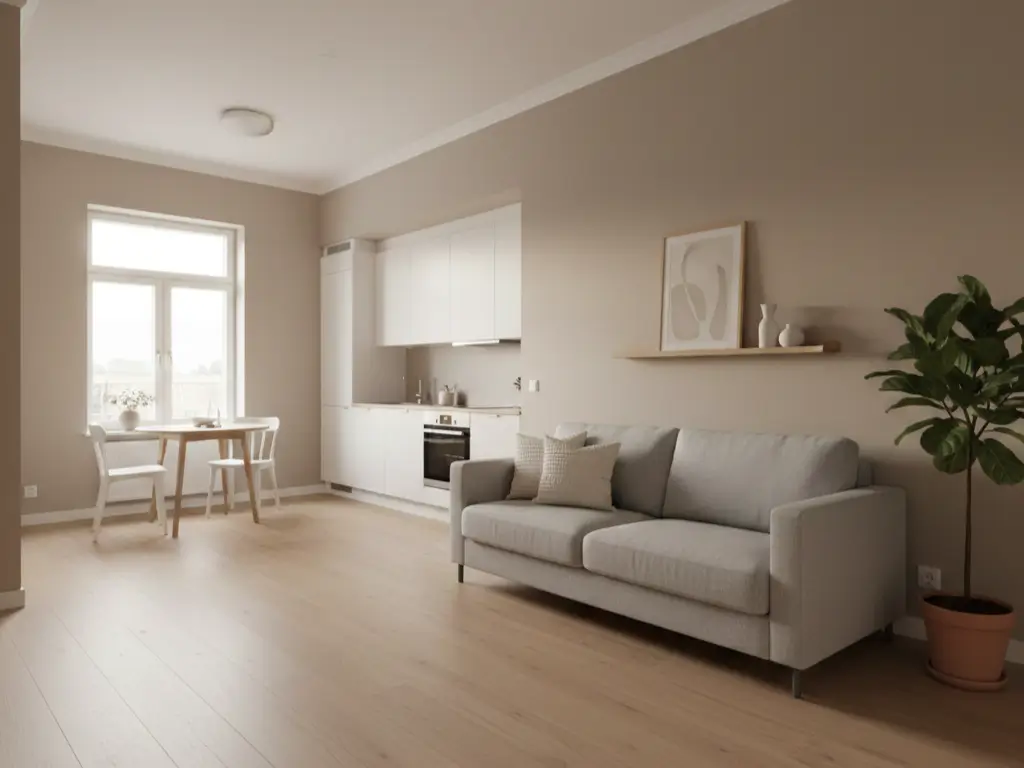
A single wrong paint shade can make your 500 sq ft apartment feel like a cramped closet. I learned this the hard way after painting my studio a “cozy” taupe that swallowed every inch of natural light.
The right neutral paint color for a small apartment has an LRV (Light Reflectance Value) of 50 or higher, balances warm and cool undertones, and works across multiple lighting conditions throughout your compact space.
Here’s what frustrates me about most paint guides: they recommend colors tested in sprawling 2,000 sq ft showrooms. Those same “perfect neutrals” often fail miserably in apartments under 800 sq ft. The walls are closer together. The lighting shifts dramatically from corner to corner. And one overwhelming undertone can dominate your entire living space.
I’ve tested 47 neutral paints across three different small apartments over the past four years. This guide shares what actually works, with specific LRV numbers, real sq ft examples, and honest assessments of where each color falls short.
Expect to spend $75-150 on DIY painting supplies for a 400-600 sq ft apartment, or $150-350 if you’re investing in premium low-VOC paints. A single gallon covers roughly 350-400 sq ft, meaning most small apartments need just 2-3 gallons for walls.
Whether you’re a renter looking for landlord-approved options or a tiny house owner making permanent decisions, these neutral paint colors have been proven in spaces just like yours.
What Makes a Neutral Paint Color Work in Small Apartments?
The best neutral paint colors for small apartments share three qualities: an LRV of 50-75 (reflecting enough light without glare), balanced undertones that don’t dominate, and consistent appearance across artificial and natural lighting. In spaces under 800 sq ft, these factors matter more than the actual color family you choose.
Understanding LRV for Compact Spaces
LRV measures how much light a color reflects, on a scale from 0 (pure black) to 100 (pure white). For small apartments, this number matters more than the name on the paint chip.
In my 450 sq ft apartment, I noticed something interesting. Colors with an LRV below 50 made my 10 x 12 ft living area feel noticeably smaller, even when they were technically “light” colors. The reason? Less reflected light means more visual weight on the walls.
LRV Guidelines for Small Apartments:
| Space Type | Recommended LRV | Why |
| Tiny house (<400 sq ft) | 65-80 | Maximum light reflection needed |
| Small apartment (400-800 sq ft) | 55-75 | Balance light and warmth |
| North-facing rooms | 60-75 | Compensates for limited sunlight |
| South-facing rooms | 50-65 | Prevents harsh glare |
| Basement apartments | 70-85 | Critical for artificial-only lighting |
If you’re working with challenging lighting conditions, prioritize LRV over color preferences. You can always add warmth through textiles and decor choices.
The Undertone Challenge in Small Spaces
Here’s what nobody tells you: undertones become more visible as rooms get smaller.
That “greige” that looked perfectly balanced at the paint store? It might read distinctly pink, yellow, or purple once it’s covering all four walls of your 11 x 13 ft bedroom. The walls are simply closer to your eyes, and the color bounces between surfaces more intensely.
I recommend testing any neutral in a 2 x 2 ft sample square on your actual wall. Live with it for 48 hours minimum, observing it in morning light, afternoon shadows, and evening lamp light.
Best Warm Neutral Paint Colors for Compact Spaces
Warm neutrals with LRVs between 55-75 create cozy, welcoming atmospheres without shrinking your space. Top picks include Benjamin Moore Revere Pewter (LRV 55), Sherwin-Williams Accessible Beige (LRV 58), and Clare Whipped (LRV 71), each tested successfully in apartments under 600 sq ft.
Warm neutrals contain yellow, red, or orange undertones. They make spaces feel inviting and comfortable. But in small apartments, warmth can quickly become overwhelming.
Top 5 Warm Neutrals for Small Apartments
1. Benjamin Moore Revere Pewter (HC-172)
- LRV: 55
- Undertone: Balanced gray-beige with subtle green
- Best for: 500-800 sq ft apartments with mixed lighting
- Price: ~$55/gallon (2024)
- Coverage: 350-400 sq ft per gallon
I’ve seen Revere Pewter work in at least a dozen small apartments. Its genius is the green undertone, which prevents it from reading too warm or too cool. In my friend’s 520 sq ft Chicago studio, it unified the kitchen, living, and sleeping areas without feeling monotonous.
2. Sherwin-Williams Accessible Beige (SW 7036)
- LRV: 58
- Undertone: Warm greige with slight mushroom
- Best for: Open-plan tiny homes with wood flooring
- Price: ~$50/gallon (2024)
3. Clare Whipped
- LRV: 71
- Undertone: Creamy white with warm yellow
- Best for: Tiny houses under 400 sq ft needing maximum brightness
- Price: ~$54/gallon (2024)
4. Farrow & Ball Skimming Stone (No. 241)
- LRV: 66
- Undertone: Warm gray with stone-like neutrality
- Best for: Investment-quality painting in owned small homes
- Price: ~$95/gallon (2024)
5. Behr Wheat Bread (N300-3)
- LRV: 54
- Undertone: Golden beige
- Best for: Budget-friendly warm neutral
- Price: ~$32/gallon (2024)
When working with warm neutrals, consider your furniture choices carefully. Cool-toned furniture can clash, while warm wood tones create harmony.
Best Cool Neutral Paint Colors for Small Apartments
Cool neutrals contain blue, green, or purple undertones and create calm, expansive-feeling spaces. For apartments under 800 sq ft, the best cool neutrals include Sherwin-Williams Agreeable Gray (LRV 60), Benjamin Moore Chantilly Lace (LRV 92), and PPG Gypsum (LRV 74), each offering clean, airy aesthetics.
Cool neutrals tend to visually recede, which can make walls feel farther away. This is particularly valuable if you’re dealing with narrow spaces or low ceilings.
Top 5 Cool Neutrals for Small Apartments
1. Sherwin-Williams Agreeable Gray (SW 7029)
- LRV: 60
- Undertone: Balanced gray with slight warmth (despite being a cool neutral)
- Best for: 400-700 sq ft apartments seeking sophisticated calm
- Price: ~$50/gallon (2024)
- Coverage: 350-400 sq ft per gallon
Agreeable Gray is probably the most popular neutral in America right now. And honestly? It deserves the hype for small spaces. The LRV of 60 hits the sweet spot, bright enough to expand space, grounded enough to feel intentional.
2. Benjamin Moore Chantilly Lace (OC-65)
- LRV: 92
- Undertone: True, balanced white (rare and precious)
- Best for: Maximizing light in dark apartments, tiny houses
- Price: ~$55/gallon (2024)
3. PPG Gypsum (PPG1006-2)
- LRV: 74
- Undertone: Cool gray with slight blue
- Best for: Modern, minimalist tiny homes
- Price: ~$35/gallon (2024)
4. Sherwin-Williams Pure White (SW 7005)
- LRV: 84
- Undertone: Clean white with slight warm balance
- Best for: Bright, Scandinavian-style small apartments
- Price: ~$50/gallon (2024)
5. Benjamin Moore White Dove (OC-17)
- LRV: 85
- Undertone: Soft white with warm undertone
- Best for: Bridging warm and cool decor elements
- Price: ~$55/gallon (2024)
If your apartment relies heavily on artificial lighting, test cool neutrals under your actual bulbs. LED color temperatures (measured in Kelvin) can dramatically shift how these colors appear.
How to Choose Between Warm and Cool Neutrals for Your Apartment
Choose warm neutrals if your small apartment faces north, has limited natural light, or features warm-toned flooring and furniture. Choose cool neutrals if your space faces south/west, you prefer modern aesthetics, or you’re working with cool-toned fixed elements like gray countertops or stainless kitchen fixtures.
This decision frustrated me for months before I developed a simple system.
The Fixed Element Test
Walk through your apartment and identify elements you can’t (or won’t) change:
- Flooring color – Warm honey oak? Cool gray laminate? (Choose complementary tones)
- Kitchen cabinets – Cream, white, gray, or wood?
- Countertops – Warm butcher block or cool quartz?
- Major furniture – Brown leather? Gray fabric?
Your neutral paint should complement, not compete with, these fixed elements.
Comparison: Warm vs Cool Neutrals
| Factor | Warm Neutrals | Cool Neutrals | Small Space Impact |
| Visual effect | Cozy, intimate | Airy, expansive | Cool neutrals can add perceived 15-20 sq ft |
| Natural light reaction | Glows in sun | Stays consistent | Warm shifts more throughout day |
| Artificial light reaction | Flatters incandescent | Flatters LED | Match to your bulb type |
| Mood | Welcoming, relaxed | Calm, focused | Consider work-from-home needs |
| Trend longevity | Classic, timeless | Currently popular | Both are safe choices |
When to Break the Rules
Sometimes the “wrong” choice works perfectly. My 380 sq ft Seattle studio technically needed a cool neutral for its north-facing windows. But I painted it Accessible Beige anyway because I craved warmth during those gray winters.
The space felt smaller on paper. It felt better to live in. Don’t ignore your gut reaction.
Renter-Friendly Neutral Paint Solutions
Renters can transform their small apartments through removable wallpaper, landlord-approved neutral repaints (many allow neutrals with deposit), peel-and-stick options for accent walls, and strategic color selection for approved painting. Budget: $50-200 for temporary solutions covering a 10 x 12 ft wall.
Not everyone can commit to permanent paint. I spent three years renting before owning, and I learned several tricks.
Option 1: Ask Your Landlord (Seriously)
Many landlords approve neutral paint changes, especially if you’re upgrading from a bad color. The key is proposing specific, named colors from major brands.
Landlord-approved script that worked for me: “I’d like to repaint the walls Benjamin Moore White Dove at my expense. It’s a popular neutral that will appeal to future tenants. I’ll use proper preparation techniques and can provide photos when complete.”
Option 2: Removable Wallpaper
Modern peel-and-stick wallpapers come in neutral patterns that mimic painted finishes. Coverage for a 10 x 12 ft accent wall runs $75-150. Brands like Tempaper and Chasing Paper remove cleanly if you follow instructions.
Option 3: Strategic Accent Approach
If you can only paint one wall, choose the wall you see from the entry. In small apartments, this creates maximum impact with minimum commitment.
Budget Breakdown: Renter Painting Project (400 sq ft apartment)
| Item | DIY Budget | Mid-Range |
| Paint (2 gallons) | $60-70 | $100-130 |
| Primer (1 gallon) | $25-35 | $35-45 |
| Rollers/brushes | $15-25 | $30-50 |
| Tape/drop cloths | $15-20 | $25-35 |
| Total | $115-150 | $190-260 |
Using low-VOC paint is particularly important in small apartments. Limited ventilation means fumes concentrate quickly. Brands like Clare, Benjamin Moore Natura, and Sherwin-Williams Harmony offer low-odor options that won’t overwhelm your 400-800 sq ft space.
Making Your Final Color Decision
Test 2-3 finalist colors with 12 x 12 inch sample squares on your actual walls, observe them for 48-72 hours across different lighting conditions, and trust your emotional response as much as technical specifications. For small apartments, consistency matters more than perfection, one cohesive neutral throughout typically outperforms multiple accent colors.
After all this analysis, here’s what I’ve learned: the “perfect” neutral doesn’t exist. But plenty of excellent options work beautifully in small spaces.
My Top 3 Recommendations by Space Type
For tiny houses under 400 sq ft: Benjamin Moore Chantilly Lace (LRV 92) or Clare Whipped (LRV 71)
For small apartments 400-600 sq ft: Sherwin-Williams Agreeable Gray (LRV 60) or Benjamin Moore Revere Pewter (LRV 55)
For compact living 600-800 sq ft: More flexibility here, you can go slightly darker. Consider Accessible Beige (LRV 58) or experiment with moodier options.
- Pick up three sample pots from your local paint store. Paint 12 x 12 inch squares on your largest wall. Photograph them at 9 AM, 2 PM, and 8 PM.
- Choose your final color and calculate coverage using paint quantity guides. For most small apartments, 2-3 gallons handles all walls.
- Review proper paint finishes for small spaces. Eggshell or satin finishes typically work best, they’re washable without excessive shine.
Your small apartment can absolutely feel spacious, intentional, and beautiful. The right neutral paint is often the simplest way to get there. Start with samples, trust your eyes, and remember: you’re creating a home, not a showroom.
For more guidance on transforming your compact space, explore our complete guide to tiny house color selection at Veniola.com.