
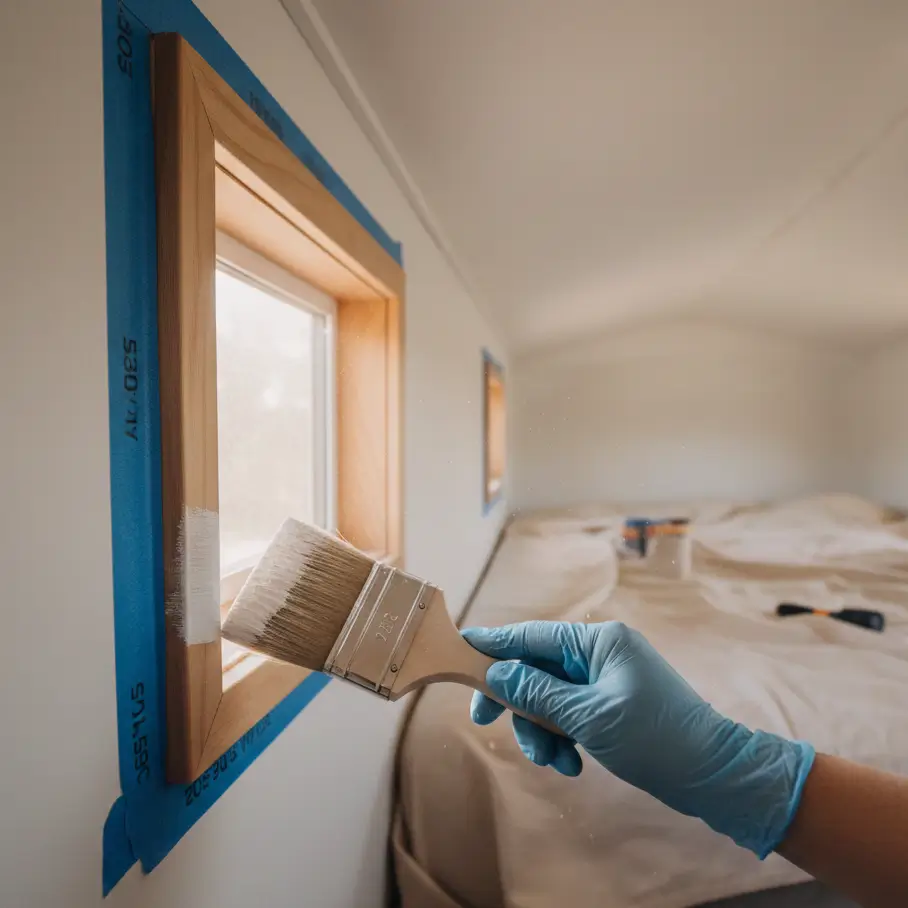
There is a rule in small space design I call the “Proximity Factor.” In a standard 2,500-square-foot suburban home, you might look at a wall from across a 20-foot living room. In a tiny house or 400-square-foot apartment, you are rarely more than three feet away from any vertical surface.
When walls are this close, texture matters. Flaws are magnified. The decision of spray vs brush vs roller for tiny house interiors isn’t just about speed, it’s about the finish you see inches from your face every day.
For occupied tiny houses, high-quality rollers and brushes are superior due to lower setup time, zero dangerous aerosolized fumes in small volumes, and easier cleanup. Spraying is only recommended for empty shells during the initial build or specifically for cabinetry where a glass-smooth finish is required.
In this guide, I’ll break down the math, the mess, and the finish quality of each method specifically for spaces under 600 square feet.
The Logistics of Painting Small Spaces
Painting a tiny house presents unique challenges: ventilation, furniture displacement, and “elbow room.” While spraying is faster (15 minutes per coat for 300 sq ft), masking takes 4+ hours. Rolling takes 2 hours per coat but only 30 minutes of prep. For spaces under 800 sq ft, rolling usually wins on total project time.
The “Furniture Tetris” Problem
In a standard home, you move furniture to the center of the room and cover it. In a tiny house, there is no center of the room.
- Spraying: Requires an empty room. Overspray drifts everywhere. You have to move everything out or wrap your entire life in plastic.
- Rolling/Brushing: You can work one wall at a time, shifting furniture just a few feet.
I once tried to spray a 340 sq ft studio without moving the sofa. Despite taping plastic sheeting everywhere, I found a fine mist of “Naval Blue” dust on the kitchen counter 15 feet away. The aerosolization in a small volume is intense.
Air Quality and Safety
This is critical. Spraying atomizes paint into the air. In a confined volume of 2,500-3,000 cubic feet (typical tiny house), the concentration of fumes and particulates skyrockets instantly.
- Spraying: Mandatory respirator. You must vent the space aggressively, which is hard if you have few windows.
- Rolling: Lower airborne particulates. If you choose low VOC paint for tiny houses, you can sleep in the loft the same night.
The Paint Sprayer
Best for empty shells (new builds) or cabinetry.
- Budget: $150-$400 (Handheld HVLP or Airless)
- Coverage: Fast, but uses 20-30% more paint due to overspray.
- Finish: Glass-smooth, factory-like.
When to Spray in a Tiny House
If you are in the build phase and the house is an empty shell, spray it. You can coat the entire interior (walls, ceiling, loft underside) in under two hours. The finish is flawless, which helps reflect light in tight corners.
However, for renovations or occupied spaces, spraying is aggressive.
- Prep Time: Masking windows, floors, and loft railings takes 3x longer than the painting itself.
- Tool Storage: A Graco Magnum X5 is roughly 15x12x15 inches. Where do you store that in a tiny house after the job? Handheld units (like Wagner) are smaller but heavier to hold.
- Clean Up: Cleaning a sprayer requires flushing gallons of water or solvent. Do you have a large enough sink or outdoor space for this? Doing this in a tiny RV sink is a nightmare.
Note: If you are tackling built-ins, check our guide on tiny house kitchen design. Spraying cabinet doors outside (then reinstalling) is the pro move.
The Roller (Microfiber & Foam)
Best for walls and ceilings in occupied spaces.
- Budget: $30-$60 (Frame, pole, tray, sleeves)
- Coverage: Efficient. A gallon covers ~350-400 sq ft.
- Finish: Slight “stipple” (orange peel) texture, depending on nap size.
Optimizing the Roll for Small Spaces
Because you are looking at the walls up close, you want to minimize texture. Standard 1/2-inch nap rollers leave too much texture for a small room, it can make walls feel like they are closing in.
- Recommendation: Use a 3/8-inch or 1/4-inch microfiber roller cover. Microfiber holds more paint than foam but leaves a smoother finish than standard woven covers.
- The Pole: Get a telescoping extension pole (2-4 ft). Even in a tiny house with 8ft ceilings, the pole gives you leverage and saves your back. It’s vital for painting tools in tight spaces.
The Storage Advantage
A roller frame, two covers, and a collapsible tray fit in a shoebox. For a minimalist or van-lifer, this is the only logical choice for long-term maintenance.
The Brush
Best for trim, corners, and touch-ups.
- Budget: $15-$25 per high-quality brush.
- Coverage: Slow. Not for broad surfaces.
- Finish: Visible brush strokes unless you use additives (Floetrol).
The “Cutting In” Reality
In a tiny house, you have a higher ratio of edges to wall space. You have window frames, loft joists, built-in shelving, and wheel well boxes. You will spend 50% of your time with a brush in your hand, regardless of whether you roll or spray the middle parts.
Invest in a 2.5-inch angled sash brush (nylon/polyester blend). The angle allows you to get sharp lines at the ceiling without using painter’s tape, saving money and waste.
The “Tiny House” Scorecard
Rolling wins on logistics; Spraying wins on finish quality.
For a 300 sq ft tiny house with a loft, here is how the numbers break down:
| Feature | Paint Sprayer | Roller & Brush | Small Space Impact |
| Speed (Total) | 6-8 Hours (mostly prep) | 4-5 Hours (mostly painting) | Rolling is faster for one room. |
| Paint Used | 1.5 – 2 Gallons | 1 – 1.25 Gallons | Spraying wastes paint (costly). |
| Finish Quality | 10/10 (Smooth) | 7/10 (Light Texture) | Smooth walls feel “lighter.” |
| Tool Storage | bulky box | Shoebox size | Vital for <400 sq ft living. |
| Air Quality | Hazardous (Aerosol) | Manageable | Ventilation is hard in tiny homes. |
If you are worried about the cost of wasted paint during spraying, review our paint budget cost analysis.
Hybrid Approach: The Professional Compromise
Combine methods for the best ROI. Spray the cabinetry; roll the walls.
Here is the workflow I recommend for most tiny house owners:
- Spray the Removables: Take all cabinet doors, drawer fronts, and loose shelving outside. Spray them with a handheld HVLP sprayer or rattle cans (high quality). This gives you that durable, factory finish on the surfaces you touch most.
- Roll the Shell: Inside the house, use a high-quality microfiber roller for the walls and ceiling. The slight texture on the walls is forgiving, it hides dings and scratches that happen frequently in tight quarters.
- Brush the Details: Use an artist’s brush for tight spots around tiny house electrical systems or exposed conduit.
Texture vs. Durability
In a hallway that is only 36 inches wide, your shoulders or bags will brush the walls. A sprayed finish is harder to touch up invisibly. A rolled finish has a texture that blends well when you dab a paintbrush over a scuff mark later.
For high-traffic areas, the sheen matters more than the tool. Check out paint finishes for small spaces to decide between eggshell (forgiving) and semi-gloss (durable).
Specific Surface Challenges
1. Loft Ceilings
Painting a loft ceiling where you only have 3 feet of headroom is physically difficult.
- Roller: You can lie on your back and use a short pole. It’s tiring but controlled.
- Sprayer: Trying to spray overhead in a 3-foot clearance loft guarantees you will be covered in paint mist. It also bounces off the ceiling and fills the loft with clouds of paint. Avoid spraying lofts unless the house is empty.
2. T&G Wood Paneling
Many tiny homes use Tongue and Groove wood.
- Brush: You must brush the grooves first, or the roller will bridge over them, leaving gaps.
- Spray: This is the one area where sprayers dominate. They force paint into the grooves instantly. If you have raw wood walls, consider painting wood guides to prep properly.
3. Metal Walls (Container Homes/Buses)
If you are converting a school bus (Skoolie) or shipping container:
- Spray: Almost mandatory for metal to avoid rust streaks and brush marks. Metal shows texture aggressively. Refer to painting metal surfaces for primer specs.
What Should You Buy?
If you live in your tiny house currently: Buy a premium Roller Setup.
The risk of fumes, the hassle of moving furniture, and the difficulty of cleaning a sprayer in a small sink make spraying impractical for occupied tiny homes. The finish difference is negligible to the naked eye if you use a microfiber roller.
If you are building a new tiny house (empty shell): Rent or Buy a Sprayer.
You will save days of labor. You can prime and paint the entire interior in a weekend. Just make sure you back-roll (run a roller over the wet spray) to ensure adhesion.
- Measure your square footage: Don’t guess. Calculate wall area minus windows.
- Choose your weapon: If rolling, buy a 3/8″ microfiber nap.
- Ventilate: Even with rollers, open those windows.
Painting a small space is the highest ROI project you can do. It changes the light, the mood, and the perceived size of the room for under $200.