When I built my first tiny house on wheels, I made a classic rookie mistake. I fell in love with a gorgeous, thick reclaimed oak plank. It looked amazing in the store. But when I did the math, I realized installing it would add nearly 900 pounds to my trailer weight and steal almost an inch of precious headroom in my loft.
In a 2,000-square-foot home, an inch doesn’t matter. In a tiny house where your loft ceiling is already inches from your nose, that inch is everything.
If you are planning a tiny house flooring installation, you have to think differently. You aren’t just looking for style; you are balancing weight, thickness, durability, and moisture resistance, all while trying to keep your budget under control.
Whether you are renovating a 450-square-foot apartment or building a mobile unit from scratch, this guide covers how to get professional results without the professional price tag.
What is the Best Flooring for Tiny Houses? (Weight vs. Durability)
For most tiny houses (under 400 sq ft), Luxury Vinyl Plank (LVP) is the superior choice. It is lightweight (approx. 1.5 lbs/sq ft), thin (4mm-6.5mm), and 100% waterproof. It costs between $2.50 and $4.50 per sq ft. Engineered hardwood is a strong runner-up for aesthetics but requires more maintenance.
The Weight Factor
If you are building on a foundation, weight matters less. But if you are on wheels, every pound counts toward your Gross Vehicle Weight Rating (GVWR).
- Solid Hardwood: Heavy. Can add 2.5 – 3 lbs per sq ft.
- Tile: Very heavy and prone to cracking during transit.
- LVP (Vinyl): Light. Usually 1.5 – 2 lbs per sq ft.
In a 200 sq ft tiny house, choosing LVP over hardwood saves you roughly 200-300 lbs. That is weight you can use for better appliances or personal belongings.
The Headroom Factor
Standard hardwood with a plywood subfloor can eat up to 1.5 inches of vertical space. Floating vinyl floors often come with attached underlayment and might only be 5mm to 7mm thick total. This keeps your transition to the tiny house kitchen design flush and saves headroom.
I generally recommend sticking to flooring that is under 8mm thick for tiny applications.
Preparing Your Subfloor in Tight Spaces
A successful installation relies on a flat subfloor. In small spaces, deviations greater than 3/16-inch over a 10-foot radius can cause planks to separate. Use a long level to check for dips. Fill low spots with a self-leveling compound and sand down high spots before laying the underlayment.
Why Small Spaces are Tricky
In a large room, a slight dip in the floor isn’t noticeable. In a tiny house hallway that is only 36 inches wide, a dip feels like a pothole. You will feel it every time you walk to the bathroom.
Before you buy a single box of flooring, check your subfloor. If you are building a tiny house on wheels, ensure your trailer is perfectly level on jack stands before leveling the subfloor. If the trailer is twisted during installation, your floor will buckle when you move it.
Moisture Barriers and Insulation
If you are in a tiny house on wheels, your floor is exposed to outside air underneath. You need proper insulation.
- Trailer Deck: usually flashing and insulation.
- Subfloor: Plywood or OSB (Oriented Strand Board).
- Vapor Barrier: Essential if your flooring doesn’t have one attached.
- Flooring: The finish layer.
Check out our tiny house insulation guide for deep details on keeping that floor warm in winter. Cold floors are a major complaint in tiny living, so don’t skip the thermal break.
Step-by-Step: Installing Click-Lock Flooring
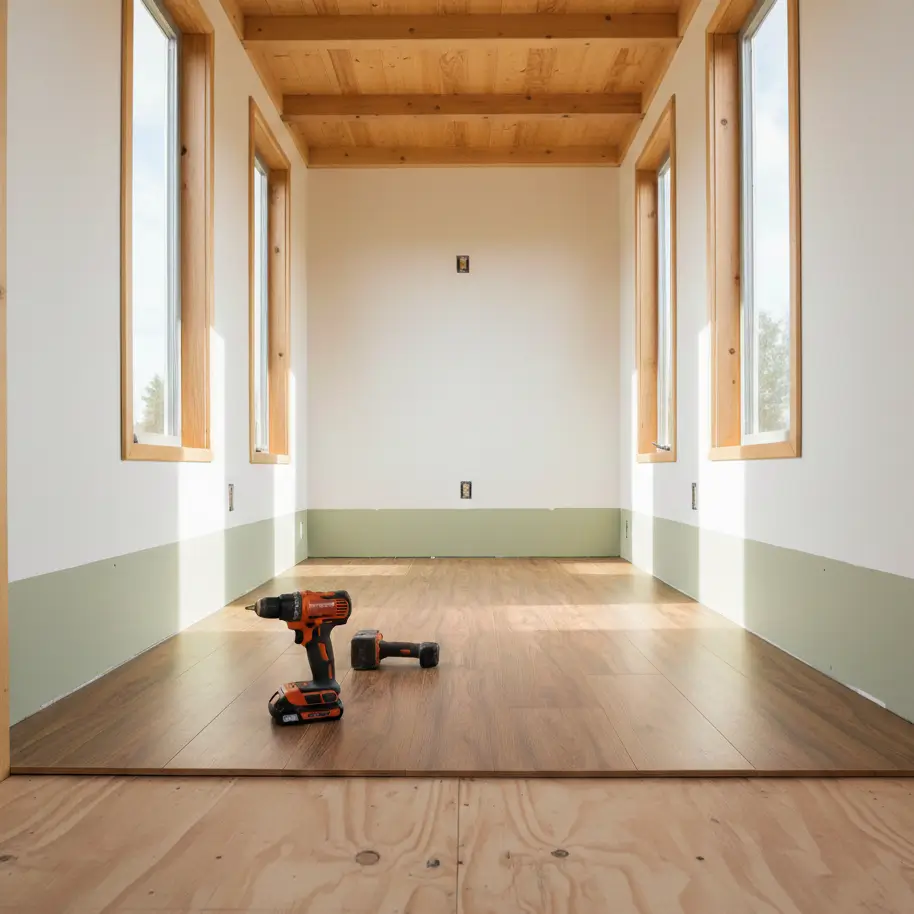
To install click-lock flooring: 1) Undercut door jambs for a clean look. 2) Lay the first row with the “tongue” side facing the wall, using spacers to maintain a 1/4-inch expansion gap. 3) Snap planks together, staggering seams by at least 6 inches. 4) Use a tapping block to close gaps. 5) Install trim to cover the expansion gap.
1. Acclimation is Key
Even vinyl needs to adjust to the temperature of your home. Bring the boxes inside at least 48 hours before you start. Stack them flat, not on their ends. This prevents warping.
2. The First Row (The Hardest Part)
In a tiny house, your walls might not be perfectly square. If you start your first row crooked, the whole floor will be crooked.
- Measure the room width.
- Divide by the width of a plank.
- If the remainder is less than 2 inches, cut the first row of planks narrower. You don’t want the last row to be a tiny sliver of flooring.
3. Dealing with Obstacles
You will likely be working around built-in furniture, wheel wells, or tiny house plumbing systems.
- Jigsaws are your best friend here.
- Make a template out of cardboard for difficult cuts around pipes or wheel well boxes.
- Trace the cardboard onto the plank and cut.
4. The Expansion Gap
This is where most DIYers fail. You must leave a 1/4-inch gap around the perimeter. Tiny structures heat up and cool down faster than big houses. The materials expand and contract. Without that gap, your floor will buckle in the summer. You cover this gap later with baseboards or quarter-round molding.
LVP vs. Engineered Wood vs. Laminate
LVP wins for durability and water resistance ($3/sq ft). Engineered Wood wins for resale value and feel ($6/sq ft) but scratches easier. Laminate is cheap ($1.50/sq ft) but swells if it gets wet, making it risky for tiny homes where the kitchen and bath are close to everything.
| Feature | Luxury Vinyl Plank (LVP) | Engineered Hardwood | Laminate | Small Space Impact |
| Waterproof | 100% | Water Resistant | No | Critical (Spills spread fast in small rooms) |
| Thickness | 4mm – 7mm | 10mm – 15mm | 7mm – 12mm | Thinner = More Loft Headroom |
| Weight | ~1.5 lbs/sq ft | ~2.5 lbs/sq ft | ~2 lbs/sq ft | Lighter = Better Towing |
| DIY Ease | High (Score & Snap) | Medium (Saw required) | High (Saw required) | Easier installation in tight corners |
| Cost | $2.50 – $4.50 | $4.00 – $10.00 | $1.00 – $3.00 | Mid-range budget friendly |
The “Feel” Test
LVP has come a long way, but some people hate the feeling of plastic. If texture is your priority, look for rigid core vinyl. It feels more substantial underfoot.
If you crave real wood, engineered hardwood is a great middle ground. It uses a thin slice of real wood over a plywood core. It handles temperature changes better than solid wood wood materials for tiny houses, but remember, it scratches. If you have a large dog in a 200 sq ft space, those claws will find every inch of that floor.
Tiny House Specific Challenges & Solutions
Small spaces present unique hurdles like wheel wells, multi-purpose zones, and limited cutting space. Solution: Use a guillotine-style laminate cutter indoors to reduce dust. Use transitions strips between the main floor and the bathroom if you change materials to contain water.
No Room to Work
When I floored my 180 sq ft space, I couldn’t exactly set up a chop saw in the living room.
- Tip: Do your cutting outside if possible.
- Tool: If you must work inside, rent or buy a manual flooring cutter (guillotine). It shears the vinyl without creating sawdust. This is huge for keeping your tiny house electrical systems free of dust.
Multi-Functional Moisture
In a regular house, the mudroom is separate from the kitchen. In a tiny house, your entry mat might be your kitchen floor.
- Durability: Choose a flooring with a wear layer of at least 12 mils (20 mils is better for pets).
- Sealing: Even with waterproof flooring, water can seep through the edges at the walls. Caulk the perimeter of the bathroom and kitchen areas with 100% silicone before putting down trim.
See more on protecting wet areas in our tiny house bathroom design article.
Aesthetic Tricks for Small Spaces
To make a small room look bigger, run flooring planks parallel to the longest wall. Use wider planks (7+ inches) to reduce visual clutter from seams. Lighter colors reflect light and make the space feel airy, while darker floors ground the space but require good lighting.
Orientation Matters
If your tiny house is 8 feet wide and 24 feet long, run the planks lengthwise (the 24-foot direction). Running them width-wise creates a “ladder” effect that makes the space feel choppy and shorter.
Color Selection
- Light Oaks/Maples: Hide dust well and open up the space. Great if you have limited tiny house lighting solutions.
- Dark Walnuts/Greys: Create a cozy, intimate vibe but show every speck of dust and dog hair. In a small space, debris accumulates visibly fast.
Continuity
Try to use the same flooring throughout the entire space, including the bathroom and loft (if possible). Breaking up the floor materials chops the visual flow, making the house feel smaller. If you need inspiration on coordinating colors, check our guide on tiny house color selection.
Cost Breakdown: 250 Sq Ft Project
Let’s look at a realistic budget for a DIY installation in a 250 sq ft tiny home (excluding tools).
| Item | Estimated Cost | Notes |
| Flooring (LVP) | $750 – $1,000 | @ $3.00 – $4.00/sq ft (buy 10% extra for waste) |
| Underlayment | $100 – $150 | If not attached to the plank |
| Vapor Barrier | $30 – $50 | 6-mil plastic sheeting |
| Transitions/Trim | $100 – $200 | Quarter round and door bars |
| Consumables | $50 | Spacers, tapping block, blades |
| TOTAL | $1,030 – $1,450 | DIY Cost |
Comparing this to professional installation? Labor for flooring usually runs $2-$4 per sq ft. You save roughly $500-$1,000 by doing it yourself. That savings can go directly toward your tiny house furniture guide budget.
Maintenance and Long-Term Care
Tiny house floors see “concentrated traffic.” In a big house, you might walk on a specific spot in the hallway four times a day. In a tiny house, you pivot on the same spot in front of the sink thirty times a day.
- Rug Pads: Use non-slip rug pads that don’t contain rubber (rubber can discolor vinyl).
- Furniture Pads: Put felt pads on everything. Chairs move constantly in multi-use layouts.
- Cleaning: Use a pH-neutral cleaner. Avoid steam mops on vinyl; the heat can damage the adhesive or warping the planks.
If you scratch a plank, click-lock flooring has a secret benefit: you can un-click the floor back to the damaged board, replace it, and re-lay the floor. It’s annoying, but cheaper than refinishing a whole floor.
Wrap Up
Your tiny house flooring installation sets the stage for everything else in your home. It’s the foundation for your design and the surface you’ll interact with most.
By choosing a lightweight, waterproof option like LVP and taking the time to level your subfloor, you create a space that feels solid, looks spacious, and can handle the rigors of tiny living. Don’t rush the prep work. That 1/4-inch expansion gap and that level subfloor are the difference between a squeaky, buckling mess and a professional finish.
- Measure your space today and calculate your square footage (add 10% for waste).
- Order samples to see how they look in your specific lighting.
- Check your subfloor level before buying the full pallet.
For more details on finishing your interior, explore our tiny house decorating basics or dive into tiny house wall materials to match your new floor.