
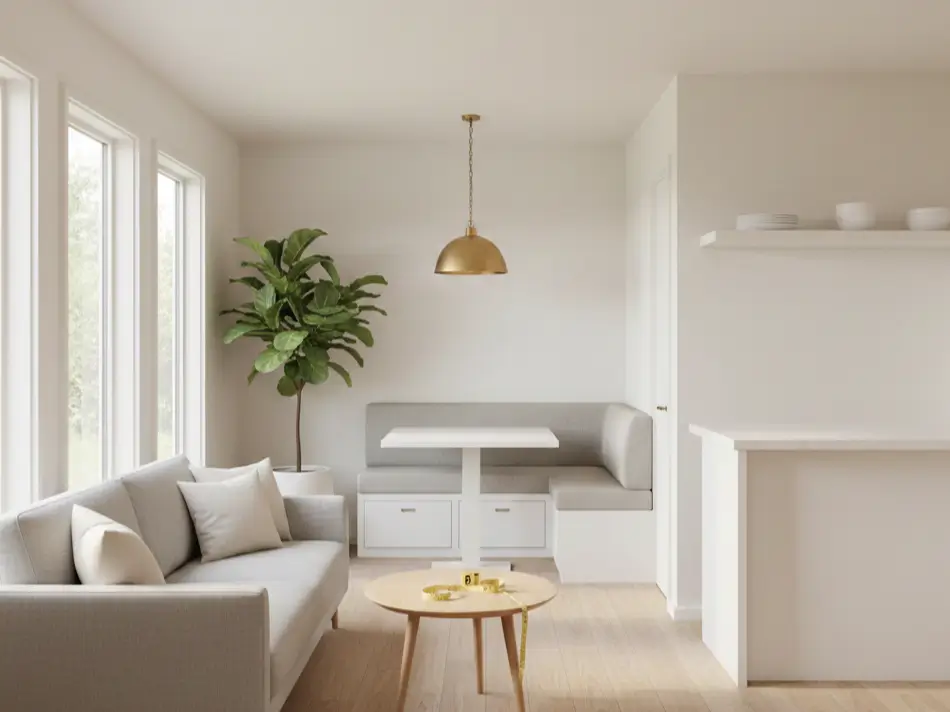
Here’s something that took me years to understand: choosing the wrong aesthetic for a tiny house doesn’t just look bad, it physically shrinks your usable space.
I learned this the hard way in my first 320 sq ft tiny house. After Pinterest-inspired farmhouse purchases (shiplap accent wall, oversized lantern pendants, chunky wood furniture), I’d unintentionally eaten up nearly 15% of my floor space with visual and physical bulk. The style I loved in photos made my home feel cramped and chaotic.
The right tiny house style aesthetic does three things simultaneously: creates visual calm, maximizes functional space, and reflects your personality. The wrong choice forces you to choose between aesthetics and livability.
You’ll learn which styles genuinely work under 500 sq ft, how to adapt trending looks for compact living, and where to invest your limited budget. Expect honest assessments, some popular aesthetics translate beautifully to tiny living, while others belong in 2,000 sq ft homes no matter how much you love them.
Budget range: $150 for DIY styling refreshes to $3,000 for complete aesthetic transformations. Most readers land around $400-800 for a cohesive look.
What Makes a Design Style Actually Work in a Tiny House?
Successful tiny house aesthetics share three characteristics: low visual weight (clean lines, limited patterns), multi-functional pieces, and cohesive color stories. Styles that rely on layering, collections, or oversized statement pieces typically fail in spaces under 400 sq ft, while streamlined aesthetics with intentional negative space make tiny homes feel 15-25% larger.
Before comparing specific styles, you need to understand visual weight. This concept changed everything about how I approach tiny house decorating basics.
The Visual Weight Framework
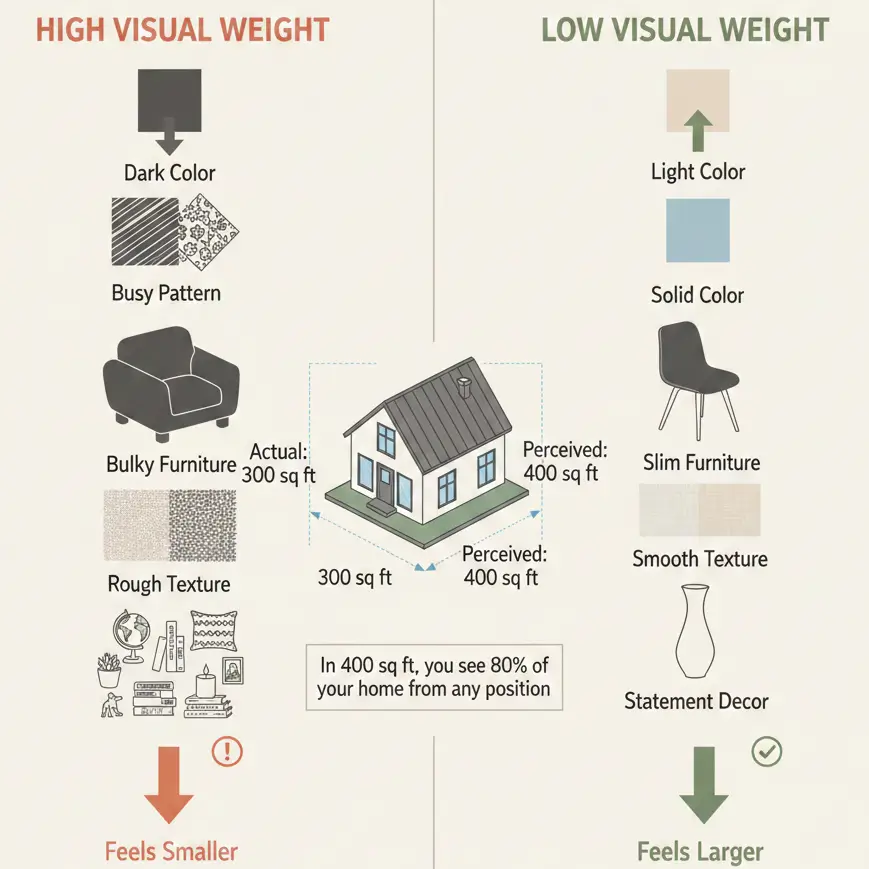
Every design element carries “weight” that your eye processes. Heavy elements include:
- Dark colors (absorb light, advance toward you)
- Busy patterns (demand attention, create chaos)
- Bulky silhouettes (take up physical AND visual space)
- Rough textures (add visual complexity)
- Collections and groupings (multiply visual impact)
Light elements include:
- Pale and mid-tone colors (reflect light, recede)
- Solid colors or subtle patterns (rest the eye)
- Slim profiles and raised furniture (create breathing room)
- Smooth textures (reduce visual noise)
- Curated single pieces (create focal points)
In a 400 sq ft space, you can see approximately 80% of your home from any standing position. Heavy visual elements compound quickly. A 250 sq ft studio with high-visual-weight decor feels suffocating, while the same space with low-visual-weight choices feels open and functional.
This doesn’t mean tiny houses must be sterile or boring. It means choosing your “heavy” moments intentionally. One statement piece? Beautiful. Seven competing statement pieces? Visual chaos.
Your tiny house color selection dramatically impacts visual weight, sometimes more than furniture choices.
7 Best Tiny House Aesthetic Styles (With Honest Small-Space Ratings)
Scandinavian, Japandi, and modern minimalist styles rate highest for tiny houses (9/10), followed by coastal (7/10) and mid-century modern (7/10). Bohemian (5/10) and modern farmhouse (4/10) require significant adaptation and work best in the 600-800 sq ft range rather than true tiny houses.
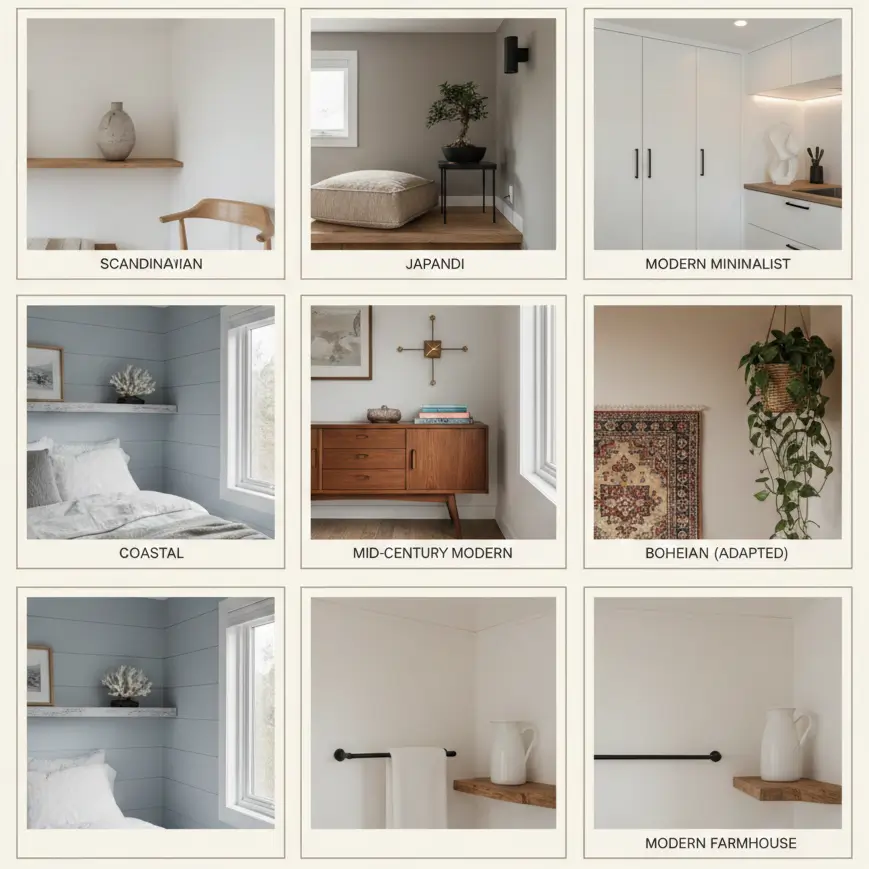
1. Scandinavian (Small-Space Rating: 9/10)
Why it works: Built for small Nordic apartments. Light colors, functional design, and intentional simplicity are core principles, not adaptations.
Key elements for tiny houses:
- White or light gray walls (LRV 70+)
- Blonde wood tones (birch, ash, light oak)
- Furniture with slim legs (creates visual floor space)
- Maximum 3-4 colors total
- Textiles for warmth without bulk
Budget breakdown:
- DIY approach: $200-400 (paint, textile swap, decluttering)
- Mid-range: $800-1,200 (quality sofa, lighting upgrades)
- Investment: $1,500-2,500 (designer pieces, custom storage)
What to skip: Hygge-inspired layering gets heavy fast. In true tiny spaces (under 350 sq ft), limit throw blankets to two and decorative pillows to three.
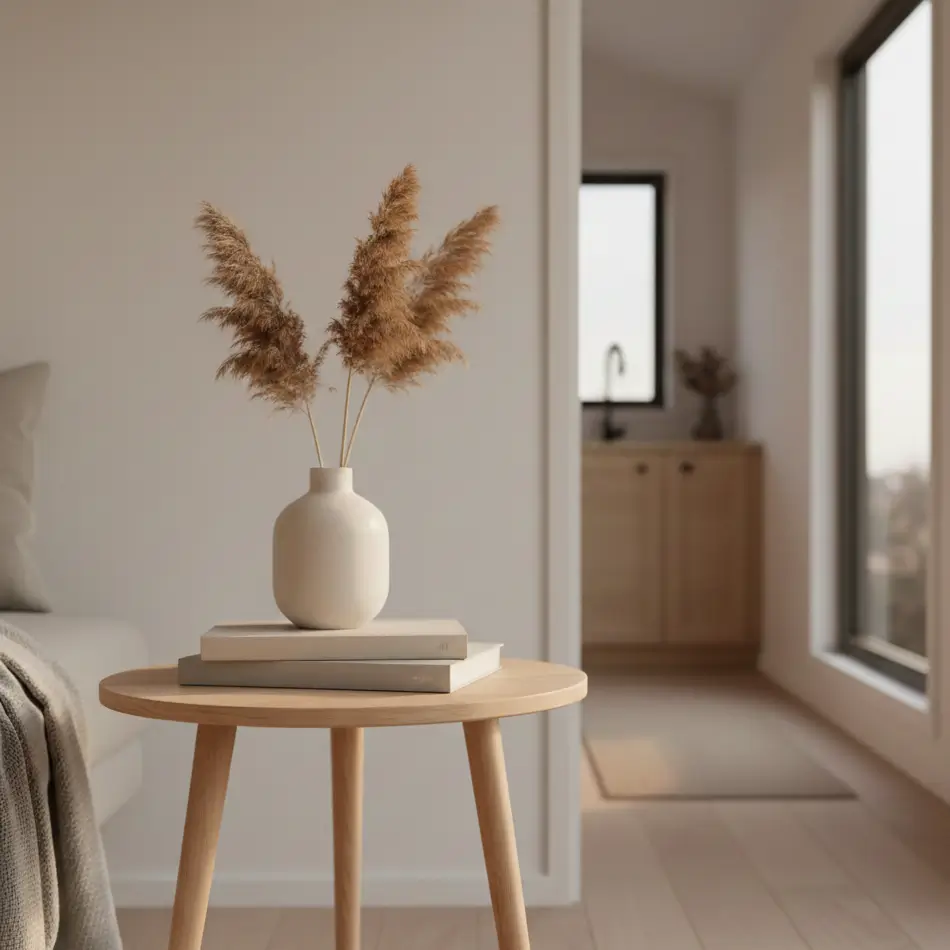
2. Japandi (Small-Space Rating: 9/10)
Why it works: Combines Japanese minimalism with Scandinavian function. The emphasis on negative space (ma) and quality over quantity translates perfectly.
Key elements:
- Warm neutrals with black accents
- Natural materials: wood, stone, ceramic, linen
- Low-profile furniture (reduces visual mass)
- Intentional empty space
- Handcrafted over mass-produced
Budget breakdown:
- DIY: $250-450 (focused on decluttering, thrifted ceramics)
- Mid-range: $900-1,400 (one quality wood piece, lighting)
- Investment: $2,000-3,000 (artisan furniture, natural fiber textiles)
Your tiny house furniture guide covers low-profile pieces that work beautifully for Japandi spaces.
3. Modern Minimalist (Small-Space Rating: 9/10)
Why it works: Strips design to essentials. Every item earns its place. Perfect for those who want tiny living to feel deliberately curated rather than compromised.
Key elements:
- Monochromatic color schemes
- Geometric, clean-lined furniture
- Hidden storage (nothing on counters)
- Architectural lighting
- Art as singular focal points
Budget breakdown:
- DIY: $150-350 (radical decluttering, paint, concealment solutions)
- Mid-range: $700-1,100 (quality storage systems, statement light)
- Investment: $1,800-2,800 (custom built-ins, designer furniture)
Reality check: True minimalism requires robust tiny house storage solutions. You’re not eliminating possessions, you’re hiding them. Budget for concealed storage.
4. Coastal/Beachy (Small-Space Rating: 7/10)
Why it works: Light color palettes (whites, blues, sandy neutrals) naturally brighten small spaces. The casual vibe suits tiny house living’s informal nature.
What needs adaptation: Skip the collections (shells, driftwood groupings, nautical items). In tiny spaces, one large piece of coral beats fifteen small shells. Brighten a dark apartment with paint using coastal-inspired pale blues and whites.
Key elements scaled down:
- White or pale blue walls
- Natural textures: jute, rattan (used sparingly)
- Blue accents in textiles, not accessories
- Light wood or whitewashed finishes
- Maximum 2 “beachy” statement pieces
Budget: $300-1,500 depending on approach
5. Mid-Century Modern (Small-Space Rating: 7/10)
Why it works: Furniture designed with slim legs and tapered profiles creates visual lightness. The “less is more” philosophy aligns with tiny living.
What needs adaptation: Original mid-century pieces often have large footprints. A vintage credenza at 72″ wide won’t fit a 180 sq ft studio. Look for apartment-scale reproductions (48-54″ widths) or authentic smaller pieces.
Budget reality: Authentic mid-century runs $800-5,000+ per piece. Quality reproductions from $200-600. This style costs more per square foot than others. Check tiny house budget planning before committing.
6. Bohemian (Small-Space Rating: 5/10)
Why it works (sometimes): Warmth, personality, collected-over-time aesthetic appeals to many tiny house dwellers who reject mainstream minimalism.
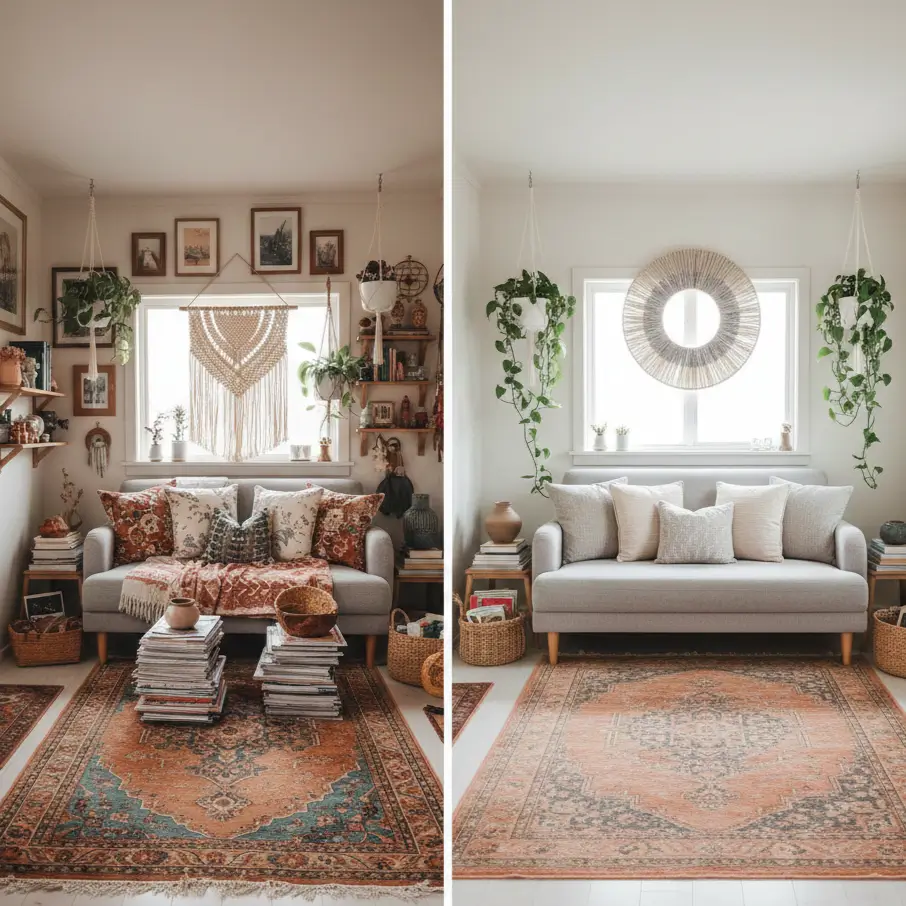
Why it often fails: Traditional boho relies on layering, pattern mixing, and collections, all high visual weight elements. A fully bohemian 280 sq ft tiny house typically feels cluttered within months.
Small-space adaptation (Minimal Boho):
- ONE bold pattern (rug or textile)
- Plants as decor (see indoor plants for small apartments)
- Warm neutrals as base
- Vintage/thrifted furniture (one or two pieces max)
- Macramé OR rattan OR textiles, not all three
Honest take: Bohemian works better in the 500-800 sq ft range. Under 400 sq ft, even restrained boho accumulates visual weight quickly.
7. Modern Farmhouse (Small-Space Rating: 4/10)
Why it struggles: Core elements, shiplap, barn doors, chunky furniture, open shelving with displayed collections, consume physical and visual space. The “warm and full” aesthetic conflicts with tiny house realities.
When it works: Tiny houses on rural property where the style connects to surroundings. Otherwise, farmhouse elements overwhelm small spaces.
If you’re committed:
- Skip shiplap (adds 3/4″ depth on every wall)
- Choose slim-profile furniture
- Limit barn doors to ONE (they require wall space when open)
- Closed storage only, no “styled” open shelving
- Neutral palette, minimal accessories
Consider exploring tiny house wall materials for alternatives that suggest farmhouse without the bulk.
How to Choose Your Tiny House Style in 5 Steps
Start with your non-negotiables (3 must-have elements), assess your space’s natural light and layout, determine your budget per square foot, test with temporary elements first, and commit gradually over 6-12 months rather than all at once.
Step 1: Identify Three Non-Negotiables
What makes you feel at home? Write down exactly three elements you can’t live without:
- “Warm wood tones”
- “Plants everywhere”
- “Bold color”
- “All white everything”
- “Texture-rich textiles”
- “Clean, uncluttered surfaces”
These three elements point toward compatible styles. Warm wood + plants + texture = Japandi or Scandinavian. Bold color + texture + plants = adapted Bohemian.
Step 2: Assess Your Space Honestly
Take these measurements:
- Total square footage
- Ceiling height (8 ft standard vs. 10+ ft lofted areas)
- Natural light direction and intensity
- Fixed elements you can’t change
A north-facing 280 sq ft tiny house with 8 ft ceilings needs very different styling than a south-facing 450 sq ft with 12 ft loft ceilings. Your tiny house layout floor plan determines which styles realistically fit.
Step 3: Calculate Your Budget Per Square Foot
Here’s a framework I use:
- Light refresh: $0.50-1.00 per sq ft ($150-300 for 300 sq ft)
- Moderate transformation: $1.50-3.00 per sq ft ($450-900)
- Complete overhaul: $4.00-8.00 per sq ft ($1,200-2,400)
This helps you choose between a $200 DIY Scandinavian refresh or a $1,500 mid-century investment approach.
Step 4: Test Before Committing
Before purchasing furniture:
- Paint ONE wall in your chosen palette
- Borrow or thrift one representative piece
- Live with it for 30 days
- Photograph at different times of day
Many aesthetics photograph beautifully but live differently. Testing prevents expensive mistakes in spaces where every piece matters.
Step 5: Layer Gradually
Tiny house styling works best when built over 6-12 months:
- Month 1-2: Paint and lighting solutions
- Month 3-4: Major furniture pieces
- Month 5-8: Textiles and rugs
- Month 9-12: Art and final accessories
This approach lets you adjust as you live in the space. What seems perfect on paper often needs tweaking in practice.
Scandinavian vs. Bohemian: Which Tiny House Aesthetic Fits Your Lifestyle?
Choose Scandinavian if you value order, easy cleaning, and visual calm. Choose adapted Bohemian if you’re comfortable with more maintenance, crave warmth and personality, and have 450+ sq ft. Scandinavian costs less upfront ($300-800), while quality Bohemian requires more investment in textiles and plants ($500-1,200).
| Factor | Scandinavian | Bohemian (Adapted) |
| Best for sq ft | 150-600 | 450-800 |
| Cleaning time | 15 min daily | 30+ min daily |
| Dust accumulation | Low | High (textiles, plants) |
| Starter budget | $300-800 | $500-1,200 |
| Visual weight | Very low | Medium-high |
| Personality level | Subtle | Bold |
| Works for renters | Excellent | Good with limitations |
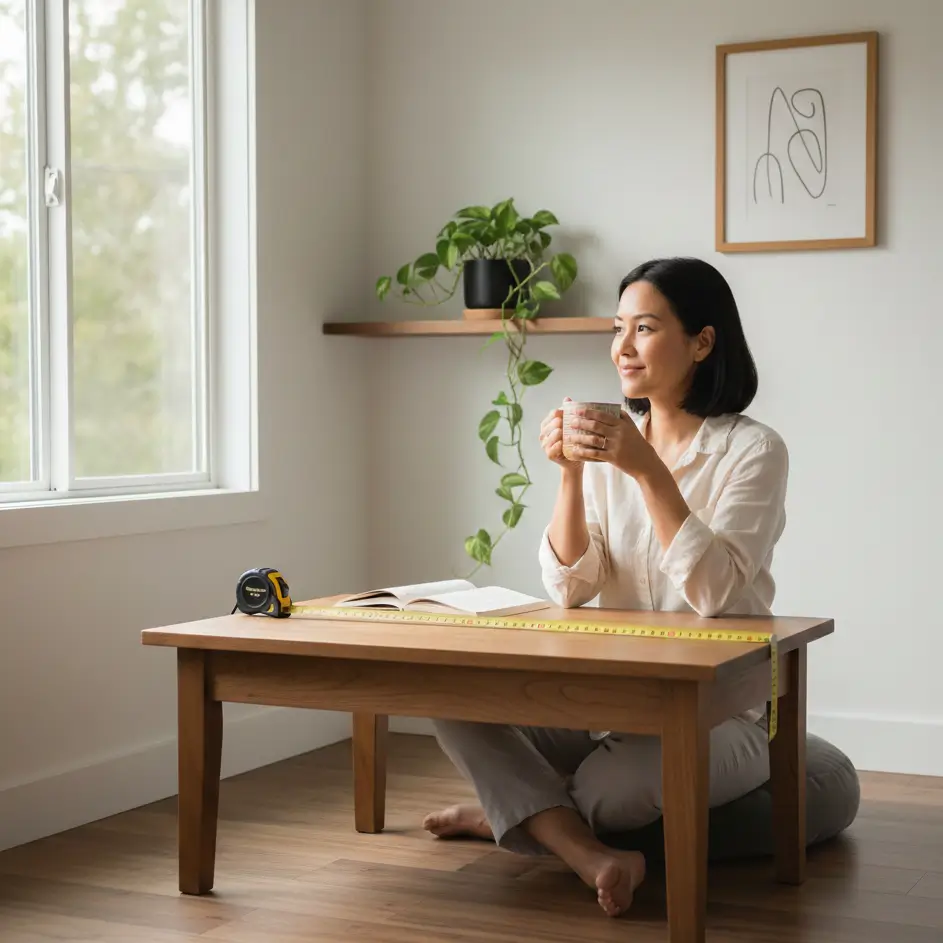
Maya lives in a 340 sq ft tiny house on wheels. She loves the bohemian aesthetic but found her initial decor choices, layered rugs, hanging plants, macramé, patterned pillows, made daily life frustrating. Cleaning took 45 minutes. Finding things took longer. The space felt smaller than before she decorated.
Her solution: Scandinavian foundation with three bohemian elements (one vintage rug, two trailing plants, a woven wall hanging). This “Scandi-Boho” hybrid reduced cleaning to 20 minutes while keeping the warmth she wanted.
For more room-specific guidance, explore tiny house bedroom design and tiny house kitchen design.
Common Tiny House Styling Mistakes (And What Actually Works)
The biggest mistakes are choosing styles based on photos rather than function, over-accessorizing, ignoring vertical space proportions, and committing to trendy aesthetics that won’t last. Successful tiny house styling prioritizes livability first, with aesthetics layered on top, not the reverse.
Mistake 1: Copying Large-Home Styling
A statement chandelier that looks perfect in a 400 sq ft great room overwhelms a 150 sq ft main living area. Scale matters more than style.
Fix: Measure everything. That “perfect” 24″ pendant light needs 36″ minimum of vertical clearance plus visual breathing room. In an 8 ft ceiling space, this rarely works. Choose 10-14″ fixtures for compact spaces.
Mistake 2: Over-Accessorizing
Every surface covered = visual chaos = stress. I see this constantly in tiny house “after” photos that look styled for Instagram but impossible to live in.
Fix: The 3-5-7 rule scaled down. In a tiny house, aim for 3 decorative items per 100 sq ft maximum. A 300 sq ft space supports about 9 intentional decorative pieces total.
Mistake 3: Ignoring Transitions
Where flooring meets, where wall colors change, where one “zone” ends and another begins, these transitions matter enormously in tiny spaces. Too many create visual fragmentation.
Fix: Limit floor material changes to 2 maximum. Walls should flow continuously unless you’re intentionally defining a sleeping loft. Fewer transitions = larger feeling space.
Mistake 4: Trend Chasing
That 2023 trending aesthetic might feel dated by 2025. In tiny houses, where you live with every design choice intensely, trend-proof choices matter more.
Fix: Core elements (paint, flooring, major furniture) in timeless neutrals. Express trends through easily-swapped textiles and accessories, items under $100 you can update without guilt.
For sustainable approaches to your tiny house style choices, focus on durable, classic pieces over fast-decorating trends.
Your Next Steps
Start here: Walk through your current space and identify three items with the highest visual weight. These are your immediate attention areas, not necessarily things to remove, but elements to evaluate first.
Then pick ONE style from this guide that resonates. Spend a week gathering inspiration images, but critically, save only images of spaces under 600 sq ft. Those 3,000 sq ft dream home photos won’t translate.
If you’re building or renovating, review tiny house decorating basics before making permanent choices. And remember: the best tiny house aesthetic is one you can actually live in, not just photograph.
Your tiny house forces intentionality. Let that constraint become your design advantage. Every piece earns its place. Every color choice carries weight. That’s not limitation, that’s curation. And curated spaces, regardless of size, feel like home.
For more guidance on making the most of your compact living space, explore Veniola’s complete tiny house resources.