
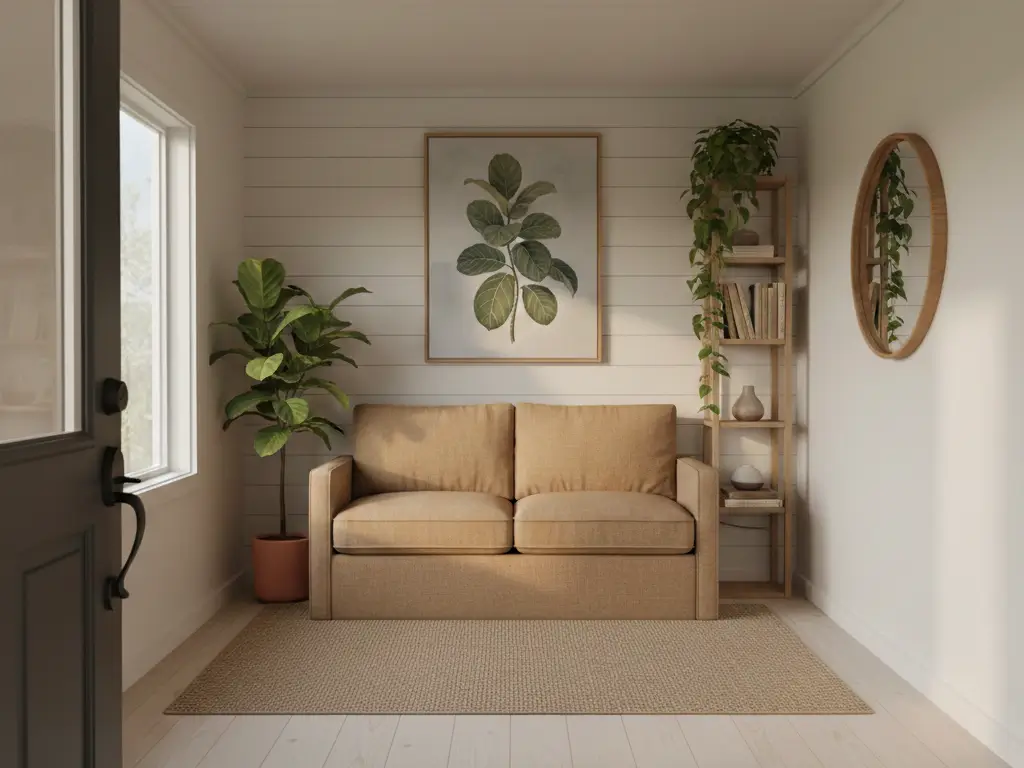
A 280 square foot tiny house in Portland taught me everything I thought I knew about decorating was wrong. The homeowner had spent $3,200 on furniture and decor that looked perfect online. In person, the space felt like a storage unit with nice things crammed inside.
The same rules that make a 2,000 square foot home beautiful will make a 200 square foot tiny house feel suffocating. Small spaces amplify every design choice, good and bad.
You’ll learn specific proportion rules, color strategies, and the “earned space” test that helps you decide what stays and what goes. Budget range: $150 for DIY refreshes up to $2,500 for a complete tiny house decorating overhaul.
I’ve spent 11 years helping people furnish spaces under 600 square feet. The patterns are clear. Some approaches consistently work. Others consistently fail. What follows isn’t theory, it’s tested in real tiny houses, small apartments, and compact homes across different climates and lifestyles.
What Makes Tiny House Decorating Different From Regular Interior Design?
Tiny house decorating requires a “space-to-impact ratio” mindset where every item must earn its footprint through visual contribution, practical function, or genuine emotional value. A 14-inch decorative bowl that would disappear in a normal living room dominates a 120 sq ft tiny house main area.
The math explains why traditional decorating advice fails in small spaces. A typical tiny house on wheels measures 8.5 feet wide by 20-28 feet long, roughly 170-238 square feet of total floor space. Remove the bathroom (15-25 sq ft), kitchen (30-40 sq ft), and sleeping loft access, and you’re decorating maybe 100-150 square feet of actual living area.
In that context, a 3×5 foot area rug covers 15 square feet. That’s 10-15% of your usable floor. One wrong choice and you’ve visually consumed a significant portion of your space.
This isn’t about having less decor. It’s about different decor.
The principles that guide tiny house style and aesthetic choices apply directly here: intentionality matters more than accumulation. A single 24×36 inch botanical print positioned correctly creates more impact than five small frames scattered across walls.
What separates successful tiny house decorating from cramped-feeling spaces comes down to three shifts in thinking:
- Scale awareness: Every item’s size relative to walls, ceiling height, and floor area matters exponentially more
- Multi-function priority: Decorative items that also serve practical purposes earn their space twice
- Negative space respect: Empty wall sections and clear floor areas become design elements themselves
Understanding your tiny house layout and floor plan before buying any decor prevents the expensive mistake of beautiful pieces that simply don’t fit the architecture.
The 9 Essential Rules for Decorating Tiny Houses Under 400 Square Feet
These nine rules address proportion, placement, color, and function, the four pillars that determine whether a tiny space feels curated or chaotic. Following them saves both money and regret. Breaking them costs more in small spaces than large ones.
Rule 1: Apply the Two-Thirds Proportion Standard
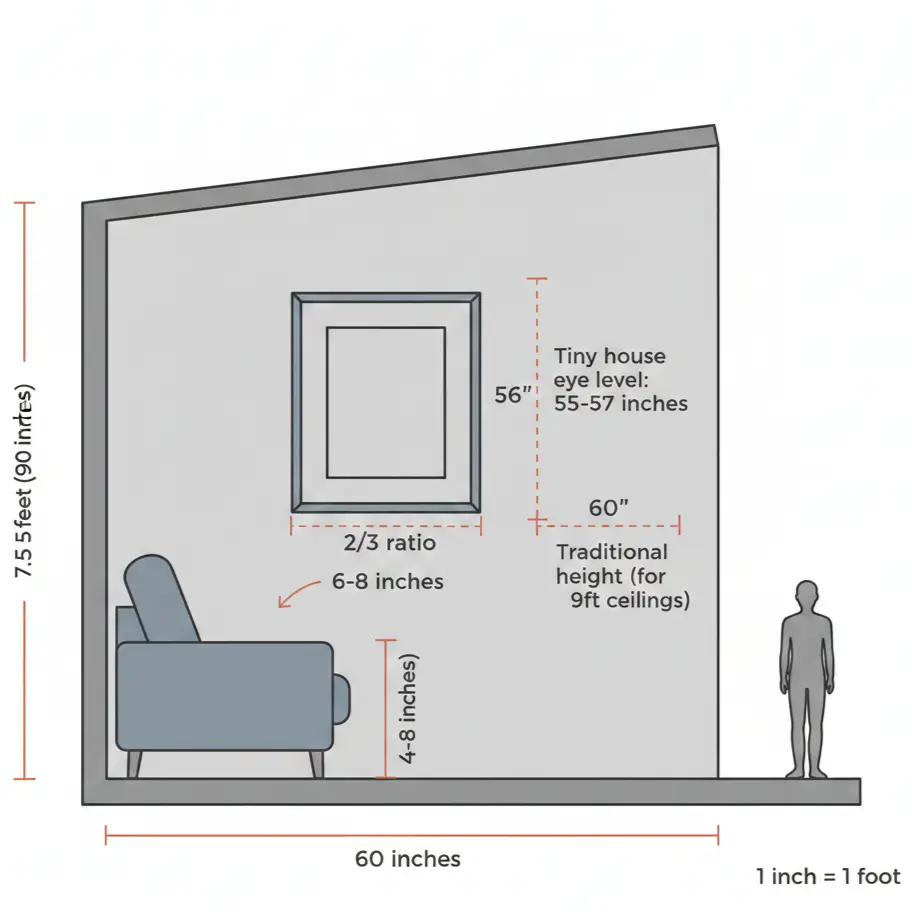
Wall art, headboards, and statement pieces should span approximately two-thirds the width of the furniture below them. Above a 60-inch sofa in a tiny house living area, that means art measuring 36-42 inches wide, not the 24-inch pieces most people default to buying.
This proportion creates visual balance. Too-small art above furniture makes walls feel awkwardly empty in ways that actually shrink perceived space.
Rule 2: Mount Art at Tiny House Eye Level (55-57 Inches)
Standard gallery height of 57-60 inches works in rooms with 9-foot ceilings. Most tiny houses have 7-8 foot ceilings in main areas. Adjust downward to 55-57 inches at center to maintain comfortable viewing and prevent that “everything floats too high” feeling.
Rule 3: Choose Fewer, Larger Pieces Over Many Small Ones
This contradicts instinct. People assume smaller furniture and decor fits small spaces better. Reality: one 48-inch console table with storage creates a cleaner look than three small side tables that serve the same function but create visual chaos.
The same applies to tiny house furniture choices, one quality sofa beats two cheap chairs.
Rule 4: Use Vertical Space for Decor Storage
In a 185 square foot tiny house I worked with last year, we installed a 6-foot tall narrow shelving unit (only 12 inches deep) that held books, plants, and decorative objects. Floor footprint: 2 square feet. Visual impact and storage capacity: equivalent to pieces that would have consumed 8 square feet of floor space.
This connects directly to tiny house storage solutions that treat organization as part of the decor strategy.
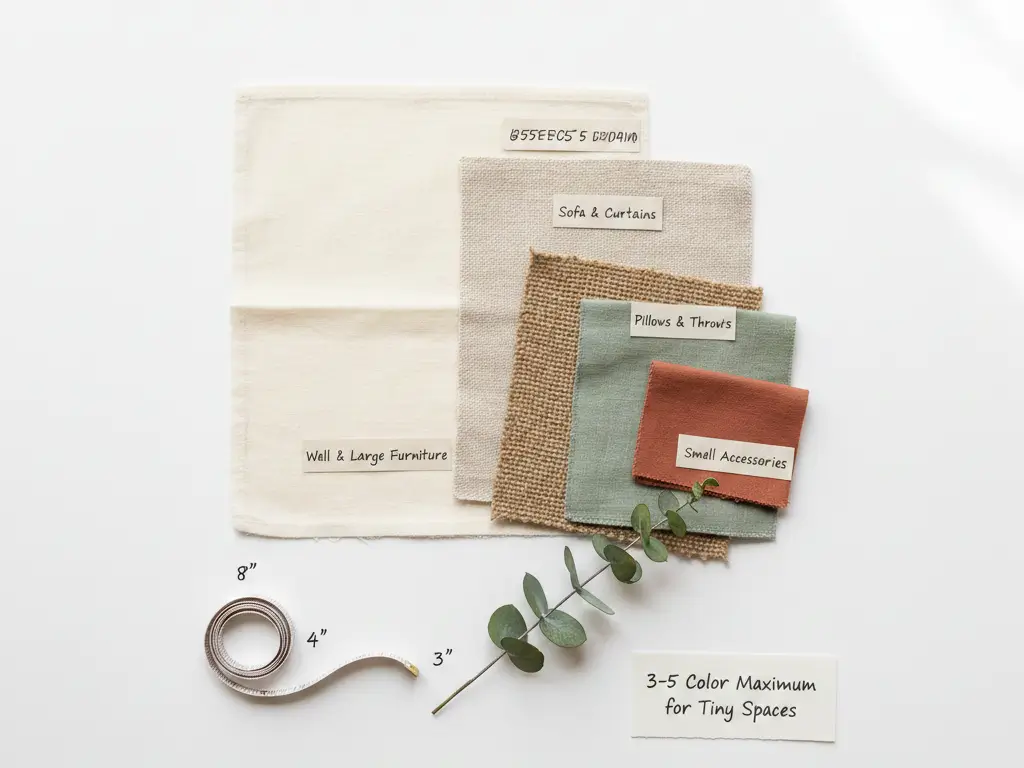
Rule 5: Limit Your Color Palette to Three to Five Colors
Tiny houses can’t absorb the visual stimulation of varied color schemes. Choose one dominant neutral (walls, large furniture), one secondary neutral (textiles, flooring), and one or two accent colors for decor pieces.
The tiny house color selection guide explains why light-reflecting colors work best as dominants while deeper accents draw the eye to intentional focal points.
Rule 6: Add Mirrors Strategically (Not Randomly)
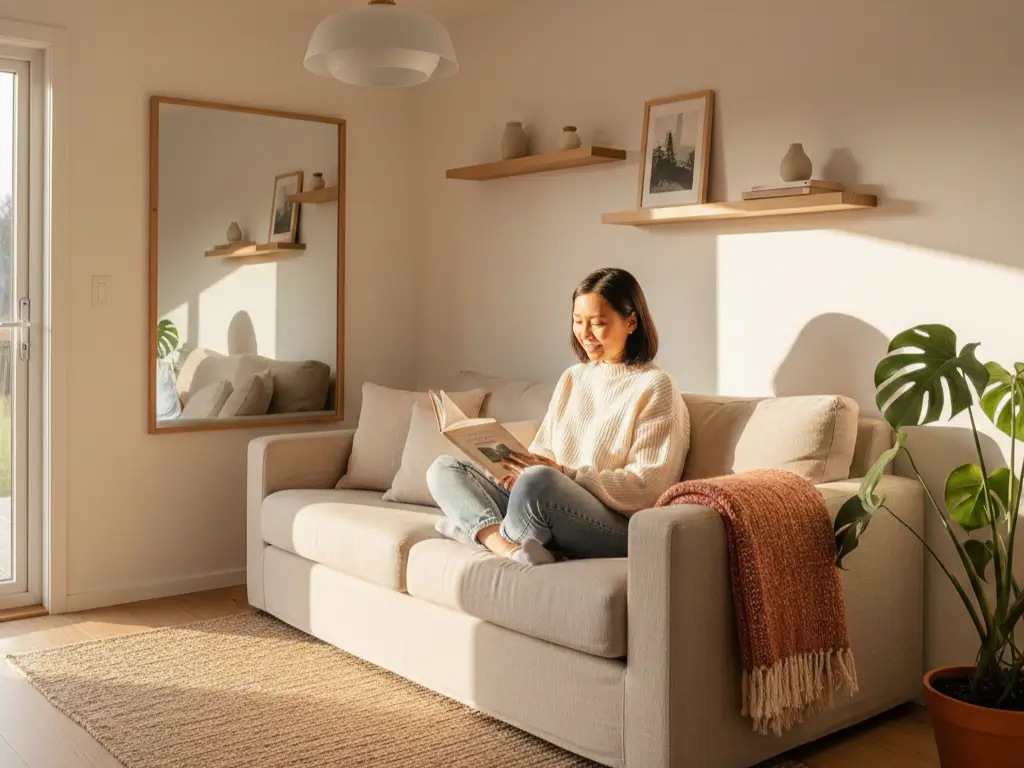
One well-placed 24×36 inch mirror across from a window genuinely doubles light perception. Three random mirrors create visual confusion.
Position mirrors to reflect:
- Natural light sources
- Outdoor views
- The longest sightline in your space
Avoid reflecting cluttered areas or closed doors.
Rule 7: Let Decor Do Double Duty
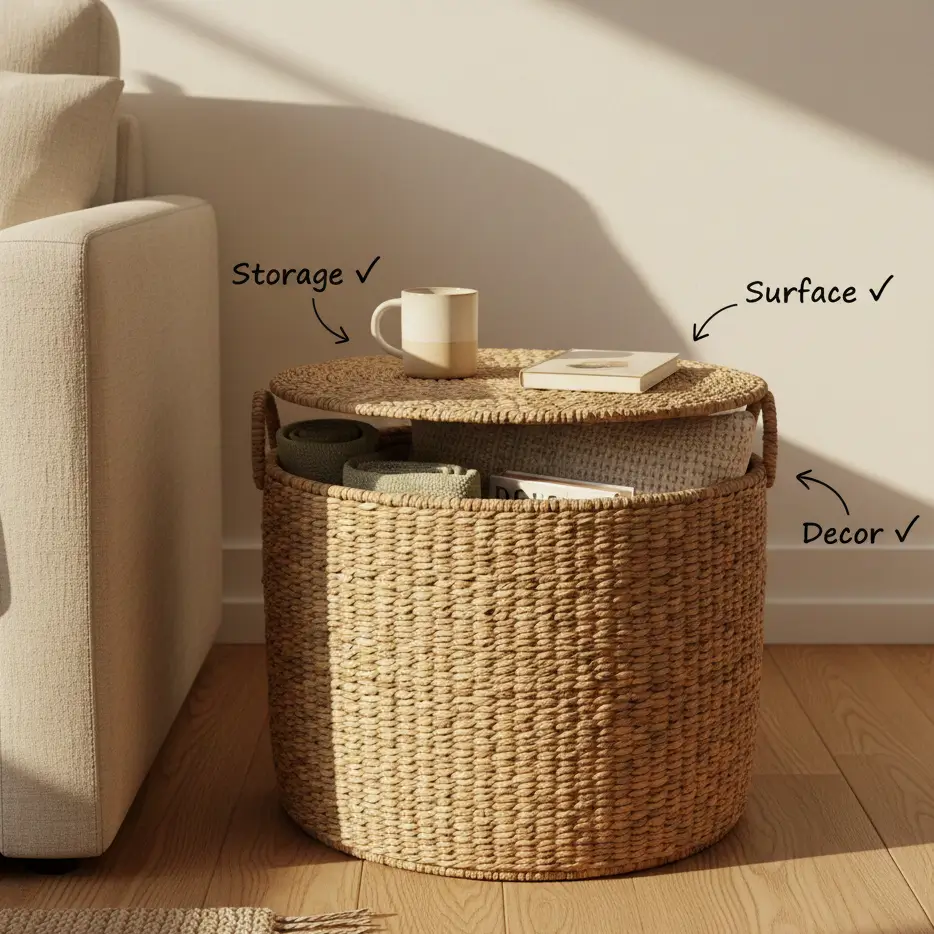
A $180 woven basket that stores blankets and serves as a side table earns its 2 square foot footprint twice. A $180 purely decorative sculpture does not.
In tiny houses, I recommend the “two-job minimum” for any item larger than 8 inches: it must contribute visual appeal AND practical function. Exceptions exist for genuinely meaningful items, family photos, artwork with personal significance, but those should be limited to 3-5 pieces maximum.
Rule 8: Respect the 60-30-10 Floor Coverage Rule
Keep 60% of floor space completely visible. Thirty percent can hold furniture and functional items. Only 10% should feature decorative floor items like plants, baskets, or sculptures.
In a 150 square foot main living area:
- 90 sq ft remains bare floor
- 45 sq ft holds essential furniture
- 15 sq ft maximum for decorative floor items
This ratio maintains the breathing room tiny houses need.
Rule 9: Test Before Committing
Before any decor purchase over $50, I cut cardboard to exact dimensions and tape it where the item would go. This 10-minute step has saved me (and clients) thousands in wrong-size purchases.
For tiny house bedroom design, this testing becomes especially important where measurements around lofts can be tricky.
How to Choose Decor That Actually Fits Your Tiny Space
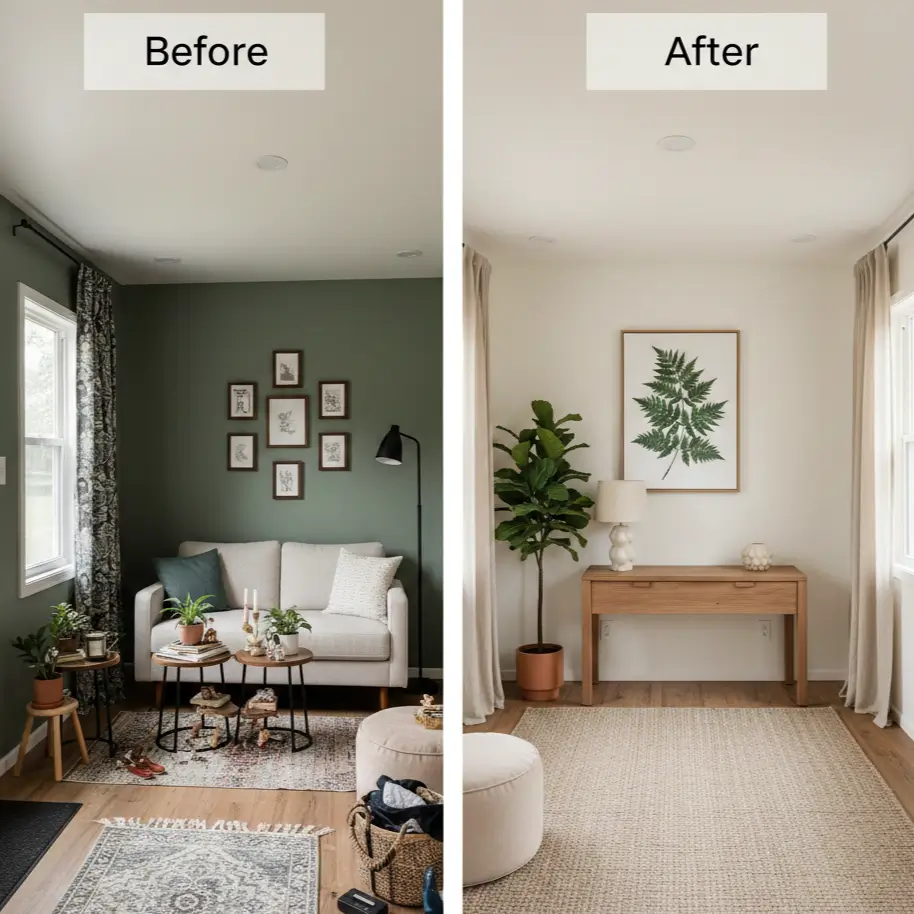
Measure everything, twice. Know your ceiling heights (typically 7-8 feet in tiny houses, lower in lofts), doorway widths (usually 24-28 inches), and the largest item that can physically enter your space. Most tiny house decorating regret comes from buying before measuring.
The Measurement Checklist for Tiny House Decor:
| Item Type | Measure This | Typical Tiny House Range |
| Wall art | Wall width, ceiling height, furniture below | Walls 8-20 feet, ceilings 7-8 feet |
| Area rugs | Room dimensions, furniture placement | 4×6 ft maximum in main areas |
| Floor plants | Diameter including leaves, mature height | Max 24-inch diameter, 5 ft height |
| Shelving | Wall length, clearance for walking paths | 12-inch depth max for walkways |
| Mirrors | Wall space, what they’ll reflect | 18×24 to 24×36 inches optimal |
The tiny house measurements and standards guide provides comprehensive dimension references for common tiny house builds.
Scale Selection Strategy:
When choosing between size options, tiny houses benefit from going slightly larger on single items rather than accumulating multiple smaller pieces. One 16-inch decorative bowl creates less visual clutter than three 6-inch bowls, even though the small bowls take up less physical space combined.
This seems counterintuitive until you see it in practice. The single larger piece registers as intentional design. Multiple small pieces register as accumulated stuff.
For tiny house lighting solutions, this principle applies to fixtures: one appropriately-scaled pendant light beats three small mismatched lamps.
Common Tiny House Decorating Mistakes (And How to Fix Them)
The top five tiny house decorating failures are: over-accessorizing, ignoring vertical proportions, choosing dark colors without balance, blocking natural light, and buying furniture before planning decor zones. Each has a specific fix that doesn’t require starting over.
Mistake 1: The Accessory Avalanche
What it looks like: Every surface holds something. Candles, frames, small plants, figurines, decorative books, surfaces become crowded display areas.
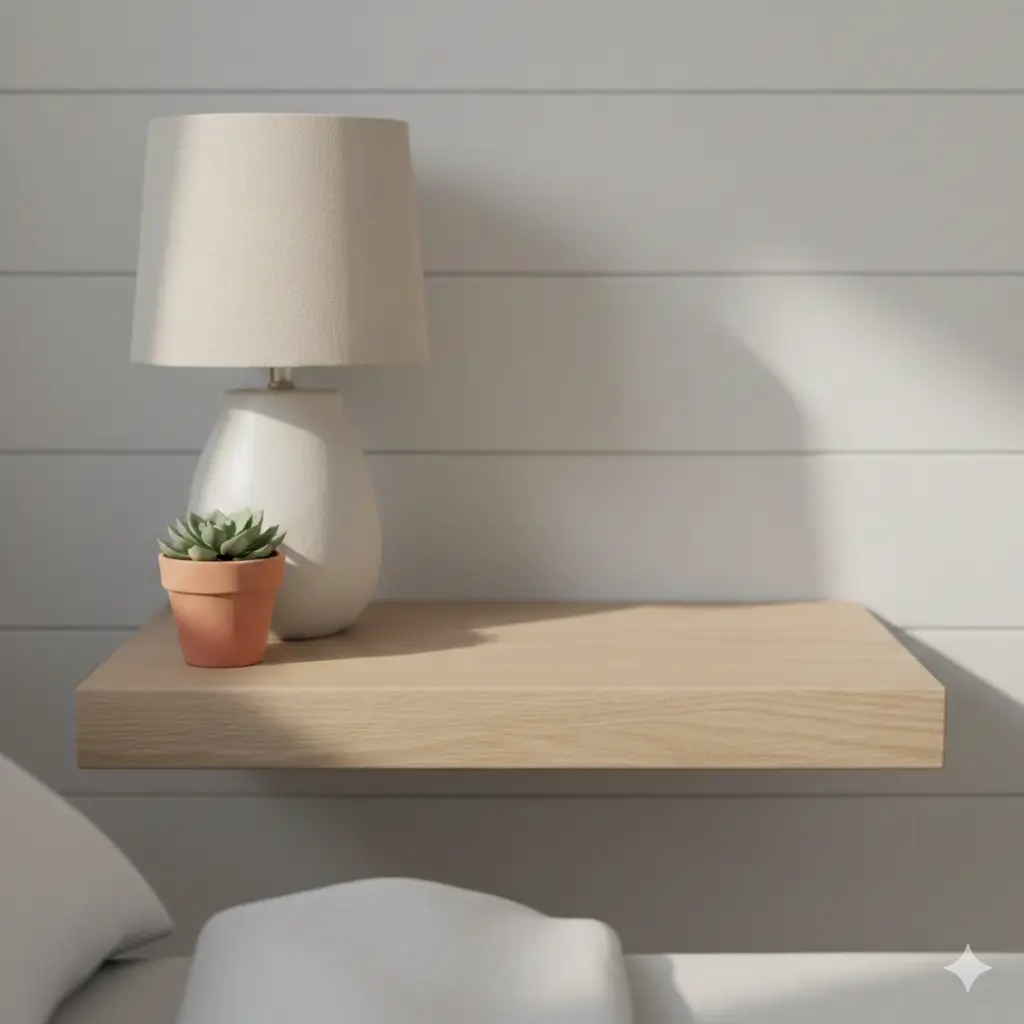
The fix: Apply the “surface one-third rule.” Only one-third of any horizontal surface should hold items. A 24-inch wide nightstand gets one lamp, one small object. Nothing more.
This connects to tiny house minimalist living principles that treat editing as essential design.
Mistake 2: Ignoring Ceiling Height Ratios
What it looks like: Low-hanging light fixtures in 7-foot ceiling areas. Tall floor lamps that nearly touch the ceiling. Vertical decor that emphasizes rather than disguises low ceilings.
The fix: Keep hanging fixtures 6 feet 6 inches minimum from floor in walkways. In loft areas with lower ceilings (often 4-5 feet), use wall-mounted lighting and horizontal decor elements.
The low ceiling paint solutions guide explains color strategies that complement these decor choices.
Mistake 3: Dark Color Overload
What it looks like: A Pinterest-inspired moody aesthetic that works in 1,500 square feet but makes 300 square feet feel like a cave.
The fix: Dark colors can work, in moderation. Limit saturated or dark colors to 20% of surfaces maximum. Use them for small accent furniture, textiles, or one feature wall, never as dominant room colors.
Mistake 4: Window Treatment Mistakes
What it looks like: Heavy drapes that block light, blinds that stay closed, or window treatments that stop at the window frame rather than extending beyond.
The fix: Mount curtain rods 3-4 inches above window frames and extend them 3-6 inches past each side. This makes windows (and walls) appear larger. Choose lightweight, light-filtering fabrics that allow natural light through when closed.
For brightening dark apartment spaces, window treatment choices matter as much as wall color.
Mistake 5: No Decor Zones
What it looks like: Decor scattered throughout without intentional groupings. No clear focal points. The eye has nowhere to rest.
The fix: Create 2-3 “decor zones” in your tiny house. One near the entry, one in the main living area, one in the sleeping space. Each zone gets a small curated grouping. Spaces between zones remain minimal or empty.
Budget-Smart Decorating: Where to Invest and Where to Save
Invest in lighting (30% of decor budget), one statement textile (20%), and mirrors (15%). Save on wall art (DIY or thrift), small accessories, and seasonal items. Total tiny house decorating budget typically ranges $300-2,500 depending on starting point and quality level.
| Category | Budget Tier | Price Range | ROI in Tiny Spaces |
| Lighting | Investment | $150-400 | High, visible in every photo and daily use |
| Primary textile (rug/throw) | Mid-range | $80-200 | High, sets color tone, adds warmth |
| Mirror(s) | Mid-range | $60-150 | High, expands space perception |
| Wall art | DIY/Thrift | $20-100 | Medium, personal expression matters more than price |
| Plants | Budget | $15-60 | High, life and texture for minimal cost |
| Small accessories | Budget | $5-30 each | Low, easy to replace, don’t overspend |
The tiny house budget planning guide offers complete cost frameworks for furnishing and decorating from scratch.
Where DIY Makes Sense:
Custom-sized items often work better in tiny houses than standard retail sizes. A floating shelf built to exact 38-inch specification fits where no standard 36-inch or 48-inch shelf would work.
For guidance on building custom pieces, the wood furniture for small spaces guide covers material selection and finishing for DIY projects.
The Sustainability Angle:
Secondhand decor often fits tiny house aesthetics better than new items anyway. Vintage pieces carry visual interest that mass-produced items lack. A $35 thrift store lamp becomes a conversation piece in ways a $35 Target lamp never will.
This approach aligns with tiny house sustainability principles, reducing consumption while creating spaces with character.
Your Next Steps
Decorating a tiny house well means constant editing, not constant adding. Start with the 60-30-10 floor rule before buying anything new. Measure every space twice. Test with cardboard before committing.
Walk through your space and count every decorative item. Anything that doesn’t pass the “earned space” test, visual contribution, practical function, or genuine emotional value, gets relocated.
Identify your three decor zones and create one intentional grouping in each, removing scattered items that fall outside these zones.
For structural changes like built-in shelving or wall treatments, consult the DIY tiny house building projects guide to ensure decor enhancements integrate with your tiny house structure.
Small spaces don’t require less attention to decorating, they require more. But the payoff of a well-decorated tiny house is a home that feels genuinely curated rather than compromised. And that’s worth the extra thought.
For more guidance on creating your ideal tiny space, explore the complete resources at Veniola.