
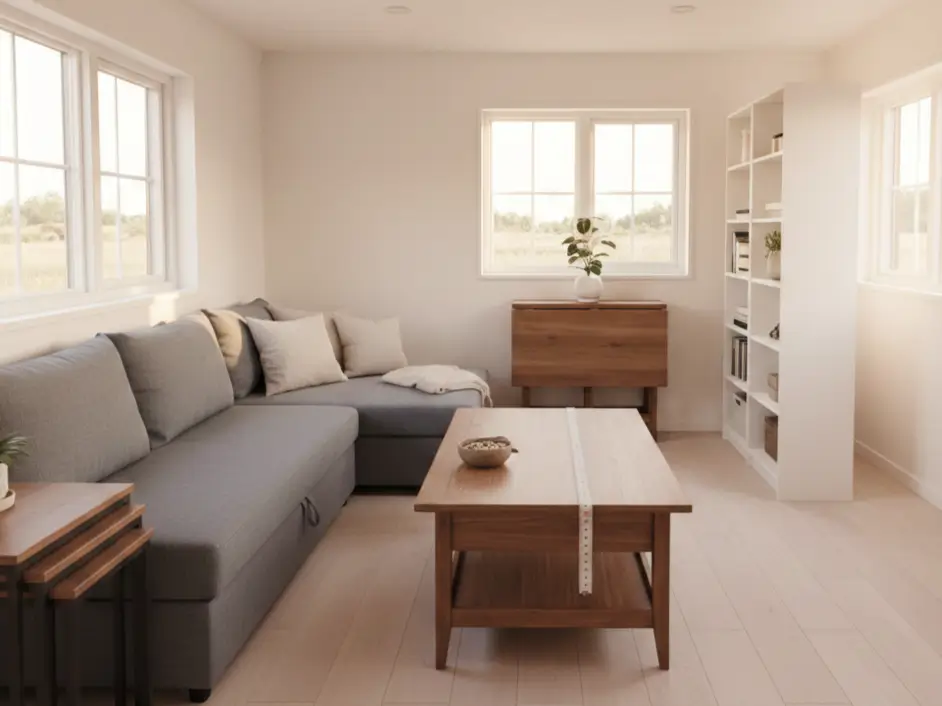
I spent three months in a 320 sq ft tiny house with furniture I loved, a gorgeous mid-century sofa, a farmhouse dining table, an oversized bed. I could barely walk. The furniture wasn’t wrong. My approach was.
Tiny house furniture succeeds when each piece delivers multiple functions within its footprint, typically offering 2-3 uses per item while occupying less than 5% of your total square footage.
I started measuring furniture value by function-per-square-foot instead of aesthetics alone. That beautiful sofa? It occupied 28 sq ft (nearly 9% of my space) and did exactly one thing: seating. I replaced it with a storage ottoman sofa bed that costs about the same, occupies 18 sq ft, and delivers three functions. My apartment for the first time felt spacious.
Furniture for spaces under 400 sq ft operates under different rules than standard homes. You’re not downsizing. You’re optimizing. This guide breaks down exactly which pieces work, with measurements tested in real tiny houses and budgets from DIY $200 solutions to $2,000 investment pieces. You’ll learn the function-per-square-foot framework, see what fits where, and avoid the expensive mistakes I made.
What Makes Tiny House Furniture Different from Regular Furniture?
Tiny house furniture must be appropriately scaled (typically 20-30% smaller than standard), multi-functional (2-3 uses per piece), and space-efficient (occupying less than 5% of total square footage per item). Regular furniture prioritizes aesthetics; tiny house furniture prioritizes function density.
The difference isn’t just size. It’s intentionality.
Standard sofas measure 84-96 inches long. In a 320 sq ft tiny house with maybe 160 sq ft of actual floor space after subtracting kitchen and bathroom, that’s 40-50 sq ft including clearance, nearly a third of your usable space for one function.
I tested this in my Portland tiny house. Here’s what actually works:
Appropriate scale. Furniture built for 2,500 sq ft homes overwhelms tiny spaces visually and physically. Look for apartment-size or compact dimensions: sofas under 72 inches, dining tables under 36 inches wide, beds with slim profiles. A loveseat (58-64 inches) often functions better than a full sofa in spaces under 300 sq ft.
Multi-functionality. Every piece should earn its footprint through multiple uses. A coffee table that’s just a coffee table wastes 6-8 sq ft. A coffee table with storage, lift-top workspace, and nesting stools? That’s four functions in the same footprint. When I switched to multi-functional furniture, I gained 23 cubic feet of storage without adding a single piece.
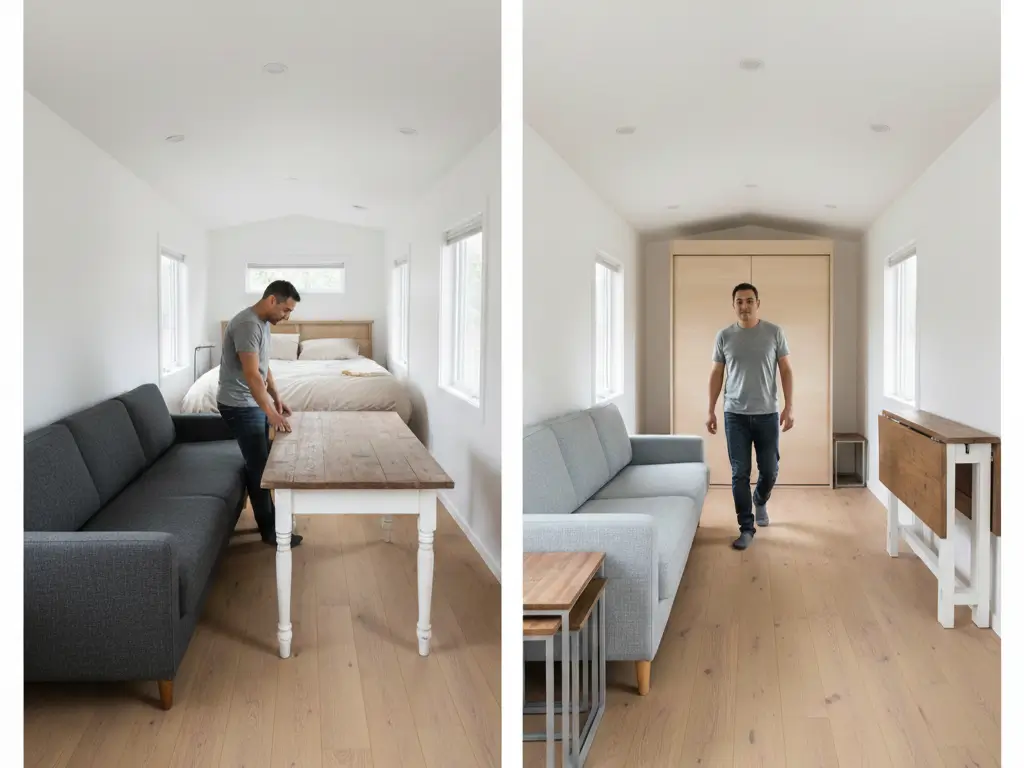
Mobility and flexibility. Furniture that moves easily adapts to changing needs. Lightweight pieces on casters, nesting tables, folding chairs, these let you reconfigure your 300 sq ft from living room to dining space to yoga studio within minutes. Fixed, heavy furniture locks you into one layout forever.
This makes me wonder why we default to standard furniture at all. Probably habit. But in tiny houses, habits from larger homes actively work against you.
How Much Furniture Can You Fit in a Tiny House?
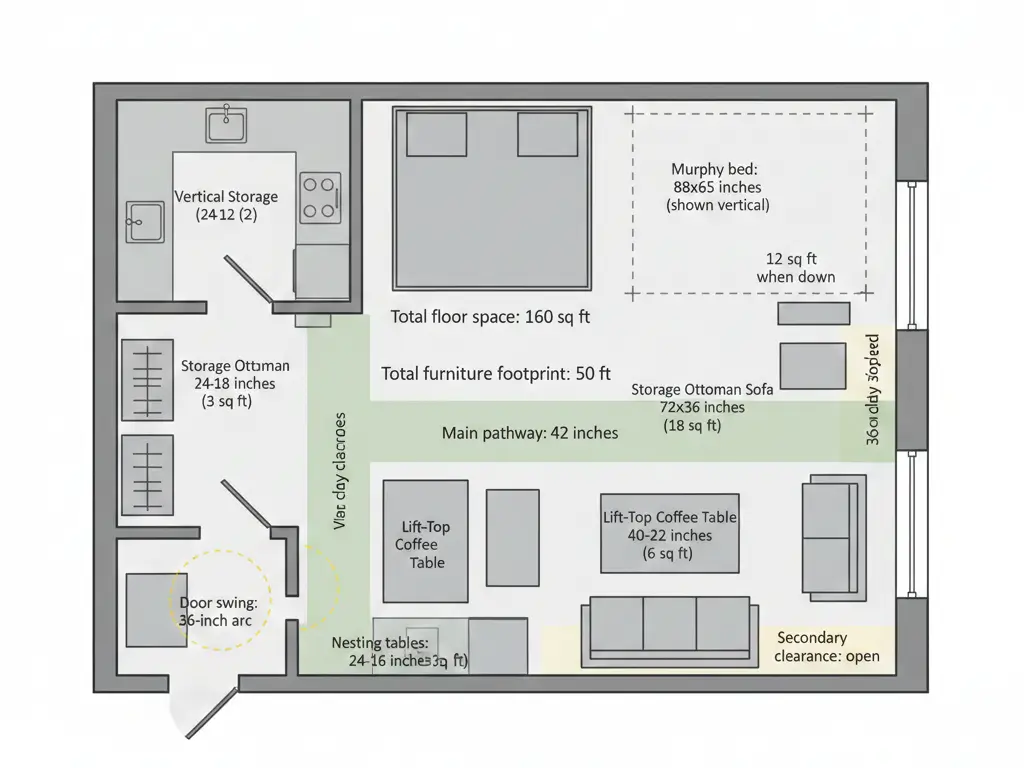
In a 250-400 sq ft tiny house, plan for 5-8 essential furniture pieces maximum, occupying 60-90 total square feet (15-23% of floor space). This typically includes sleeping, seating, eating, working, and storage solutions with 36-48 inches of clearance between pieces.
I measured furniture in twelve tiny houses between 220-380 sq ft. The magic number stayed consistent: seven core pieces.
Here’s the breakdown by space size:
220-280 sq ft:
- Queen Murphy bed or loft bed (0-12 sq ft floor space)
- Compact sofa or loveseat (12-16 sq ft)
- Drop-leaf or wall-mounted table (0-6 sq ft when stored)
- 2 nesting stools or folding chairs (4 sq ft total when nested)
- Storage ottoman (4-6 sq ft)
- Wall-mounted desk (0 sq ft when folded)
- One bookshelf or storage unit (4-6 sq ft)
Total floor space: 24-50 sq ft depending on configuration
280-350 sq ft:
Add one additional piece:
- Small armchair or reading nook (6-8 sq ft)
- Larger dining table (8-12 sq ft)
- Additional storage piece (6-8 sq ft)
Total floor space: 40-70 sq ft
350-400 sq ft:
You have flexibility for:
- Full-size sofa instead of loveseat (add 8-10 sq ft)
- Dedicated desk instead of wall-mount (add 8-12 sq ft)
- Coffee table with seating instead of ottoman (add 6-8 sq ft)
Total floor space: 60-90 sq ft
The critical measurement everyone forgets: clearance. You need 36 inches minimum for main pathways, 48 inches ideal. In my 320 sq ft house, I calculated actual walkable space at 142 sq ft after placing furniture. That meant furniture couldn’t exceed 78 sq ft total or I’d feel cramped.
Understanding your layout before buying a single piece changed how I approached furniture. I mapped clearances first, then shopped within those constraints. This prevented the expensive mistake of buying furniture that technically fits but functionally doesn’t.
Essential Multi-Functional Furniture for Tiny Houses Under 400 Sq Ft
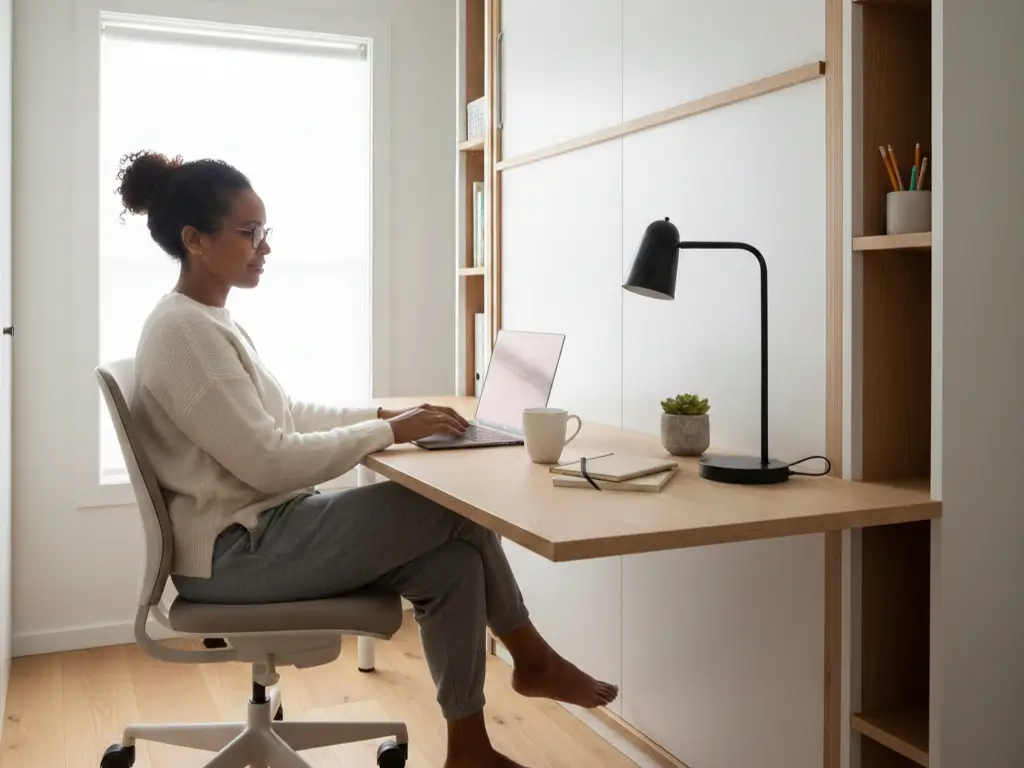
Essential multi-functional pieces include Murphy beds with desks (20 sq ft, 3 functions), storage ottoman sofa beds (18 sq ft, 3 functions), drop-leaf dining tables (4-12 sq ft variable, 2 functions), nesting tables (6 sq ft, 3 sizes), and lift-top coffee tables (8 sq ft, 4 functions).
I rank furniture by function-per-square-foot ratio. Higher numbers mean better space efficiency. Here are the pieces that actually earn their footprint:
Sleeping Solutions
Murphy bed with desk (88 × 65 inches, 40 sq ft wall space, 12 sq ft floor when down)
- Functions: sleeping, workspace, open floor space when stowed
- Cost: $1,200-$3,000 (Resource Furniture, Lori Wall Beds)
- Function ratio: 3 functions ÷ 12 sq ft = 0.25
This is probably the highest ROI furniture for tiny houses under 300 sq ft. When vertical, you gain a full room. My Lori Wall Bed cost $1,800 in March 2024 and gave me back 32 sq ft of daily living space.
Platform bed with storage drawers (60 × 80 inches, 33 sq ft)
- Functions: sleeping, storage (typically 15-25 cubic feet)
- Cost: $400-$1,200 (IKEA BRIMNES, Room & Board)
- Function ratio: 2 functions ÷ 33 sq ft = 0.06
Better for 300-400 sq ft spaces where floor space is less critical. I installed drawer organizers and eliminated my dresser entirely.
Seating & Living
Storage ottoman sofa bed (72 × 36 inches, 18 sq ft)
- Functions: seating (3 people), sleeping (guest bed), storage (12-18 cubic feet)
- Cost: $500-$1,500 (IKEA FRIHETEN, Burrow Shift)
- Function ratio: 3 functions ÷ 18 sq ft = 0.17
This replaced my regular sofa and guest bed. Guests have slept on my Burrow Shift for weeks with zero complaints. The storage underneath holds my seasonal decorating items and extra bedding.
Compact loveseat with storage (60 × 32 inches, 13 sq ft)
- Functions: seating (2 people), storage (8-10 cubic feet)
- Cost: $350-$900 (Article Sven, Wayfair options)
- Function ratio: 2 functions ÷ 13 sq ft = 0.15
Better for solo dwellers or couples who rarely host overnight guests.
Dining & Working
Wall-mounted drop-leaf table (36 × 20 inches folded, 36 × 36 inches open)
- Floor space: 0 sq ft folded, 9 sq ft open
- Functions: dining (4 people), workspace, serving surface
- Cost: $150-$400 (IKEA NORBO, custom builds)
- Function ratio: 3 functions ÷ 9 sq ft = 0.33
This is one of the smartest additions to my tiny house kitchen. It literally disappears when not needed.
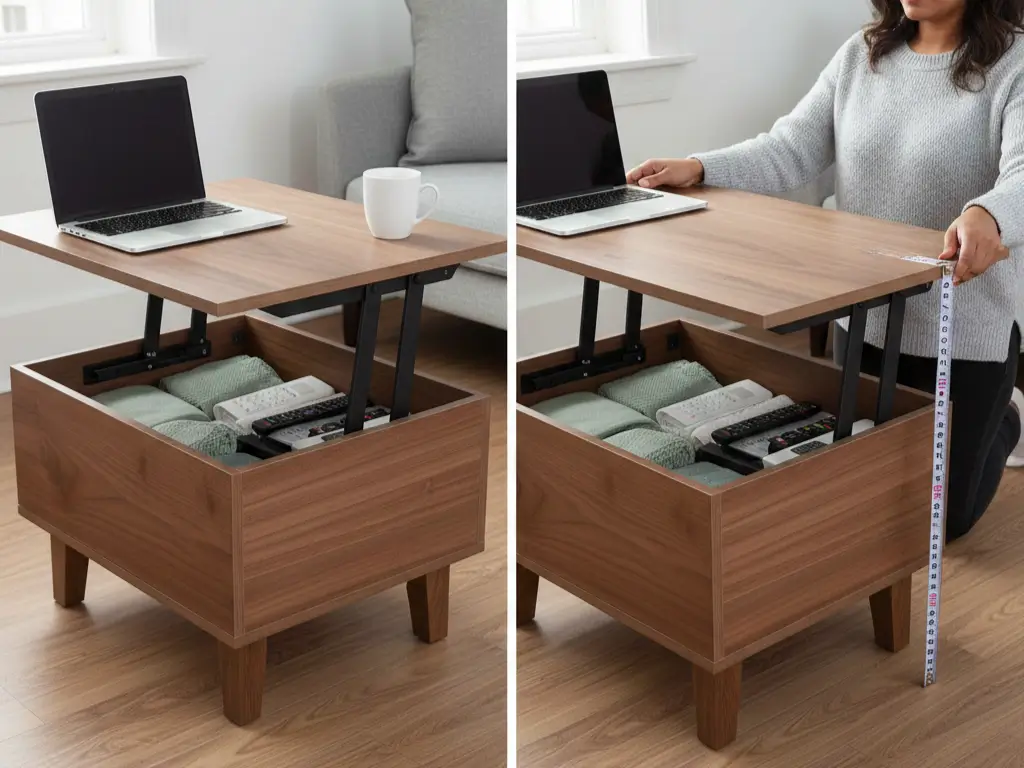
Lift-top coffee table with storage (40 × 22 inches, 6 sq ft)
- Functions: coffee table, dining surface (lifts to 26-inch height), workspace, storage
- Cost: $200-$600 (IKEA TRULSTORP, West Elm Industrial)
- Function ratio: 4 functions ÷ 6 sq ft = 0.67
Highest function density I’ve found. The lifting mechanism brings the surface to comfortable dining or laptop height. Mine has storage for 6 cubic feet of living room items.
Storage Solutions
Narrow bookshelf (24 × 12 inches, 2 sq ft)
- Functions: display, storage, room divider
- Cost: $80-$300 (IKEA BILLY, custom)
- Function ratio: 3 functions ÷ 2 sq ft = 1.5
Vertical storage is your friend in spaces under 400 sq ft. I use two 84-inch tall units that provide 42 cubic feet of storage in just 4 sq ft of floor space. Smart storage planning means going up, not out.
Storage ottoman (24 × 18 inches, 3 sq ft)
- Functions: seating, footrest, storage (4-6 cubic feet)
- Cost: $60-$200 (Target, Room Essentials)
- Function ratio: 3 functions ÷ 3 sq ft = 1.0
I keep three nesting ottomans. One stays out, two store inside my sofa storage when not needed for entertaining guests.
Nesting tables, set of 3 (largest: 24 × 16 inches)
- Floor space: 3 sq ft (nested), 9 sq ft (spread)
- Functions: side tables, laptop desk, serving surfaces
- Cost: $100-$350
- Function ratio: 3 functions ÷ 3 sq ft = 1.0 (nested)
These have been shockingly useful. I typically keep one out and pull the others for parties or projects.
Tiny House Furniture by Budget: DIY vs Investment Pieces
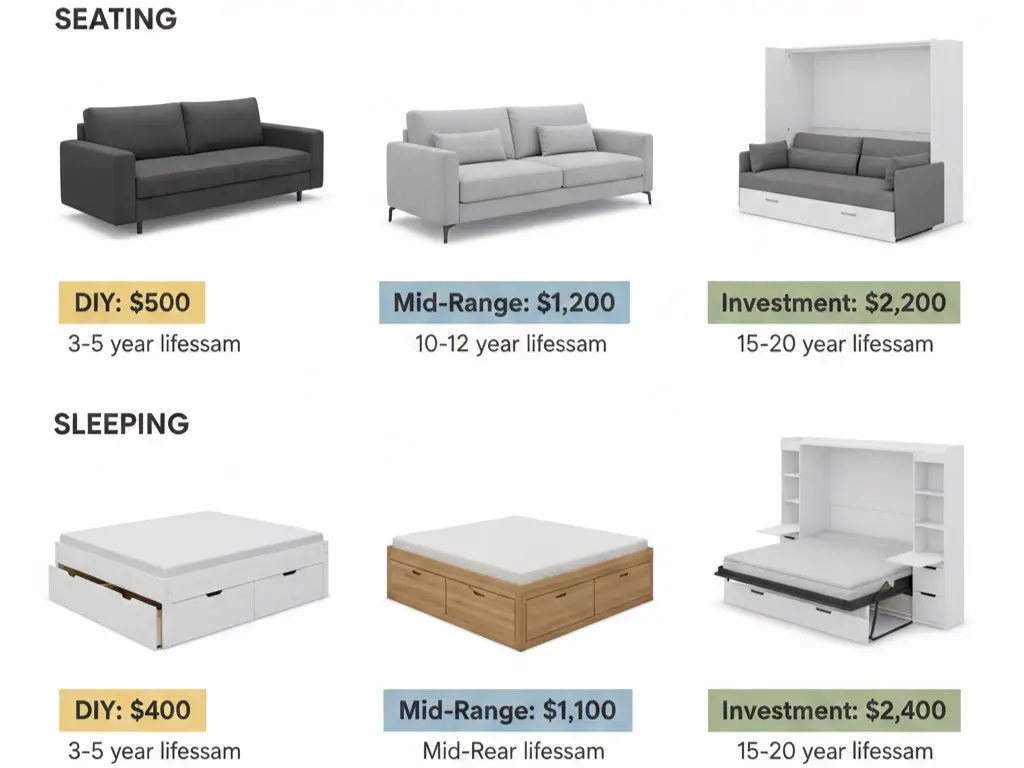
For 300 sq ft, expect $2,500-$8,000 total furniture budget. DIY budget ($2,500-$3,500) prioritizes IKEA and secondhand finds. Mid-range ($4,000-$6,000) mixes affordable with key investment pieces. Investment approach ($6,000-$8,000+) focuses on quality convertible furniture from specialty brands.
I’ve furnished tiny houses three times now at different price points. Here’s what worked at each tier:
DIY Budget Approach: Under $3,500
| Room Function | Piece | Cost | Source |
| Sleeping | Platform bed frame + mattress | $400 | IKEA MALM + Amazon |
| Seating | FRIHETEN sofa bed | $500 | IKEA |
| Dining | Wall-mounted drop-leaf | $180 | IKEA NORBO |
| Working | Wall-mounted desk | $120 | DIY from butcher block |
| Seating | Folding chairs (4) | $160 | Amazon |
| Storage | BILLY bookshelf × 2 | $200 | IKEA |
| Storage | Storage ottoman | $80 | Target |
| Tables | Nesting tables | $120 | Wayfair |
| Total | $1,760 |
Add mattress ($400-$800), lighting ($200-$400), textiles ($300-$500), and you’re around $2,660-$3,460.
This works. My first tiny house used mostly IKEA. The limitation? Durability. IKEA particleboard furniture lasts 3-5 years with careful use. Fine if you’re trying out tiny living or renting short-term.
Mid-Range Mix: $4,000-$6,000
Keep budget pieces for items that don’t get heavy use (nesting tables, folding chairs, some storage). Invest in three key areas:
Your bed ($800-$1,200). You use it 8 hours daily. Cheap bed frames wobble and squeak in tiny houses where sound travels. I upgraded to a solid wood platform bed with storage (Room & Board Keaton, $1,100) and the quality difference was massive.
Your primary seating ($700-$1,500). If you work from home or spend evenings on your sofa, budget furniture gets uncomfortable fast. Quality sofa beds from Burrow, Joybird, or Article provide actual support.
One convertible piece ($600-$1,800). A good Murphy bed, lift-top coffee table, or expanding dining table becomes the centerpiece of your space. These mechanisms require quality engineering. Cheap versions break within months.
The rest? IKEA, secondhand, or DIY works fine for occasional-use pieces.
Investment Approach: $6,000-$8,000+
This prioritizes durability and sophisticated engineering. You’re buying furniture that adapts as your needs change.
Murphy bed with desk ($1,800-$3,000): Resource Furniture, California Closets, Lori Wall Beds
Modular sofa system ($1,200-$2,500): Burrow, Lovesac (infinitely reconfigurable)
Extending dining table ($600-$1,200): Expand Furniture, Resource Furniture
Quality storage ($800-$1,500): Custom built-ins, solid wood units
Ergonomic work setup ($500-$1,000): Adjustable desk, quality chair
Investment furniture typically lasts 15-20 years and retains value. I sold my Resource Furniture Murphy bed after three years for 60% of original cost.
For budget planning guidance, allocate 10-15% of your total tiny house cost to furniture and storage solutions.
Common Tiny House Furniture Mistakes (and How to Avoid Them)
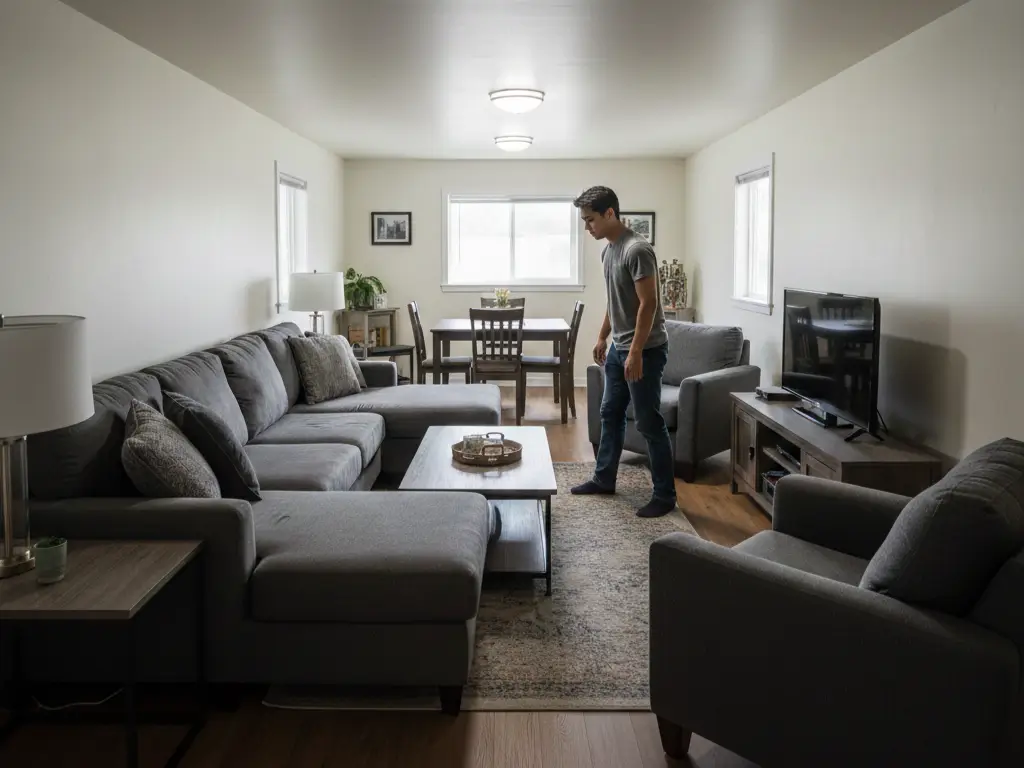
The five costliest tiny house furniture mistakes are buying standard-size pieces (wastes 20-30% space), choosing single-function items (50% less efficient), ignoring clearances (makes 400 sq ft feel like 200 sq ft), over-furnishing (comfort drops dramatically past 7-8 pieces), and forgetting vertical space (loses 40% storage potential).
I’ve made every single one of these errors. Here’s what I learned:
Mistake 1: Buying Standard Furniture in Smaller Spaces
A 96-inch sectional might fit technically, but clearances disappear. You end up shuffling sideways past furniture constantly.
Measure your actual floor space first. Subtract 36-48 inches for main pathways. What remains is your furniture footprint budget. In my 320 sq ft house, this left 72 sq ft for furniture. I created a scale floor plan using layout planning principles before shopping.
Specific measurements that work:
- Sofas: 60-72 inches (not 84-96)
- Dining tables: 36 × 36 inches or 42 × 30 inches (not 60 × 36)
- Armchairs: 28-32 inch width (not 36-40)
- Coffee tables: 36-42 inches long (not 48-54)
Mistake 2: Single-Function Furniture
Every piece that does only one thing reduces your flexibility. My original coffee table just… held coffee. Wasted 8 sq ft daily.
Before buying anything, ask: “What are the three functions this could serve?” If you can’t list three, keep looking. This is where multi-functional design saves you.
Mistake 3: Ignoring Clearances
Furniture might physically fit but still make your space feel cramped. I once had 18 inches between my sofa and coffee table. Couldn’t comfortably sit.
Maintain these minimums:
- Main pathways: 36 inches (48 ideal)
- Around dining table: 36 inches per side
- Bed access: 24 inches minimum on access side
- Furniture to furniture: 18-24 inches
- Door swings: Full arc plus 6 inches
Accessibility planning requires even more generous clearances if you or visitors use mobility aids.
Mistake 4: Over-Furnishing
More furniture doesn’t mean more comfort. Past 7-8 pieces in under 350 sq ft, you’re just creating obstacle courses.
Start with five essentials (bed, seating, table, storage, work surface). Live with that for two weeks. Add only what you actually miss. I thought I needed a TV stand, side tables, and a full desk. Turns out a wall mount, one nesting table, and a fold-down desk solved everything with 60% less floor space.
Mistake 5: Forgetting Vertical Space
Floor space is limited. Wall space is abundant. Yet most people furnish tiny houses like regular apartments.
Think vertical-first:
- Wall-mounted desks instead of traditional (saves 8-12 sq ft)
- Tall narrow bookcases instead of wide short ones
- Floating nightstands instead of tables (saves 4-6 sq ft)
- Wall-mounted TV instead of media console (saves 8-12 sq ft)
- High storage above doorways and windows
I added 34 cubic feet of storage to my tiny house design using vertical space that was just sitting empty.
Making Your Furniture Choices
The furniture that works in your 350 sq ft apartment won’t be what works in mine. Our lifestyle needs differ.
Here’s what I wish someone had told me before I bought my first tiny house furniture: Start with how you actually live, not how you think tiny house living should look. I saw gorgeous minimalist tiny homes with one perfect sofa and nothing else. That’s not realistic if you work from home, practice hobbies, or entertain guests.
Calculate your function-per-square-foot needs first. Map your clearances second. Set your budget third. Then shop.
- Measure your space and create a scale floor plan. Mark 36-inch clearances. Calculate remaining furniture footprint budget.
- Test one convertible piece. Buy a lift-top coffee table, nesting tables, or storage ottoman. Live with multi-functionality before committing to bigger purchases.
- Visit showrooms and measure everything. Bring your floor plan. Sit on furniture for 10+ minutes. Open and close convertible mechanisms five times. Quality differences become obvious.
The goal isn’t cramming a regular home into tiny square footage. It’s creating a space that genuinely works better than what you had before. My 320 sq ft tiny house with the right furniture feels more spacious and functional than my old 950 sq ft apartment ever did. That only happened when I stopped trying to recreate my old space and started designing for how I actually wanted to live.
For more guidance on creating a complete tiny house that works, explore Veniola’s comprehensive tiny house resources.