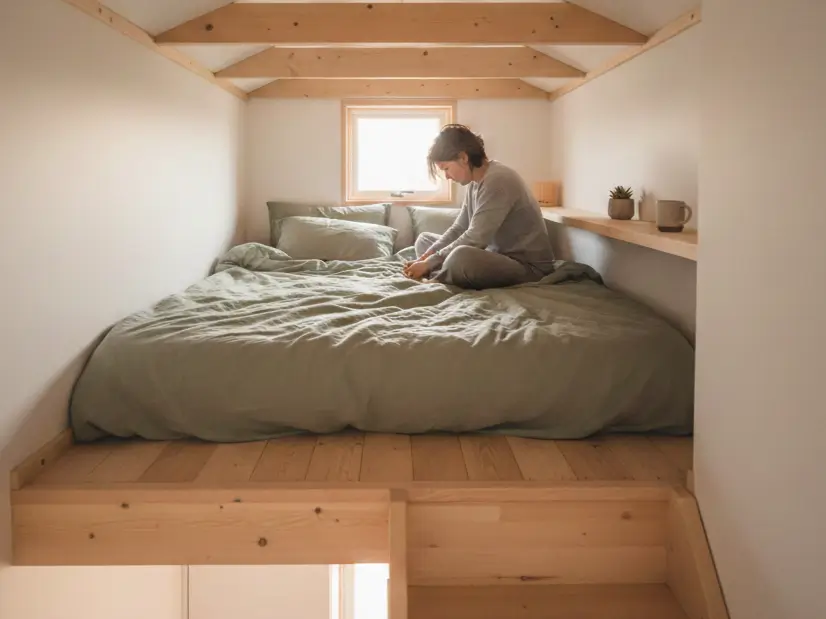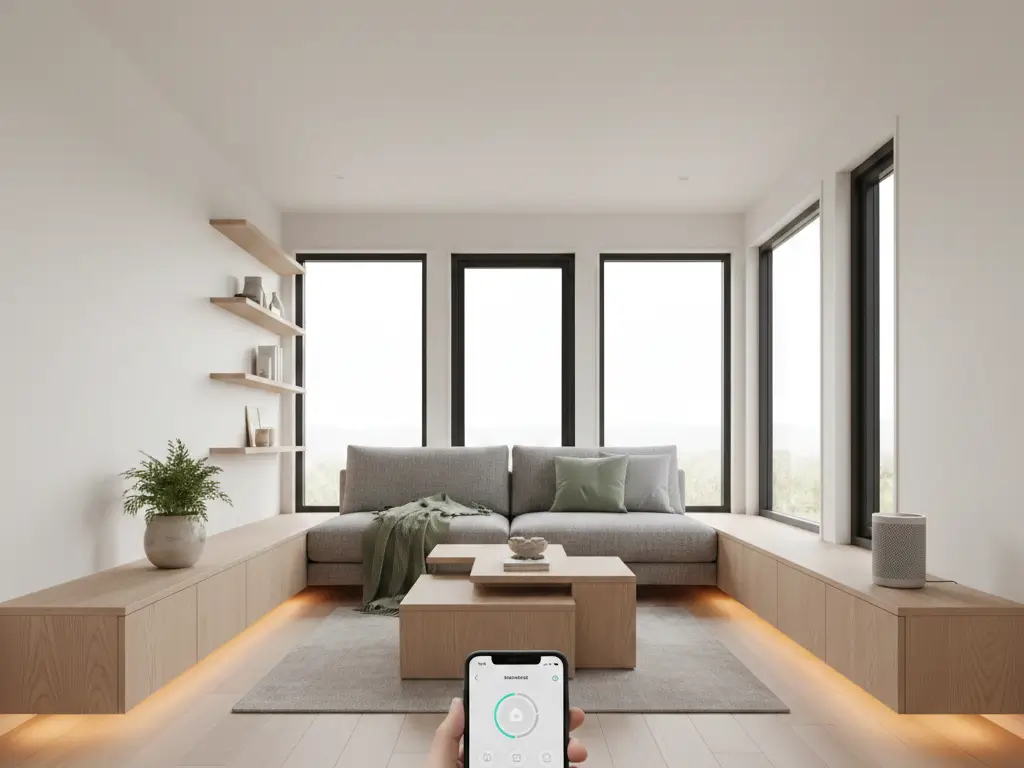
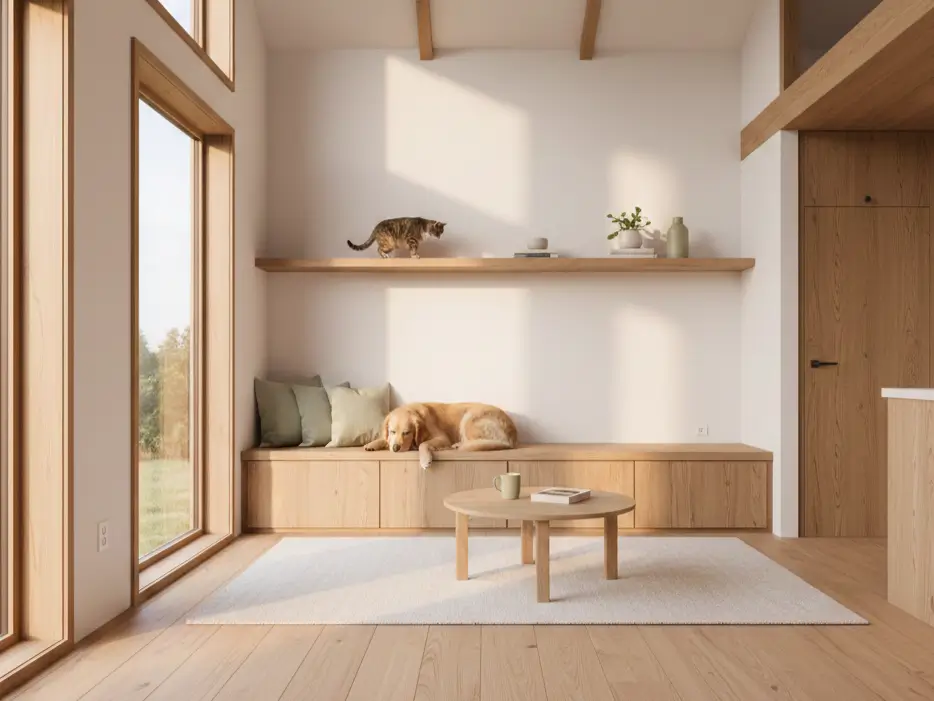
When you live in 2,000 square feet, a dog bed in the corner is just furniture. When you live in 350 square feet, that same dog bed consumes 4% of your total floor plan.
I realized the magnitude of this challenge when I visited a client living in a 24-foot tiny house on wheels (THOW) with two Golden Retrievers. The issue wasn’t the dogs; it was the lack of integration. Every time the dogs moved, the humans had to shuffle.
Living in a tiny house with pets isn’t about training your animal to take up less space. It’s about designing “negative space” into your build, utilizing the hollows under stairs, the air above your head, and the durability of your materials. Whether you are planning a DIY build on a $500 budget or commissioning a custom home, the goal is coexistence without collision.
Here is how to reclaim your square footage while giving your pets the home they deserve.
Flooring & Wall Protection: The Foundation
What is the Best Flooring for a Tiny House with Pets? For tiny houses with pets, Luxury Vinyl Plank (LVP) is the superior choice. It is 100% waterproof, scratch-resistant, and typically costs $3-$6 per sq ft. It handles moisture tracking from paws better than hardwood and is softer on joints than tile. Avoid laminate, which swells when wet.
The “High-Traffic” Reality
In a standard home, traffic is dispersed. In a tiny house, your pet walks over the exact same 15 square feet hundreds of times a day. This concentrated wear destroys standard materials quickly.
Flooring hierarchy for small spaces:
- Rigid Core LVP: Best overall. Look for a wear layer of at least 20 mil.
- Porcelain Tile: Indestructible but cold and heavy (bad for towing weight).
- Sealed Cork: Sustainable and antimicrobial, but dogs with long nails can puncture it.
See more on material specs: Tiny House Flooring Options
Wall Armor
Don’t ignore your vertical surfaces. In narrow hallways (often 36 inches wide in tiny homes), a wagging tail acts like a whip, and a wet dog shaking off hits every wall.
I recommend using a satin or semi-gloss finish for the bottom 36 inches of your walls. Flat paint holds onto oils from fur and is impossible to scrub without removing the pigment. For high-anxiety pets that scratch at doors, consider installing wainscoting or PVC paneling on the lower third of entry walls.
Related: Paint Finishes for Small Spaces
The Dog Crate Dilemma: Integrated Solutions
Where Do You Put a Dog Crate in a Small Apartment? Never use a standalone wire crate in a tiny home; it wastes vertical space. Instead, build the crate into furniture. Common locations include: under a staircase (requires 28″-36″ height), inside a media console, or as the base of a built-in sofa. A medium dog needs roughly 36″L x 24″W x 26″H of internal volume.
The “Negative Space” Approach
If you place a standard wire crate on the floor of a 400 sq ft apartment, you lose that footprint permanently. The solution is dual-functionality.
1. The Under-Stair Kennel
This is the holy grail for tiny house storage. The triangle of space beneath a staircase usually houses dust bunnies.
- Dimensions: A standard stair riser is 7-8 inches. By removing the sidewall framing under steps 3 through 6, you often gain a cavity roughly 30 inches high and 40 inches deep.
- Construction: Use rebar or custom metal grating for the door to allow airflow.
- Budget: DIY cost is roughly $150 in materials; custom metalwork can run $600+.
2. The “Murphy” Bed/Desk
For those working from home, a desk with a built-in crate underneath works perfectly. The desktop sits at 30 inches, providing ample clearance for small to medium breeds underneath.
Explore layout ideas here: Tiny House Furniture Guide
Feline Verticality: The Cat Superhighway
How to Create Space for Cats in a Tiny House? Cats live vertically. Increase their territory by installing a “superhighway” of shelves along the perimeter, 12-18 inches below the ceiling. Use sturdy brackets anchored into studs (every 16″). This adds zero footprint cost but doubles the cat’s active living space.
The 12-Inch Rule
You don’t need massive cat trees. A cat only needs a 10-12 inch deep ledge to feel comfortable. In a tiny house, run these shelves above your windows and over the kitchen cabinets.
The “Observation Deck” Strategy:
- The Route: Start with a step unit (or the back of a sofa) that leads to a mid-wall shelf.
- The Bridge: Run a plank across the loft gap.
- The Destination: A carpeted shelf near a high window or skylight (warmest spot).
The Hidden Litter Box
The litter box is the single hardest element to manage in a tiny house due to smell and space.
- The Bathroom Vanity: Cut a cat-shaped hole in the side of your vanity cabinet. Place the box inside. This contains the mess.
- Ventilation Hack: Install a small 4-inch computer fan or vent connected to the exterior wall inside the litter cabinet. This pulls odors directly outside before they enter the living space.
- Bench Storage: Use a hollow storage bench in the mudroom with top-lift access for cleaning and a side entry hole for the cat.
Check out: Tiny House Bathroom Design
Innovative Pet Feeding Stations for Small Spaces
Bowls on the floor are trip hazards in narrow walkways. Use toe-kick drawers (3.5″ to 4″ high) under kitchen cabinets to house bowls. You pull them out for feeding and kick them shut after. Alternatively, use wall-mounted elevated feeders that allow a Roomba or broom to pass underneath.
The Toe-Kick Drawer Build
Most kitchen cabinets have a 4-inch wasted space at the bottom called the toe kick.
- Dimensions: You need a clearance of at least 3.5 inches.
- Mechanism: Use heavy-duty drawer slides (rated 100lbs) because a drawer full of water and heavy kibble can sag standard slides.
- Waterproofing: Line the drawer with a rubber mat or seal the wood with marine-grade polyurethane to prevent mold from splashes.
Related: Tiny House Kitchen Design
Managing Pet Smells and Heat in Tiny Homes
Tiny homes heat up and cool down 4x faster than standard homes. For pets left alone, a mini-split system with Wi-Fi control is mandatory to monitor temps. To combat dander and odors in small air volumes, use a HEPA air purifier rated for double your square footage.
The Volume Problem
In a 2,000 sq ft house, a wet dog smell dissipates. In 200 sq ft, it saturates.
- Air Exchange: An Energy Recovery Ventilator (ERV) is excellent for airtight tiny homes, constantly swapping stale air for fresh without losing heat.
- Materials: Avoid wall-to-wall carpet. It acts as a sponge for odors. Stick to throw rugs you can take to a laundromat.
- Cleaning: Ensure your vacuum is cordless and stick-style. You have limited storage for bulky cleaning appliances.
Deep dive on systems: Tiny House Heating and Cooling
DIY Hacks vs. Custom Built-Ins
Budgeting for Pet-Friendly Tiny House Features
DIY adaptations (wall shelves, customized furniture) usually cost $50-$300. Structural built-ins (integrated crates, under-floor storage) must be planned during the framing phase and can add $1,000-$2,500 to a build due to custom cabinetry and framing labor.
| Feature | DIY Retrofit (Cost) | Custom Build (Cost) | Small Space Impact |
| Cat Shelves | $40 – $100 (Brackets + Wood) | $300+ (Integrated millwork) | High (Uses zero floor space) |
| Dog Crate | $80 (Modified end table) | $600+ (Under-stair/counter) | Massive (Reclaims ~6-8 sq ft) |
| Feeding | $30 (Wall mount bowl) | $200 (Toe-kick drawer) | Moderate (Clears walkways) |
| Flooring | $2/sq ft (Peel & Stick) | $5/sq ft (Rigid LVP) | Critical (Long-term durability) |
If you are currently building, spend the money on the flooring and the under-stair crate. These are nearly impossible to change later. You can always add cat shelves or wall-mounted feeders yourself for cheap.
For planning finances: Tiny House Budget Planning
Access & Safety: The Mud Nook
Do I Need a Mudroom in a Tiny House? Yes, but scale it down. A “mud nook” requires only 24 inches of wall width. It needs three elements: heavy-duty hooks for leashes, a washable rug or grate to catch grit, and a designated towel basket within arm’s reach of the door for wiping paws immediately.
The “Paw-Wipe” Protocol
Dirt management is critical. When your bed is only 10 feet from the front door, mud tracks migrate instantly.
- Flooring Transition: Use a rough-textured tile or a heavy coir mat recessed into the floor specifically at the entry.
- Storage: Keep treats and waste bags in a dispenser right at the door. If it’s not easy to grab, it becomes clutter.
Organization tips: Tiny House Storage Solutions
Final Thoughts
Designing a tiny house with pets forces you to be a better architect. You stop seeing a staircase as just steps and start seeing it as a potential kennel. You stop seeing a wall as a barrier and see it as a feline jungle gym.
The key takeaway is measurement. Measure your pet (height while standing, length while sleeping) before you build. A crate that is two inches too low is useless; a crate that is six inches too high is wasted storage space.
Start with the floor. Secure the durability there, and then look up. Your pets will adapt to the smaller square footage faster than you will, provided you give them their own dedicated spots to retreat.
- Measure your pet today (Height, Length, Turn-around radius).
- Audit your floor plan for “dead space” (corners, under-beds, toe-kicks).
- Choose one vertical upgrade (wall shelves or hooks) to implement this weekend.