
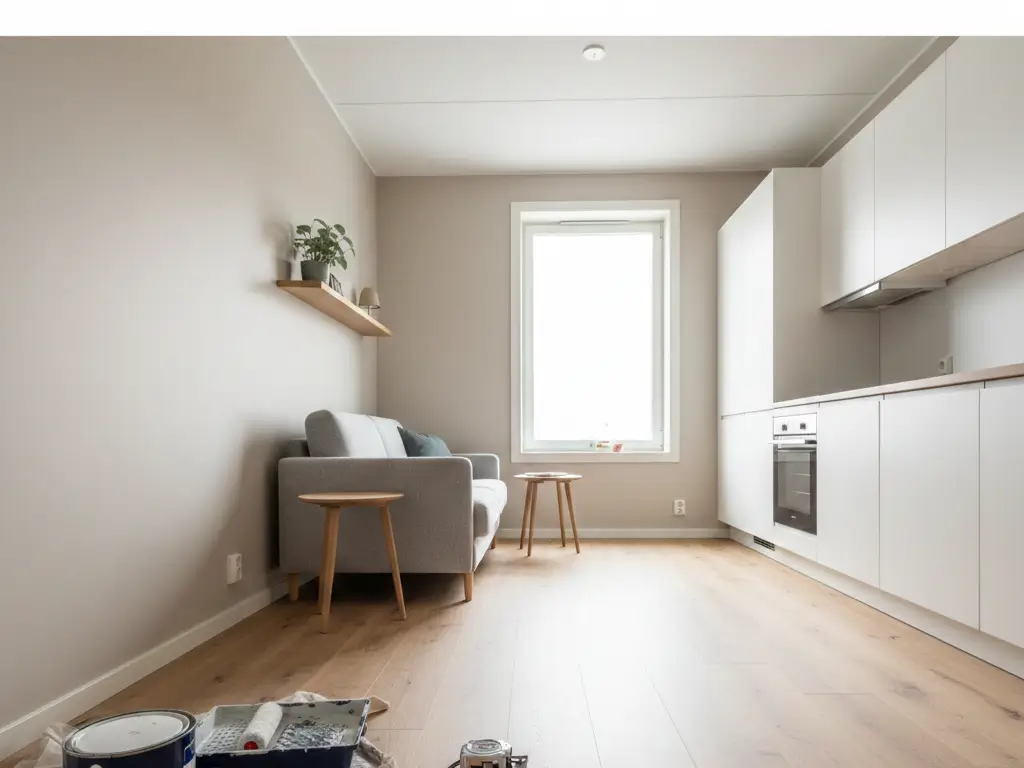
A single gallon of paint covers about 400 square feet. That means in a 350 sq ft tiny house, one gallon might coat nearly every wall you own. This math changes everything about how you should think about paint quality.
The right paint brand for small spaces prioritizes low VOC emissions, excellent coverage in one coat, and sample availability, because in compact living, every fume lingers longer and every dollar covers more of your home.
I learned this the hard way in my 450 sq ft apartment. I grabbed whatever was cheapest, ended up needing three coats, and spent two weeks with headaches from fumes that had nowhere to go. That $30 “savings” cost me $60 more in extra paint and a week of productivity.
Here’s the reality: small space dwellers face unique painting challenges that most brand comparisons ignore. Your ventilation is limited. Your wall area is smaller, so quality defects show more. And your budget per square foot actually allows for premium options, if you run the numbers correctly.
This guide breaks down seven paint brands through a small-space lens, with pricing from $35 to $95 per gallon and coverage specifics for homes under 800 sq ft. Whether you’re painting a tiny house on wheels or refreshing a studio apartment, you’ll know exactly which brand matches your space, budget, and air quality needs.
What Makes a Paint Brand “Small-Space Friendly”?
Small-space-friendly paint brands offer low or zero VOC formulas (critical when you can’t open multiple windows), true one-coat coverage to minimize fume exposure time, and sample sizes so you can test colors without buying full gallons you’ll never use.
Not every paint marketed as “premium” works well in compact living. I’ve tested paints that claim one-coat coverage but needed two passes on 8-foot walls in my narrow galley kitchen. In a 75 sq ft kitchen, that’s the difference between a Saturday project and a weekend ordeal.
The Three Non-Negotiables
VOC Levels Under 50 g/L
In a 400 sq ft apartment with one window, paint fumes concentrate 3-4x faster than in a 1,500 sq ft house. The EPA recommends VOC levels below 250 g/L, but that standard assumes normal ventilation. For tiny houses and small apartments, look for brands under 50 g/L or “zero VOC” ratings. Your low VOC paint options expand significantly when you prioritize this from the start.
True One-Coat Coverage
Every additional coat means more time with windows open (heating/cooling escaping), more fume exposure, and more paint purchased. In spaces under 600 sq ft, a paint that genuinely covers in one coat saves $40-80 in extra materials.
Sample Size Availability
Most brands sell gallons as their smallest size, roughly $40-75 that covers 400 sq ft. When your entire bedroom is 120 sq ft, a gallon is overkill for testing. Brands like Clare, Backdrop, and Benjamin Moore offer 8 oz samples ($8-15) that cover about 50 sq ft. That’s enough to paint a test section and see the color in your specific lighting.
Your tiny house color selection process becomes far less expensive when samples are readily available.
The 7 Best Paint Brands for Tiny Houses & Small Apartments
For small spaces, Clare and Backdrop lead for curated selection and DTC convenience, Benjamin Moore Natura tops premium durability, Behr Marquee wins budget one-coat coverage, and ECOS Paints dominates zero-VOC purity, each serving different priorities between $35-95 per gallon.
Here’s my breakdown after testing these in spaces ranging from 280 sq ft to 780 sq ft:
1. Clare Paint , Best for Color Confidence
Price: $54/gallon | VOC: <50 g/L | Coverage: 375-425 sq ft/gallon
Clare launched specifically for people overwhelmed by paint aisle decisions. Their collection of 55 designer-curated colors eliminates choice paralysis. For a 500 sq ft apartment, their peel-and-stick samples ($2 each) let you test without commitment.
What I appreciate: colors are grouped by room and mood, with LRV (light reflectance value) listed for each. When you’re trying to brighten a dark apartment, knowing a color reflects 72% of light versus 45% matters.
Small-space verdict: Excellent for decision-fatigued renters who want foolproof colors.
2. Benjamin Moore Natura , Best Zero-VOC Premium
Price: $75-85/gallon | VOC: Zero | Coverage: 400-450 sq ft/gallon
This is the paint I’d choose if I had chemical sensitivities and lived in a tiny house with minimal ventilation. Genuinely zero VOC, not just “low.” The self-priming formula means you skip a step, and skip additional fume exposure.
In a 320 sq ft tiny house, one gallon handles the main living walls with primer included. At $80, that’s $0.25 per square foot for premium, zero-emission coverage.
Small-space verdict: Worth the premium for health-conscious tiny house owners with limited airflow.
3. Behr Marquee , Best Budget One-Coat
Price: $50-55/gallon | VOC: <50 g/L | Coverage: 400 sq ft/gallon
Available at Home Depot, Behr Marquee consistently delivers one-coat coverage in my testing, actually important since budget paints often require extra coats that erase savings. Their color-matching technology is solid, and samples ($4 for 8 oz) are inexpensive.
For rental apartment painting, Marquee hits the sweet spot: good enough quality without premium price anxiety about potentially painting over it when you move.
Small-space verdict: Best value when you need reliable coverage without specialty features.
4. Backdrop , Best for Small-Space Aesthetics
Price: $55/gallon | VOC: Zero | Coverage: 350-400 sq ft/gallon
Backdrop was literally designed with small apartments in mind. Their 50-color palette emphasizes colors that work in limited natural light and tight spaces. Peel-and-stick samples are $4 each or 5 for $5.
Their “Standard” sheen is what they recommend for small spaces, a modern matte that still cleans well. In my experience, it’s less shiny than eggshell but more practical than flat. This matters when considering your paint finishes for small spaces.
Small-space verdict: The “designed for apartment living” brand that actually delivers.
5. Sherwin-Williams Emerald , Best for Durability
Price: $85-95/gallon | VOC: <50 g/L | Coverage: 400-450 sq ft/gallon
At the top of Sherwin-Williams’ line, Emerald offers antimicrobial protection and exceptional washability. In a 400 sq ft studio where walls take more contact (narrow hallways, furniture bumping), this durability matters.
The catch: you typically need a Sherwin-Williams store, and sales are frequent but unpredictable. I’ve seen Emerald drop to $65/gallon during promotions.
Small-space verdict: Long-term value for owners (not renters) who want 10+ year durability.
6. ECOS Paints , Best for Extreme Sensitivities
Price: $65-75/gallon | VOC: Zero (tested) | Coverage: 350-400 sq ft/gallon
ECOS is the only brand I’ve found that’s independently tested for zero VOC emissions, not just zero VOC in the can, but zero emissions after application. For tiny houses with lofted bedrooms where air stratifies, this distinction matters.
They offer samples directly on their website ($5 for sample squares) and ship nationally. Colors are more limited than mainstream brands, but they cover the neutral paint colors most requested for small spaces.
Small-space verdict: The choice for chemically sensitive individuals or those building health-focused tiny homes.
7. PPG Diamond , Best for Multi-Surface
Price: $55-60/gallon | VOC: <50 g/L | Coverage: 400 sq ft/gallon
PPG Diamond works on walls, trim, doors, and cabinets without switching products. In a tiny house where you might paint 200 sq ft of walls and 50 sq ft of trim, using one product simplifies everything.
Available at Home Depot and Ace, with decent sample availability. Not as premium as Benjamin Moore, but noticeably better than basic contractor grades.
Small-space verdict: Practical choice when painting multiple surface types in one project.
How to Choose Between Budget and Premium Paint for Small Spaces
In spaces under 500 sq ft, premium paint ($70-95/gallon) often costs only $20-40 more total than budget options, making quality per square foot affordable. Above 600 sq ft, budget paints with proven one-coat coverage make more financial sense.
This is where small-space math gets interesting. Let me show you the actual numbers.
The Cost-Per-Square-Foot Reality
| Space Size | Walls (~200 sq ft) | Budget Paint ($40/gal) | Premium Paint ($80/gal) | Difference |
| 350 sq ft tiny house | ~180 sq ft | $40 (1 gal) | $80 (1 gal) | $40 |
| 500 sq ft apartment | ~320 sq ft | $40 (1 gal) | $80 (1 gal) | $40 |
| 750 sq ft apartment | ~480 sq ft | $80 (2 gal) | $160 (2 gal) | $80 |
In a typical tiny house, the premium upgrade is $40 total, about $0.22 per square foot. That’s less than a dinner out for significantly better coverage, lower VOCs, and longer-lasting finish.
Your paint budget and cost analysis should factor in these small-space economics rather than assuming bigger-home math applies.
When Budget Paint Makes Sense
Go budget (Behr Premium Plus, PPG Ultra-Hide) when:
- You’re renting and may paint over within 2 years
- Your walls are already in great condition (less coverage needed)
- You have excellent ventilation (can air out quickly)
- The space exceeds 700 sq ft (savings become meaningful)
When Premium Paint Makes Sense
Go premium (Benjamin Moore Natura, Clare, Sherwin-Williams Emerald) when:
- You own and want 8-10 year durability
- Limited ventilation requires zero/low VOC
- Walls have minor imperfections (better coverage hides them)
- Space is under 500 sq ft (premium costs minimal)
I recommend reading about primer applications regardless of paint tier, proper prep reduces coats needed at any price point.
Paint Coverage Calculator: How Much Do You Need for Under 800 Sq Ft?
Measure wall height times wall length for each wall, subtract 21 sq ft per door and 15 sq ft per window, then divide total by 400 for gallons needed. A 400 sq ft apartment typically needs 1.5-2 gallons for main living walls.
Here’s the formula I use:
Step 1: Calculate gross wall area
- Measure each wall length × ceiling height
- Standard 8-foot ceilings in a 400 sq ft apartment: approximately 280-320 sq ft of wall space
Step 2: Subtract openings
- Standard door: 21 sq ft (7 ft × 3 ft)
- Average window: 12-15 sq ft
- A 400 sq ft apartment typically has 2 doors and 3 windows = ~87 sq ft to subtract
Step 3: Calculate net paintable area
- Gross wall area – openings = net area
- Example: 300 – 87 = 213 sq ft
Step 4: Divide by coverage rate
- Most quality paints: 350-400 sq ft per gallon
- 213 ÷ 375 = 0.57 gallons (buy 1 gallon)
For more precision on your specific layout, check our paint coverage calculation guide.
Sample Sizes: The Small-Space Secret
Here’s something most guides miss: sample sizes are disproportionately valuable in small spaces.
An 8 oz sample covers ~50 sq ft. In a 120 sq ft bedroom, that’s nearly half an accent wall, genuinely enough to evaluate color in morning, afternoon, and evening light. Compare that to a 1,500 sq ft house where the same sample is a tiny patch.
| Brand | Sample Size | Price | Coverage | Cost per Tested Sq Ft |
| Clare | Peel & stick | $2 | N/A (adhesive) | , |
| Backdrop | Peel & stick | $4 | N/A (adhesive) | , |
| Benjamin Moore | 8 oz | $8-10 | ~50 sq ft | $0.18 |
| Behr | 8 oz | $4 | ~50 sq ft | $0.08 |
| Sherwin-Williams | Quart | $10-12 | ~100 sq ft | $0.11 |
Invest in 2-3 samples before committing. Your decorating basics become much easier when you’ve pre-tested colors in your actual lighting.
Small-Space Painting Tips That Actually Work
Work in sections with immediate ventilation, choose satin or eggshell finishes for light reflection without glare, and use 4-inch mini rollers designed for tight spaces, these techniques matter more than brand when walls are within arm’s reach.
After painting multiple tiny houses and small apartments, here’s what consistently makes the difference:
Ventilation Strategy
In a space under 500 sq ft, create cross-ventilation before opening paint cans. One open window isn’t enough. Use a box fan in one window pushing OUT, and open a window or door on the opposite side. This creates airflow that moves fumes out rather than circulating them.
Paint one wall section, let it off-gas with ventilation running, then continue. In a 300 sq ft studio, I painted in 4 sessions over 2 days rather than pushing through in one overwhelming session.
Finish Selection for Small Rooms
Flat finishes absorb light. In small, dim spaces, that’s counterproductive. Satin reflects 35-40% more light than flat while hiding minor imperfections. Eggshell sits between them.
For low ceiling paint solutions, ceiling paint should be flat white (bounces light without glare) while walls go satin or eggshell for reflectivity.
Tool Selection
Skip the 9-inch rollers. In narrow hallways and tight corners, a 4-inch mini roller and 2-inch angled brush give you control without constantly repositioning. Our painting tools for tight spaces guide covers specific product recommendations.
For narrow space paint solutions, extension poles with mini rollers let you paint behind furniture without fully moving it, critical when there’s nowhere to move furniture anyway.
The Prep Reality
Every small-space painting guide mentions prep, but here’s the specific truth: in compact spaces, wall imperfections are closer to eye level and lighting is less forgiving. Spend the extra hour filling nail holes and lightly sanding. One coat on properly prepped walls beats two coats on rushed prep.
Our paint preparation guide covers small-space-specific prep that saves time overall.
Making Your Decision
The paint brand question for small spaces really comes down to three factors: how long you’re staying, how sensitive you are to fumes, and whether the premium upgrade math works in your square footage.
For renters in spaces under 600 sq ft: Behr Marquee or PPG Diamond offer reliable one-coat coverage at $50-60/gallon without the heartbreak of painting over premium paint when you leave.
For owners of tiny houses: Benjamin Moore Natura or ECOS Paints justify their premium with zero-VOC formulas essential for limited-ventilation living and 10+ year durability.
For apartment dwellers prioritizing aesthetics: Clare or Backdrop curate specifically for small-space lighting challenges and offer samples that actually make sense at smaller scales.
Whatever you choose, remember that small-space economics flip the usual calculations. Premium isn’t extravagant when one gallon covers your whole living area.
Order 2-3 samples in colors you’re considering and test them on your actual walls. In small spaces, living with a test patch for 48 hours through different lighting conditions prevents expensive mistakes. Then visit Veniola for more guides on making your compact space work harder, from style and aesthetic planning to lighting solutions that complement your new wall colors.