
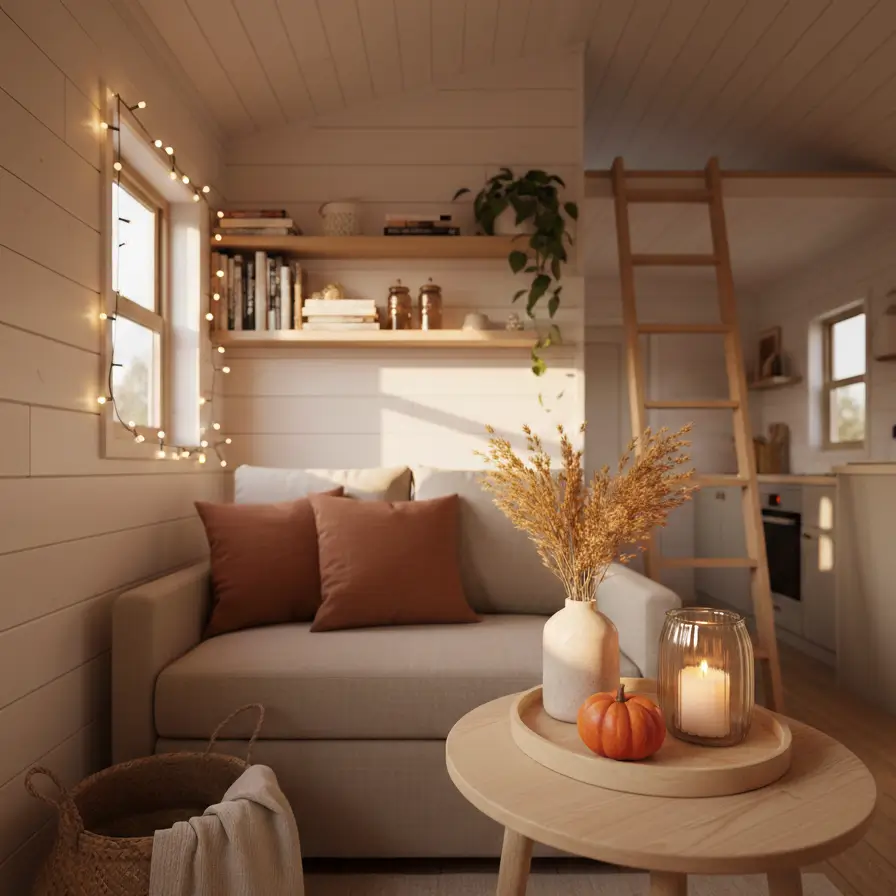
The average American household stores 15-20 boxes of seasonal decorations in their basement, attic, or garage. That’s roughly 45 cubic feet of storage, more square footage than many tiny house lofts.
The decorations themselves aren’t the problem. Storage is. When you’re working with 280-400 square feet, you can’t afford to dedicate a closet to Christmas lights and another bin to fall pumpkins.
I spent three years cycling through seasonal decorations in my 320 sq ft tiny house before I figured out what actually works. The “just buy smaller versions” advice from lifestyle blogs failed me completely. A miniature Christmas tree still needs somewhere to live during the other 11 months.
What changed everything? Shifting from seasonal ownership to seasonal transformation. Instead of swapping entire collections four times a year, I now use 12 base pieces that adapt across seasons, plus exactly 6 items stored in a single 12″ x 12″ x 18″ bin tucked under my bed.
This guide covers practical tiny house decorating strategies that celebrate each season without sacrificing the closet space you desperately need for actual necessities. Whether you’re preparing for your first tiny house holiday or you’ve already experienced the frustration of “where does this go now?”, you’ll walk away with a system that actually fits your life.
You can create year-round seasonal ambiance for $75-150 total, or invest $300-500 in quality pieces that last a decade. I’ll break down both approaches.
How Much Seasonal Decor Can a Tiny House Actually Hold?
Most tiny houses under 400 sq ft can comfortably accommodate 8-15 displayed seasonal items at once, plus one 12″ x 18″ x 12″ storage bin (approximately 1.5 cubic feet) for off-season pieces. Anything beyond this creates visual clutter and storage stress that defeats the purpose of seasonal celebration.
The number that matters isn’t how many decorations you own, it’s your display surface area. Let me break this down with actual measurements.
A typical tiny house has:
- Kitchen counter space: 8-12 sq ft usable (but you need most of it)
- Windowsills: 4-8 linear feet at 4-6″ depth
- Wall space: Limited by windows and loft access
- Tabletop surfaces: Often just 2-4 sq ft total
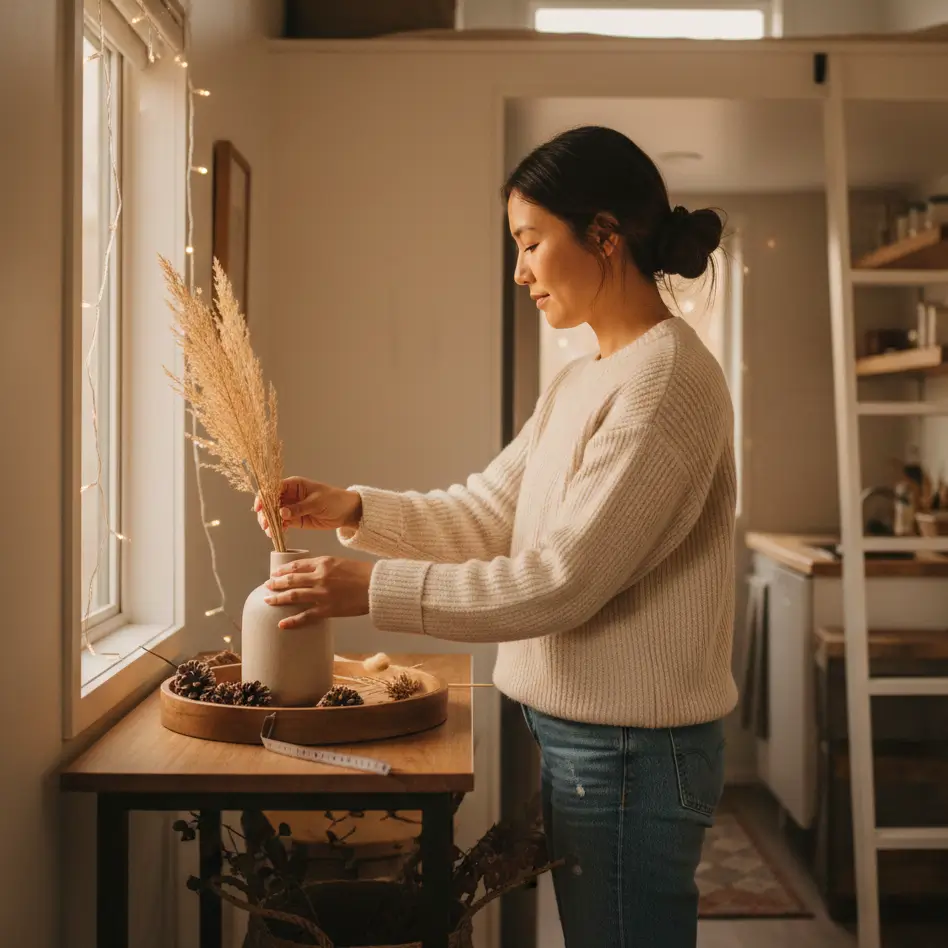
When I mapped my 320 sq ft space, I found exactly 6 sq ft of dedicated display area. That’s roughly the size of a dinner plate surface times four. This constraint actually became liberating once I stopped fighting it.
Your tiny house layout determines everything. Loft bedrooms steal wall height from living areas. Open shelving looks cluttered faster. Kitchens demand function over festivity.
The 10% rule works best: Dedicate no more than 10% of visible surfaces to seasonal decor. In a 350 sq ft space with 15 sq ft of display surfaces, that’s 1.5 sq ft of actual seasonal decorations. Sounds tiny? It’s enough for one statement piece and 3-4 supporting items.
What surprised me most: visitors always notice and compliment my seasonal touches. Less really does register as more intentional, not more sparse.
Where Do You Store Seasonal Decorations in a Tiny House?
The best tiny house seasonal storage uses dead space you already have: under-bed areas (typically 12-18″ clearance), above-cabinet gaps (usually 8-12″ height), and inside hollow furniture. Total storage needed: 1-2 cubic feet maximum when using the multi-season approach.
Storage is where most tiny house dwellers fail at seasonal decorating. They buy beautiful fall decor, love it for two months, then face the “where does this live now?” panic.
Here’s my tested hierarchy of tiny house seasonal storage spots:
Tier 1: Under-bed storage
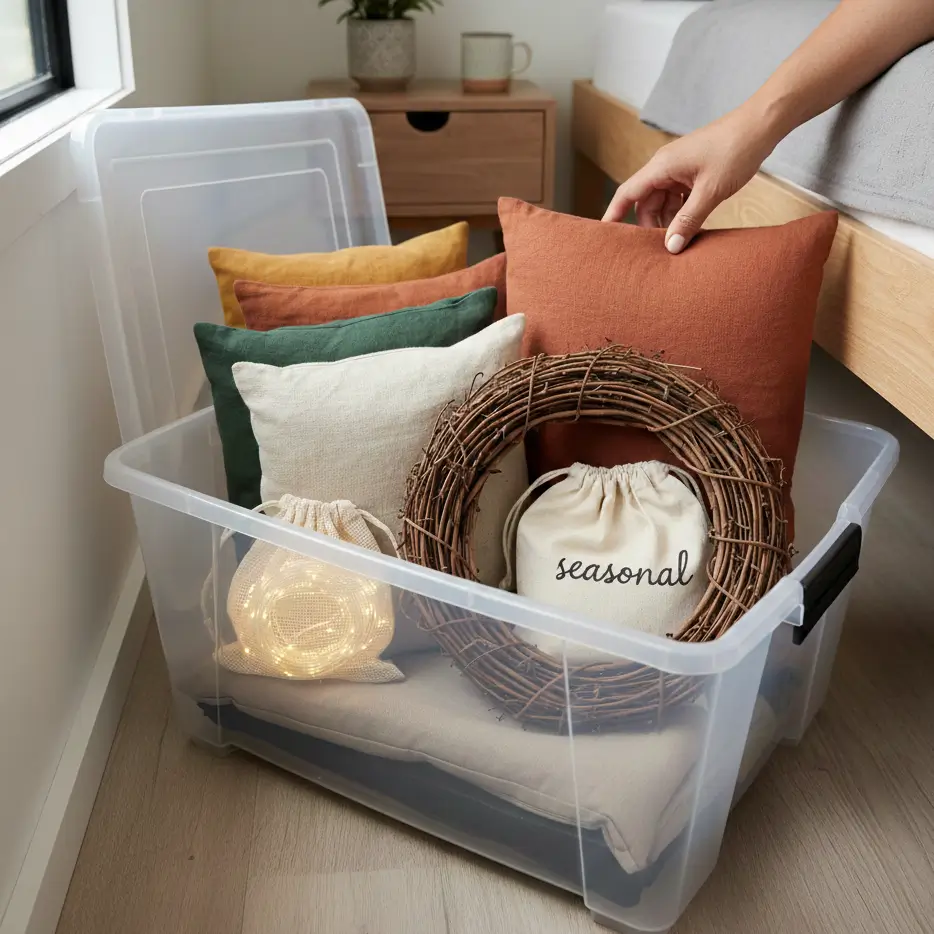
Most tiny house beds have 12-18″ clearance underneath. A flat 24″ x 18″ x 6″ bin holds 4-6 pillow covers, one compact wreath, and fairy lights for the entire year. Cost: $12-25 for the bin. This is where I store my non-negotiable seasonal items, the ones worth keeping.
Tier 2: Above-cabinet dead space
That 8-12″ gap above kitchen cabinets? Perfect for flat-stored items like table runners, fabric garlands, and folded seasonal textiles. Use vacuum bags to compress, $15 for a 6-pack compresses 40 cubic inches to 10.
Tier 3: Inside furniture
If you’ve invested in multi-functional tiny house furniture, you likely have ottoman storage, bench seats, or hollow headboards. Reserve one corner exclusively for seasonal items.
What doesn’t work:
- Overhead loft storage (too hard to access, things get forgotten)
- Exterior storage (temperature/humidity damages decorations)
- “I’ll just buy new each year” (expensive and wasteful)
The real secret? Own less. When I switched to the multi-season decoration approach covered in the next section, my storage needs dropped from one 18-gallon bin to a shoebox-sized container. Your storage solutions should support your life, not complicate it.
Multi-Season Decorations That Transform Throughout the Year
The most effective tiny house seasonal strategy uses 10-15 base items that adapt through all four seasons, supplemented by 3-5 truly seasonal pieces stored in under 1 cubic foot. This approach costs $150-300 upfront but eliminates ongoing seasonal purchases and storage battles.
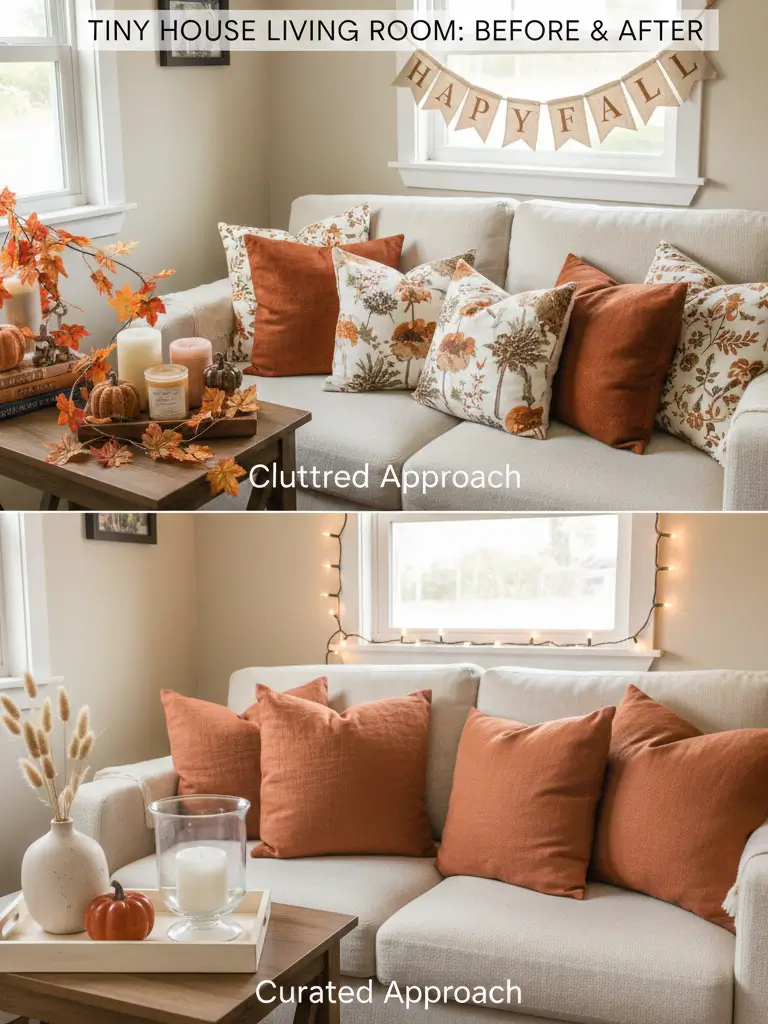
This concept changed my entire approach: instead of four separate decoration collections, I maintain one curated set that evolves.
The Foundation Pieces (Keep Year-Round):
| Item | Size | Use Across Seasons | Cost Range |
| Neutral ceramic vase | 6-8″ tall | Hold seasonal branches, flowers, or grasses | $15-45 |
| String lights (warm white) | 15-20 ft | Window outline, shelf accent, party ambiance | $12-30 |
| Natural wood tray | 12″ x 8″ | Base for seasonal vignettes | $20-40 |
| Woven basket (2-3) | 8-12″ diameter | Hold blankets, pillows, or seasonal produce | $25-60 total |
| Linen pillow covers (4) | 18″ x 18″ | Swap for seasonal colors | $40-80 total |
| Glass hurricane/candle holder | 8-10″ tall | Hold candles, fairy lights, or seasonal fill | $15-35 |
Total foundation investment: $127-290
These pieces form your tiny house style aesthetic base. They’re never “put away”, they simply hold different things.
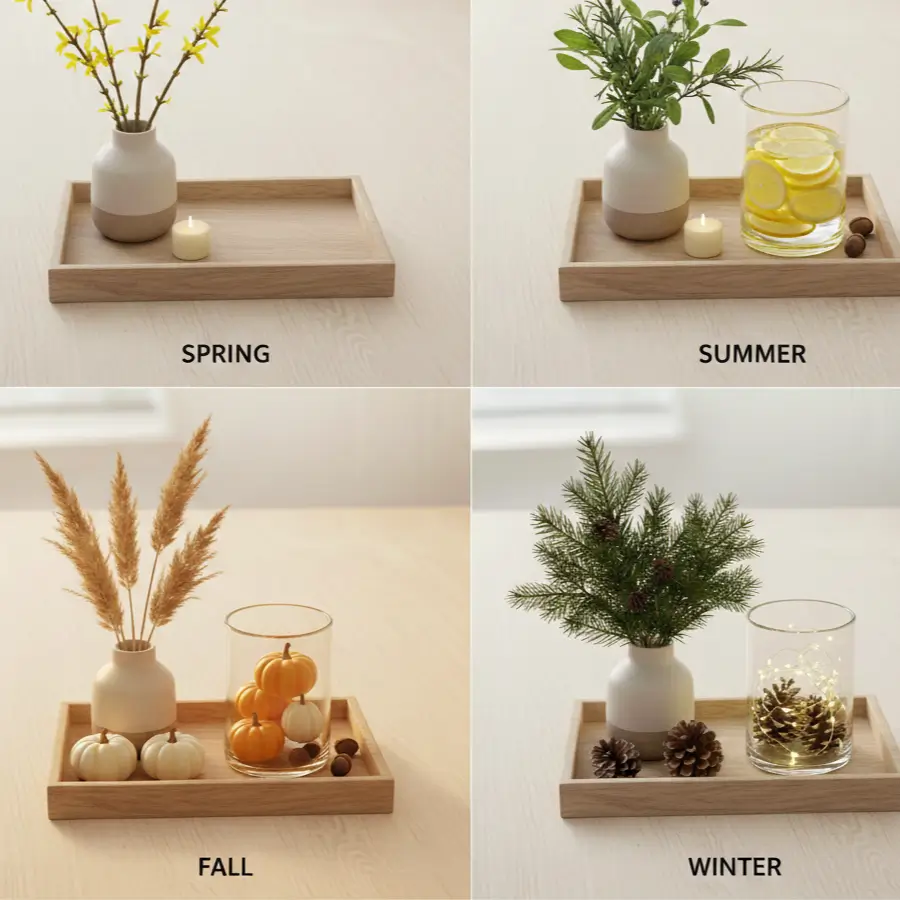
How Transformation Works:
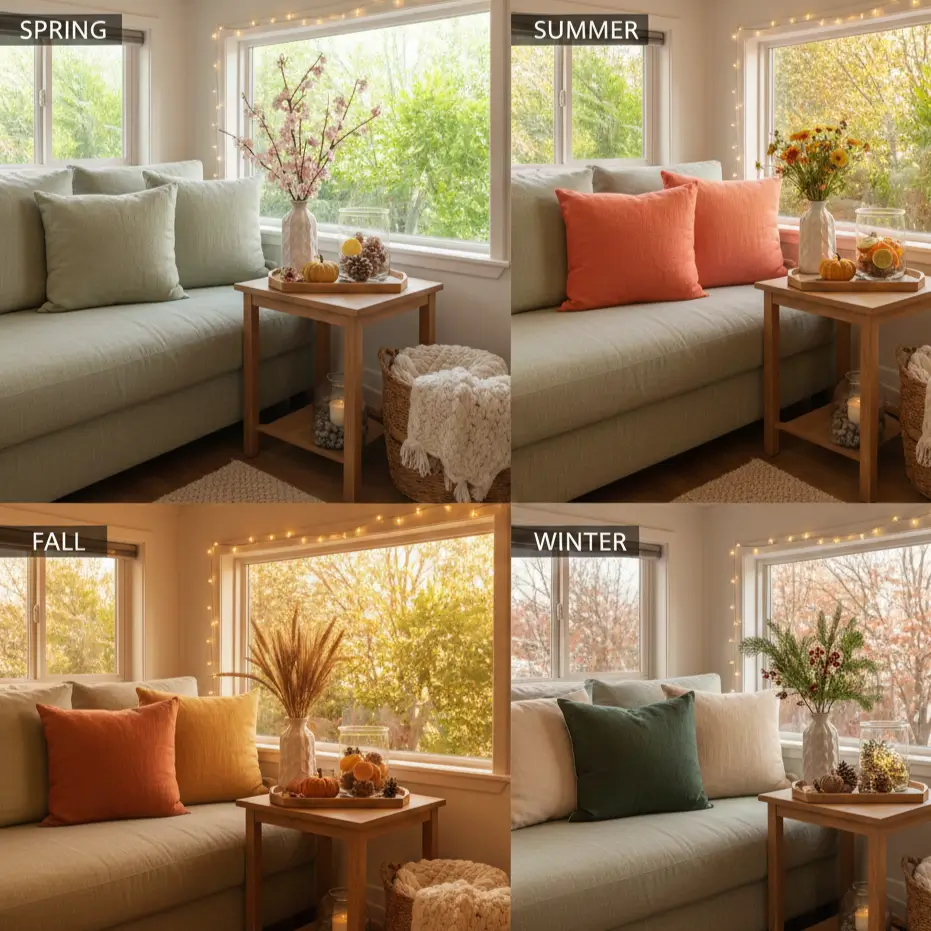
Spring: Neutral vase holds forced forsythia branches ($0 if foraged, $8 at grocery store). Pastel linen pillow covers. Hurricane holds river rocks and a candle.
Summer: Same vase holds farmers market flowers or herbs from your vertical garden. Bright pillow covers. Hurricane filled with shells or citrus.
Fall: Vase holds dried grasses or branches with leaves. Rust/ochre pillow covers. Hurricane filled with mini pumpkins or acorns.
Winter: Vase holds evergreen clippings or bare branches. Deep jewel-toned or cream pillow covers. Hurricane holds pinecones and string lights.
The Minimal Seasonal Additions:
I store exactly these items in my under-bed bin:
- One 16″ wreath form (I swap what’s attached seasonally, dried flowers, evergreen, ribbon)
- 4 seasonal pillow covers beyond my neutrals
- One strand of colored string lights (I use these maybe 6 weeks/year)
- Small bag of truly seasonal items: 3 small pumpkins (fall), one strand of red/green lights (December only)
That’s it. Everything else adapts.
Room-by-Room Seasonal Decorating for Spaces Under 400 Sq Ft
Focus seasonal decorating on your primary living zone (typically 40% of tiny house square footage), keep bedrooms minimal with textile changes only, and limit kitchen decor to one 6-8″ item to preserve function. Bathrooms need zero seasonal decor, swap hand towels only.
The mistake I see constantly: spreading seasonal decor throughout every room. In a traditional home, this creates cohesion. In a tiny house, it creates visual chaos and makes the space feel smaller.
Living Area (Priority: HIGH)
This is where seasonal energy belongs. In my 320 sq ft, my living zone is roughly 100 sq ft. I place:
- One seasonal vignette on my 12″ x 8″ tray (rotated monthly)
- String lights along one window (15 ft strand)
- 2-3 seasonal pillow covers on my 60″ loveseat
- One seasonal element on my 6″ deep floating shelf
That’s it. The impact reads as intentional, not cluttered.
Your lighting solutions can do heavy lifting here. Warm string lights (2700K) instantly shift ambiance without adding physical objects.
Kitchen (Priority: LOW)
Your tiny house kitchen needs to function. Period. I allow one seasonal item maximum, usually a 6″ plant (rosemary at Christmas, herbs in summer) or a small seasonal hand towel. Nothing on counter surfaces that disrupts cooking workflow.
Bedroom/Loft (Priority: MEDIUM)
If you have a dedicated sleeping area, seasonal textiles work beautifully without adding clutter. Swap:
- Duvet cover or throw blanket (seasonal color/weight)
- 1-2 pillow shams
- Nothing else
Avoid any tabletop seasonal decor in sleeping areas. It collects dust and disrupts the restful function of the space.
Bathroom (Priority: NONE)
Your tiny bathroom is not a decorating opportunity. Change hand towels seasonally if you want (cost: $10-20 per season). Skip everything else.
DIY Natural Seasonal Decor vs. Store-Bought: What Actually Works Better
DIY natural seasonal decor costs $0-30 per season and stores in zero space (it composts), but requires foraging access and creative confidence. Store-bought costs $40-150 per season, requires storage, but offers consistency and convenience. For most tiny house dwellers, a 70/30 DIY-to-purchased ratio works best.
| Factor | DIY Natural Decor | Store-Bought Decor | Tiny House Winner |
| Cost per season | $0-30 | $40-150 | DIY |
| Storage needed | 0 cubic feet | 1-3 cubic feet | DIY |
| Time investment | 2-4 hours | 1-2 hours | Store-bought |
| Environmental impact | Minimal/positive | Variable | DIY |
| Consistency | Varies by location | Predictable | Store-bought |
| Year-over-year cost | $0-120/year | $160-600/year | DIY |
When DIY Natural Works Brilliantly:
If you have access to outdoor spaces, even a city park, seasonal foraging provides free, zero-storage decor that naturally decomposes when you’re done.
What I collect:
- Fall: Branches with leaves, dried grasses, acorns, pinecones
- Winter: Evergreen clippings (ask neighbors with Christmas trees), bare branches, holly
- Spring: Flowering branches (forsythia, cherry), pussy willows
- Summer: Wildflowers, herbs from farmers markets, interesting leaves
This approach aligns beautifully with sustainable tiny house living. Nothing to store, nothing to throw away, no manufacturing footprint.
When Store-Bought Makes Sense:
Quality pillow covers, artificial seasonal botanicals for allergic folks, and LED lights are worth purchasing. These items last 5-10 years, store flat, and provide reliable results.
Buy once: neutral ceramic vessels, wood trays, linen pillow cover sets in seasonal colors. The color palette approach I use rotates through 3 seasonal colorways that complement my permanent decor.
Making Tiny House Holiday Entertaining Work
When guests visit your tiny house during holidays, the decoration question becomes practical, not just aesthetic. How do you create festive ambiance without blocking the only walkway or filling the only table?
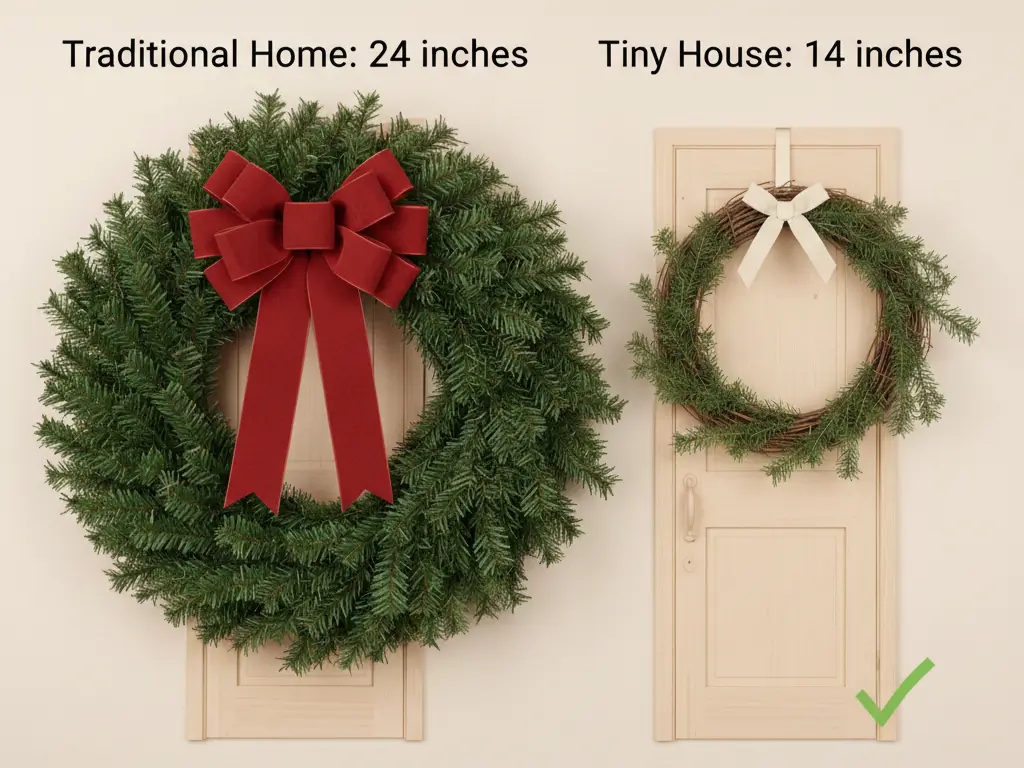
The solution connects to entertaining guests in tiny spaces: vertical decorating. Everything goes UP instead of out.
Vertical Holiday Tactics:
- Hang a wreath on the inside of your door (saves exterior hardware, visible when home)
- String lights along ceiling perimeter (15 ft covers most tiny houses)
- Window-suction hangers for lightweight ornaments
- Wall-mounted stocking hooks (no mantel needed)
A Portland couple I know hosts 8 people for Christmas dinner in their 280 sq ft tiny house. Their secret? All decorations hang above 6 ft or attach to windows. The floor and table surfaces stay completely clear for function.
The Scent Factor:
In small spaces, seasonal scent creates more impact than visual decor. One 8 oz candle or a small simmer pot transforms the sensory experience without taking display space. This works with your indoor plants too, rosemary, eucalyptus, and pine cuttings provide visual AND aromatic seasonal ambiance.
Your Seasonal Decor Action Plan
The seasonal decorating approach that works in tiny houses isn’t about deprivation, it’s about intention. You can absolutely celebrate every season, host memorable gatherings, and feel the shift from summer’s brightness to winter’s coziness.
The key insight: transformation beats accumulation. Invest in 10-15 quality base pieces that adapt, maintain a minimalist seasonal bin under 2 cubic feet, and let natural/foraged elements carry most of the seasonal specificity.
Walk through your tiny house and measure your actual display surfaces. Count the square feet available for seasonal decor, not what you wish you had, but what exists. This number determines everything.
Identify your foundation pieces. What vessels, baskets, and textile items do you already own that could serve year-round with seasonal styling?
Try the transformation approach for one season before buying anything new. Document what you actually need versus what you thought you’d want.
For more strategies on making small spaces work beautifully, explore Veniola’s complete tiny house guides, covering everything from flooring choices to minimalist living approaches that support intentional seasonal celebration.
Your tiny house isn’t a limitation on festive living. It’s an invitation to be more thoughtful about what celebration actually means to you.