
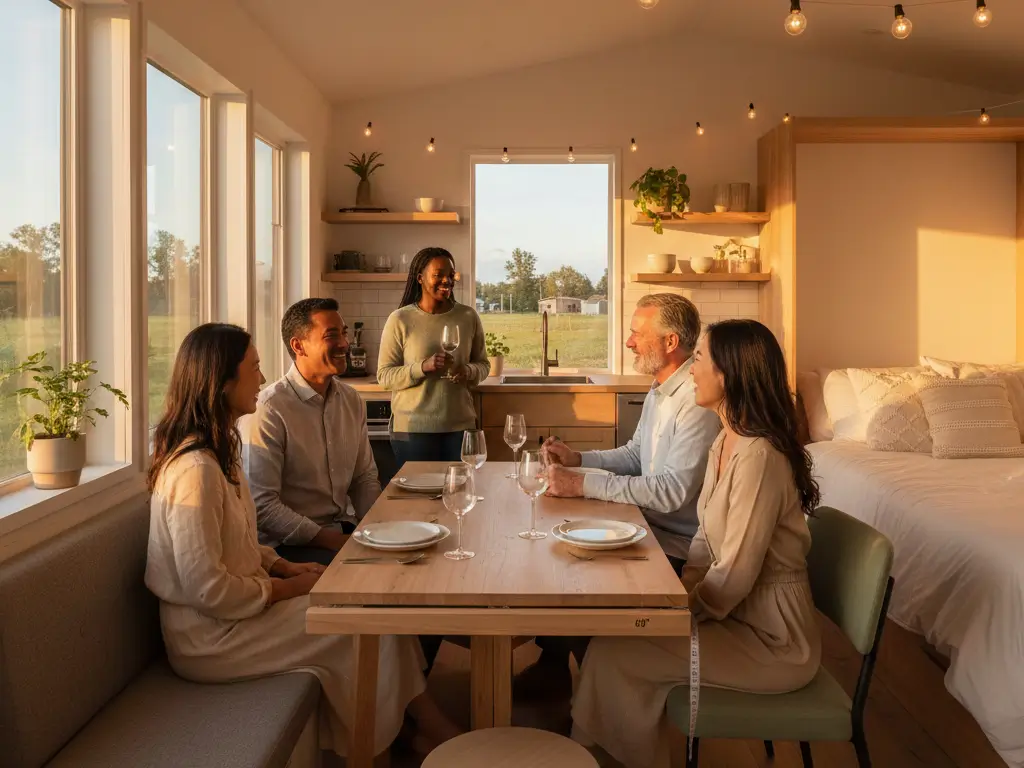
The average American hosts guests 8 times per year. When you live in 280 square feet, that statistic feels almost laughable, until you realize your tiny house can actually handle it.
You can comfortably entertain 6-8 guests in a tiny house under 400 square feet using convertible furniture, vertical space, and a 20-minute transformation system that flips your daily living setup into party mode.
I’ve hosted Thanksgiving dinner for 7 people in my 320 sq ft tiny house on wheels. It wasn’t cramped. It wasn’t stressful. And it definitely wasn’t the awkward standing-in-a-kitchen-corner situation I’d dreaded. The secret? Thinking about entertaining as a design system, not a decorating afterthought.
Whether you’re planning intimate dinner parties or overnight guests, you’ll find solutions ranging from $50 DIY fixes to $2,000+ investment pieces. Most tiny house dwellers find their sweet spot somewhere in the $300-800 range for a complete entertaining setup.
Your tiny house layout and floor plan already contains entertaining potential. Let’s unlock it.
Can You Really Entertain in a Tiny House? The Honest Space Math
A tiny house can accommodate 1 seated guest per 25-30 square feet, or 1 standing guest per 6-8 square feet. This means a 300 sq ft home can host 10-12 standing guests or 6 seated dinner guests, if you optimize furniture placement and traffic flow.
The “it’s too small” excuse usually comes from comparing tiny house parties to traditional suburban hosting. That comparison misses the point entirely.
Traditional entertaining assumes dedicated dining rooms, extra chairs stored in closets, and serving tables that stay put year-round. Tiny house entertaining works differently. It’s about transformation, not accommodation.
The Guest Capacity Formula
Here’s the math I use:
Seated entertaining (dinner parties):
- Total usable floor space ÷ 25 = comfortable guest count
- Example: 280 sq ft × 0.70 (usable after furniture) = 196 sq ft ÷ 25 = 7-8 guests
Standing entertaining (cocktail party style):
- Total usable floor space ÷ 6 = maximum guest count
- Example: 280 sq ft × 0.80 (standing space) = 224 sq ft ÷ 6 = 37 guests (though 15-20 feels comfortable)
The 0.70 multiplier accounts for kitchen, bathroom, and built-in furniture that can’t move. For standing events, you can push furniture against walls, increasing usable space to about 80%.
What’s interesting here: intimacy actually works in your favor. A dinner party in a 280 sq ft tiny house feels cozy and intentional, while that same group in a 2,000 sq ft home might feel sparse.
Your tiny house furniture choices determine whether that 0.70 multiplier drops to 0.50 or climbs to 0.85.
Essential Convertible Furniture for Tiny House Entertaining
The three non-negotiables are a fold-down wall table ($150-$400), stackable or foldable seating ($30-$100 each), and an ottoman with hidden storage ($80-$250). These create 40+ additional square feet of entertaining space while storing flat against walls or double-functioning daily.
Furniture that only serves one purpose doesn’t belong in a tiny house. Period. Every entertaining piece needs to work overtime.
DIY Budget ($50-$300):
- Wall-mounted fold-down table: $80-$150 (IKEA NORBERG at 29″ × 23″ works for 2 additional guests)
- Folding wooden stools: $25-$40 each (stack to 8″ when stored)
- Floor cushions: $15-$35 each (Japanese zaisu style, store in 6″ stack)
Mid-Range ($300-$1,200):
- Drop-leaf dining table: $200-$400 (extends from 20″ to 60″, seats 4-6)
- Convertible bench with storage: $300-$500 (seats 3, holds table linens)
- Nesting side tables: $150-$250 (set of 3, use as drink stations)
Investment ($1,200-$5,000+):
- Murphy bed with integrated sofa: $2,500-$4,500 (reclaims 24-32 sq ft for entertaining)
- Transforming coffee-to-dining table: $1,200-$2,000 (rises from 18″ to 30″ and extends to seat 6)
- Built-in banquette with hidden storage: $1,500-$3,000 (custom fit, seats 4-5 in 25 sq ft)
A Portland couple I know invested $3,200 in a wall bed system for their 340 sq ft tiny house. That purchase created a dedicated 8 × 4 ft entertaining zone that simply didn’t exist before. Their storage solutions shifted to match, find ideas in our tiny house storage solutions guide.
The 24-Inch Rule
Here’s a measurement that changed how I buy furniture: each seated guest needs 24 inches of table width. A 60-inch table theoretically seats 5 (two ends, three sides), but a 72-inch table comfortably seats 6.
For tiny houses, a table that expands from 36″ to 72″ hits the sweet spot, workable daily size, dinner party capacity when extended.
The 20-Minute Transformation: Daily Mode to Party Mode
Converting a tiny house from daily living to entertaining-ready takes exactly 20 minutes using a 5-phase system: clear surfaces (4 min), relocate daily items (5 min), expand furniture (4 min), set up serving stations (4 min), and final styling (3 min).
This is where most tiny house dwellers get stuck. The mental load of “preparing” the space feels overwhelming, so they simply don’t host.
The solution? A repeatable system. Here’s mine:
Phase 1: Clear Surfaces (4 minutes)
Everything on counters, tables, and visible shelves goes into a designated “hosting bin”, a large basket stored in a closet. No sorting. No organizing. Just sweep it in. You’ll put everything back tomorrow.
Phase 2: Relocate Daily Items (5 minutes)
- Work laptop → under bed or in closet
- Pet items → bathroom or outdoor storage
- Random shoes/clothes → behind a curtain or closed door
- Mail and papers → into hosting bin
Phase 3: Expand Furniture (4 minutes)
- Lower Murphy bed or move it against wall
- Extend drop-leaf or fold-down table
- Pull out extra seating from storage
- Move coffee table to side wall
Phase 4: Set Up Serving Stations (4 minutes)
- Kitchen counter → main food station
- Bar cart or tray on storage ottoman → drink station
- Window ledge or shelf → appetizer zone
- Bathroom counter → cleared and restocked
Phase 5: Final Styling (3 minutes)
- Dim overhead lights, add candles or string lights
- Put on background music
- Set out napkins, plates, simple florals
- One final walk-through
Your tiny house decorating basics should support this transformation. If a decorative item requires 5 minutes to relocate, it’s not worth displaying.
The key insight: don’t clean deeply before every gathering. Your regular cleaning schedule handles that. This 20-minute transformation is purely about spatial conversion.
Tiny House Kitchen Strategies for Feeding a Crowd
Prep-ahead cooking, single-vessel meals (one Instant Pot feeds 6-8), and strategic use of outdoor grilling extend your tiny kitchen’s capacity. Plan for 15 sq ft of prep/serving space per 4 guests, using temporary surfaces if needed.
Your tiny house kitchen design was built for 1-2 people. Feeding 6-8 requires a shift in strategy, not miracles.
The Prep-Ahead Method
The day-of cooking mentality doesn’t work in 40-50 sq ft kitchens. Instead:
48 hours before: Make sauces, dressings, and marinades (store in fridge)
24 hours before: Prep all vegetables, make dessert, set table
4 hours before: Start slow-cooking proteins
30 minutes before: Assemble salads, warm bread, plate appetizers
This approach means your tiny kitchen handles assembly, not active cooking, when guests arrive.
One-Pot Entertaining
My single best entertaining purchase? A 6-quart Instant Pot ($80-$120). It handles:
- Main protein for 8 (pulled pork, pot roast, curry)
- Soup course for 10
- Dessert (cheesecake, bread pudding) while guests eat dinner
Keep your kitchen fixtures and appliances multi-functional. A beautiful Dutch oven serves on the table. A wooden cutting board becomes a cheese platter.
Counter Space Hacks
| Solution | Added Space | Cost | Storage Requirement |
| Over-sink cutting board | 2 sq ft | $25-$50 | Slides behind counter |
| Fold-down wall shelf | 3 sq ft | $40-$80 | Flat against wall |
| Stovetop cover | 2.5 sq ft | $30-$60 | Above stove |
| Rolling cart | 4 sq ft | $50-$150 | Closet or corner |
These additions create 8-12 extra square feet of prep and serving surface without permanent installation, perfect for renters following our tiny house renters guide.
Overnight Guests: Where Everyone Sleeps
A 400 sq ft tiny house can sleep 4-6 people using sleeping lofts (2 guests), convertible sofas (2 guests), and quality air mattresses (2 additional guests on floor space). Allocate 21 sq ft minimum per sleeping guest for comfortable arrangements.
Overnight entertaining raises the stakes. You’re not just hosting for a few hours, you’re sharing your entire tiny existence.
Sleeping Options by Space Type
Loft spaces (typical 80-120 sq ft):
Your primary bedroom loft fits 2 guests on a queen mattress. If you’re the host, you’ll likely take the convertible option downstairs while guests get the real bed.
Main floor (200-280 sq ft):
- Sofa bed or Murphy sofa: 2 guests, requires 45 sq ft deployed
- Japanese futon or tri-fold mattress: 2 guests, stores in 3 cubic feet
- Premium air mattress: 2 guests, inflates in 3 minutes
Your bedroom design should anticipate occasional guest use. A loft with ceiling height under 4 feet works for sleeping but frustrates guests who can’t sit up.
The Guest Comfort Kit
Keep a dedicated guest bin with:
- Fresh towels and washcloths
- Basic toiletries (new toothbrush, travel shampoo)
- Phone charger with long cord
- Earplugs and sleep mask
- Water bottle
Store this in 1 cubic foot. Pull it out for every overnight guest.
A consideration worth mentioning: bathroom design becomes critical with overnight guests. One bathroom serving 4+ people needs clear scheduling and a well-stocked space.
Indoor-Outdoor Entertaining: Expanding Your Tiny Footprint
Outdoor space can double your entertaining capacity by adding 40-150 sq ft of usable area. A 10 × 12 ft deck adds room for 6-8 additional standing guests or 4-6 seated, effectively expanding a 300 sq ft home to 420 sq ft during warm months.
This is the tiny house entertaining cheat code that changes everything.
Making Indoor-Outdoor Flow Work
The key is treating outdoor space as a room extension, not a separate area:
Visual continuity:
- Match outdoor cushions to indoor palette
- Extend string lights from interior to exterior
- Use similar plants inside and out, see our indoor plants for small apartments guide
Functional connection:
- Position outdoor dining within 10 feet of kitchen window for easy food passing
- Create a drink station on the deck to pull traffic outside
- Install speakers that serve both spaces
Seasonal Considerations
Your seasonal decor approach affects outdoor entertaining viability:
Spring/Fall: Blankets, string lights, fire pit or portable heater ($80-$200)
Summer: Shade solutions, cold drink station, fans for air movement
Winter: Focus indoors, but covered porch with heaters extends space in mild climates
A 12 × 12 ft deck with basic furnishings costs $500-$1,500 to set up and adds 144 sq ft of seasonal entertaining space. For tiny house owners, that’s a 40-50% capacity increase.
When Outdoor Isn’t Available
Living in a climate that limits outdoor entertaining? Or in an apartment without private outdoor space? Focus on:
- Maximizing window views as visual space extension
- Using mirrors to expand perceived room size (covered in our lighting solutions guide)
- Creating distinct zones within your single room to prevent crowding
Making Entertaining Work Long-Term in Your Tiny Space
Entertaining in a tiny house isn’t about apologizing for your square footage. It’s about leveraging intimacy, intentionality, and smart design to create gatherings people actually remember.
The tiny house hosts I know who thrive follow three principles:
- First, they invest in dual-purpose pieces. That $300 drop-leaf table isn’t an expense, it’s the foundation of every dinner party for the next decade. Choose your style and aesthetic to support entertaining, not just daily living.
- Second, they systematize the transformation. The 20-minute switch from daily mode to party mode becomes automatic. No stress. No last-minute scrambling.
- Third, they host regularly. Entertaining is a skill. The more you do it in your tiny space, the more natural it becomes.
Start small. Invite two people for appetizers this weekend. Notice what works. Notice what doesn’t. Adjust before your next gathering.
Your tiny house can handle more than you think. The question is whether you’ll give it the chance to prove it.
For more strategies on making small space living work beautifully, explore our complete resource library at Veniola.