
I once lived in a railroad-style apartment where the hallway was exactly 36 inches wide. Walking through it felt like moving through a tunnel. If I carried groceries, my elbows brushed the walls. It felt claustrophobic, dark, and endless.
Most people told me to paint it bright white. I did. It looked like a sterile hospital corridor and somehow felt narrower.
When you are dealing with narrow spaces, whether it’s a tiny house corridor, a galley kitchen, or a rectangular bedroom in a compact apartment, standard advice fails. You don’t need “bright.” You need depth. You need optical decompression.
This guide explores specific narrow space paint solutions tailored for areas where you have less than 4 feet of clearance. We will look at manipulating depth perception, choosing finishes that survive shoulder-bumps, and application tricks for spaces where a standard ladder won’t fit.
- Budget Tier: $50 (DIY Color Block) to $300 (Premium Scuff-Resistant Paint Project)
- Time: 1 Weekend
- Skill: Beginner to Intermediate
Why The “White Box” Fails in Narrow Rooms
Painting a narrow room (under 5ft wide) entirely white often creates a “tunnel effect,” emphasizing the length rather than the width. Without contrast, the eye shoots straight to the end of the room, making the side walls feel like they are closing in. To widen a space visually, you need to interrupt that focal point.
The Physics of Visual Width
In a standard room (say, 10×12 feet), white paint reflects light around the room, making it feel airy. In a narrow space (say, 3×12 feet), light bounces back and forth between the close walls, often creating glare or highlighting wall imperfections.
To visually “push” the walls apart, we have to trick the brain.
- Cool Colors Recede: Blues, greens, and cool greys appear further away than they physically are.
- Warm Colors Advance: Reds, oranges, and warm beiges appear closer.
- Contrast Breaks Depth: A darker color on one surface changes how the eye judges distance.
If you are currently planning your layout, checking out tiny house layout floor plans can help you minimize these narrow zones, but if you are stuck with them, paint is your best renovation tool.
The “End Wall” Anchor Technique
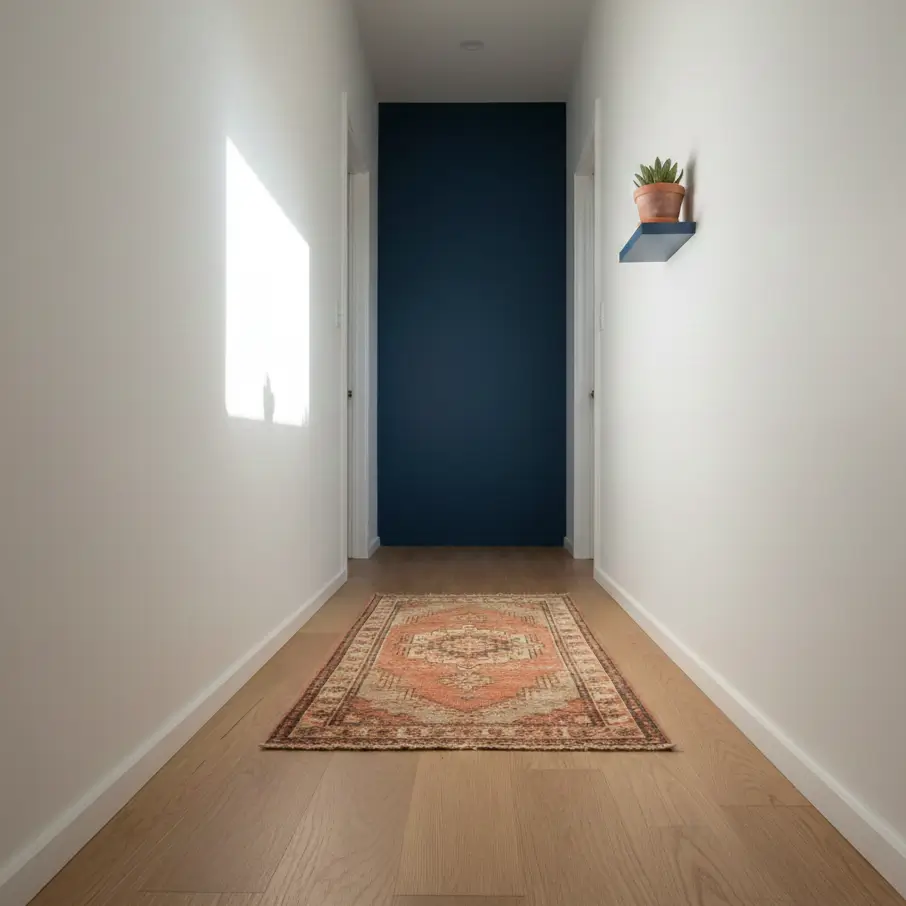
To make a narrow hallway or galley kitchen feel wider and shorter, paint the far end wall a dark, warm, or saturated color while keeping the side walls light and cool. This “advancing” color visually pulls the end wall closer, changing the perceived aspect ratio from a “tunnel” to a “room.”
How to Execute the Anchor Wall
I tested this in a 42-inch wide hallway. The side walls were painted a soft, cool off-white (LRV 75), and the back wall was painted a deep charcoal navy.
- The Result: The hallway immediately felt 2 feet shorter and significantly wider.
- Why it works: The dark color stops your eye. Instead of looking through the space to infinity, your eye rests on the back wall, allowing your peripheral vision to register the side walls as “background” rather than “barriers.”
Best Colors for the Anchor Wall
- Deep Forest Green: Adds a biophilic element.
- Charcoal or Slate: Modern and minimizes shadows.
- Terracotta: Adds warmth without closing the space in.
This technique is particularly effective if you are following tiny house decorating basics where every visual element needs to serve a structural purpose.
Sheen Strategy: Reflectivity in 36-Inch Zones
In spaces under 4 feet wide, paint finish (sheen) matters more than color. Using a Satin or Semi-Gloss finish on side walls reflects light, blurring the boundaries of the wall. However, this requires perfectly smooth walls. For uneven walls, stick to Matte or Eggshell to hide imperfections.
The Mirror Effect
High-gloss paint acts like a weak mirror. In a tiny bathroom or narrow entry, painting the ceiling in a high-gloss finish can create an illusion of infinite height. However, on narrow side walls, too much gloss can create a “funhouse” effect with glare.
My recommendation for narrow high-traffic zones:
- Walls: Satin (Standard) or “Scuff-X” Matte (Specialty).
- Trim/Doors: Semi-Gloss.
- Ceiling: Flat (unless using the high-gloss trick).
If you are dealing with low vertical clearance, combine this sheen strategy with specific low ceiling paint solutions to maximize the vertical axis while you widen the horizontal one.
Durability: The Shoulder Test
In a hallway that is 36 inches wide, your shoulders, grocery bags, and pets will touch the walls. Standard flat paint will show burnish marks (shiny rub spots) within weeks.
You must invest in high-quality resin-based paints. Brands like Benjamin Moore’s Scuff-X or Sherwin Williams Emerald are game-changers here. They cost more ($70-$90/gallon), but in a small space, you likely only need one gallon. For a deeper breakdown of products, review our guide on paint brands for small spaces.
Two-Tone Walls: Horizontal Expansion
Dividing a narrow wall horizontally with two colors creates a visual datum line that stretches the space. Paint the bottom third a darker color (grounding) and the top two-thirds a lighter color (airiness). This tricks the eye into following the horizontal line, emphasizing length and stability over narrowness.
The “Wainscoting” Effect Without Wood
You don’t need to install molding to get this benefit.
- Measure Up: Mark a line 32-36 inches from the floor (roughly hip height).
- Tape Perfectly: Use a laser level. In narrow spaces, crooked lines are obvious.
- Color Selection:
- Bottom: Darker tone (hides scuffs from shoes/bags).
- Top: Lighter tone (reflects light from fixtures).
This is widely used in tiny house kitchen design where the “bottom” color matches the cabinetry, and the “top” color matches the ceiling, making the aisle feel open.
Pro Tip: If you have very low ceilings, keep the dark section lower (around 28 inches) to maximize the light upper section.
Lighting and Undertones
In narrow spaces, light bounces off one wall and hits the other directly. This intensifies paint undertones. A “neutral” grey might turn completely purple or blue if the opposing wall reflects it. Always test paint samples on both walls of a narrow space and check them at different times of day.
The Temperature Trap
- North-Facing Narrow Rooms: Light is blue/grey. Cool paints will look icy. Opt for warmer neutrals to counteract this.
- Artificial Light Only: (Common in hallways). Check the Kelvin rating of your bulbs. If you use 2700K (warm) bulbs, your “crisp white” paint will look yellow.
If your narrow space is dark, don’t just rely on paint. You must pair your color choice with proper tiny house lighting solutions. A well-lit wall always recedes; a shadowed wall always advances.
Painting Logistics in Tight Spaces
Painting a room where you can’t fit a standard ladder requires modified tools. Use an 18-inch roller frame to cover ground faster, reducing lap marks, and use a short-handled “cubby” brush for cutting in. Remove all hardware and doors before starting to maximize elbow room.
Tools for the “Claustrophobic” Painter
When I painted my tiny utility closet (28 inches wide), a standard 6-foot ladder was impossible to open.
- The Mini-Platform: Use a small folding step stool rather than an A-frame ladder.
- Extension Poles: Use a 2-4ft extension pole on your roller. It allows you to paint the ceiling and high walls while standing in one spot, saving you from constantly stepping up and down.
- Edgers: In tight corners, taping is tedious. A high-quality edging tool can save hours.
For a full list of gear that fits in a drawer, check painting tools for tight spaces.
Ventilation Warning
Paint fumes concentrate quickly in small, narrow areas.
- Use low VOC paint for tiny houses.
- Set up a box fan at one end of the hallway blowing out.
- Wear a respirator, not just a dust mask.
Paint Solutions by Function
| Space Type | Primary Challenge | Recommended Solution | Finish Recommendation |
| Hallway (36″ wide) | Tunnel effect, scuffs | End-Wall Anchor (Dark end, light sides) | Matte sides (Scuff-X), Semi-gloss trim |
| Galley Kitchen | Busy visual, grease | Monochromatic (Match walls to cabinets) | Satin or Semi-Gloss (Washable) |
| Narrow Bath | Moisture, proximity | Light cool tones (Receding) | Satin (Moisture resistant) |
| Tiny Bedroom | “Coffin” feel | Horizontal two-tone split | Eggshell |
If you are dealing specifically with moisture-heavy narrow areas, be sure to consult our guide on bathroom paint moisture solutions.
The Verdict
Narrow spaces are not just smaller versions of big rooms; they are distinct optical environments. By abandoning the “paint it all white” rule and using physics-based visual tricks, like the End Wall Anchor or horizontal color blocking, you can trick the eye into seeing more width than the measuring tape shows.
Measure your narrow space. If it is under 48 inches wide, buy a sample pot of a deep, rich color (Navy, Charcoal, Forest Green). Tape a large sheet of paper painted in that color to the end wall. Stand back and watch the walls visually expand.
For more on unifying your small space design, explore our guide on tiny house style and aesthetic.