
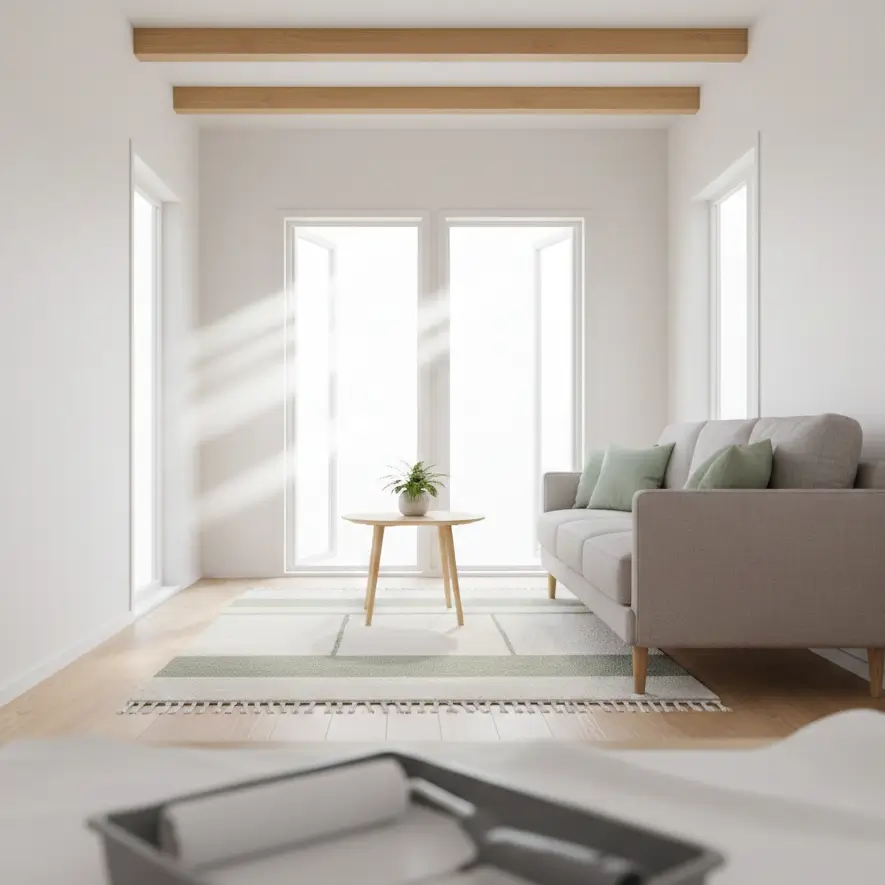
You’ve likely heard the saying that paint is the cheapest way to transform a room. In a standard 2,000-square-foot home, that’s true. But when you live in a tiny house or a 450-square-foot studio apartment, paint isn’t just about color, it’s about air quality and durability.
Here is the reality of small-space physics: The smaller the volume of air, the higher the concentration of toxins.
Using a standard oil-based primer in a large living room might be annoying; using it in a tiny house loft where you sleep could be dangerous due to concentrated off-gassing. Furthermore, in tight quarters, your walls take a beating. You brush against them constantly. The “cheap” paint that scuffs when you look at it wrong won’t survive six months in a narrow hallway.
This guide cuts through the marketing fluff to find the specific paint products and sealers that work for high-humidity, high-traffic, and low-volume living environments.
- Budget DIY: $40-$60 per gallon (Standard latex)
- Health/Performance: $70-$110 per gallon (Zero-VOC, high-pigment)
- Typical Tiny House Cost: Since you likely only need 2-3 gallons total, I recommend the “Investment” tier. The total difference is often less than $100 for a massive upgrade in health and durability.
Why Air Quality Dictates Product Choice in <600 Sq Ft
In spaces under 600 sq ft, Volatile Organic Compounds (VOCs) accumulate rapidly due to limited air volume. Always choose Zero-VOC paint products and sealers certified by GreenGuard Gold. Standard “Low-VOC” (often <50g/L) may still cause respiratory issues in tiny sleeping lofts.
The Math of Toxicity
I learned this the hard way while renovating a 180 sq ft vintage camper. I used a standard primer, and despite having windows open, the fumes were overwhelming within 15 minutes.
In a large room, VOCs disperse. In a tiny house, the ratio of painted surface area to air volume is much higher. You are essentially living inside the paint can while it dries.
What to Look For
When shopping for paint brands suitable for small spaces, ignore the “Low Odor” label, it’s unregulated marketing. Look for the technical data sheet (TDS) and check for:
- Zero VOC: Specifically <5g/L.
- GreenGuard Gold Certification: This tests for over 10,000 chemicals.
- No HAPs (Hazardous Air Pollutants): Crucial for sealers.
Top Recommendations for Small Spaces:
- ECOS Paints: Literally zero VOCs. You can paint with the windows closed.
- Sherwin-Williams Harmony: Contains technology that actually reduces odors from other sources (like cooking smells in a tiny kitchen).
- Benjamin Moore Eco Spec: A solid commercial-grade zero-VOC option.
For a deeper dive into safe options, read our guide on low VOC paint for tiny houses.
The “One-Can” Rule: Primers & Adhesion
Storage is scarce in small living. Avoid buying separate primers for wood, metal, and drywall. Use a high-bond bonding primer (like STIX or Kilz Adhesion) that covers 350-400 sq ft per gallon and sticks to glossy surfaces like IKEA laminates, PVC trim, and tiny house plywood sheathing.
Problem: Mixed Materials
In a tiny house layout, your walls might be drywall, your cabinetry might be laminate, and your built-ins might be raw pine. Buying a specific primer for each is a waste of money and storage space.
The Solution: Bonding Primers
Bonding primers are the heavy lifters of paint products and sealers. They rely on chemical adhesion rather than just mechanical “tooth,” meaning they stick to slick surfaces without excessive sanding.
My Go-To Strategy for 400 Sq Ft:
- Clean everything with TSP substitute (degreaser).
- Apply one coat of a high-quality water-based bonding primer (e.g., Insl-x STIX).
- Wait 24 hours. Even if the can says “recoat in 4 hours,” give it time to cure in a small space where humidity might be higher.
If you are dealing with moisture barriers or unique substrates, check our guide on painting over protective coatings.
Expanding Space with Sheen & LRV
Light Reflectance Value (LRV) measures how much light a color reflects. In spaces under 800 sq ft, aim for an LRV of 60-85 to push walls visually outward. Use a Satin or Eggshell finish rather than Flat; the slight sheen reflects light and resists the inevitable scuffs of tight-quarters living.
Understanding LRV
Every paint chip has a number on the back (0-100).
- 0: Absolute Black (absorbs all light)
- 100: Pure White (reflects all light)
In a narrow apartment hallway or a tiny house with limited windows, a color with an LRV of 45 might look cozy in a magazine, but it can make your space feel like a cave. I typically recommend staying above 65 for main walls in spaces with low ceilings.
The Sheen Spectrum for Durability
In a large house, you can use “Flat” or “Matte” paint in the dining room because no one touches the walls. In a tiny house, your dining room is also your hallway and your workspace. You will bump into the walls.
- Matte/Flat: Hides imperfections but scuffs instantly. Avoid in tiny homes.
- Eggshell: The sweet spot. Hides some bumps, wipeable.
- Satin: Higher durability, reflects more light (good for expanding space), but shows wall texture.
- Semi-Gloss: Reserved for trim, doors, and moisture-heavy zones.
If you are struggling with a lack of natural light, see our tips on brighten dark apartment paint.
Moisture Management: The “Wet Room” Challenge
Tiny house bathrooms and kitchens generate massive humidity relative to their size. Standard latex paint will peel. Use 100% Acrylic paint with built-in antimicrobial agents (mildewcides). Look for “Kitchen & Bath” specific formulations that create a hydrophobic seal against steam.
The Steam Factor
A shower in a 30 sq ft bathroom creates a steam density that rivals a sauna. If your paint products and sealers aren’t permeable enough to let the wall “breathe” but tough enough to repel surface water, you will get mold behind the paint film.
Best Practices for Wet Zones
- The Sealer: If you have wood paneling (common in tiny homes), seal the knots first with a shellac-based primer (spot prime only) to prevent bleed-through, then use a moisture-resistant primer.
- The Paint: Use high-quality acrylic. Brands like Benjamin Moore Aura Bath & Spa are designed to handle high humidity even in a matte finish (a rare engineering feat).
- Ventilation: No paint can fix bad airflow. Ensure your fan is pulling adequate CFM.
For more details on waterproofing these critical areas, reference bathroom paint moisture solutions.
Top 3 Paint & Sealer Systems for Small Spaces
For a balance of health, durability, and cost in a <1000 sq ft space, I recommend the Sherwin-Williams Emerald line or Benjamin Moore Aura. For wood finishes, Osmo Polyx-Oil offers a repairable, natural seal without the toxicity of polyurethane.
Comparison Table: Paint Systems
| Feature | Acrylic Latex (Standard) | 100% Acrylic (Premium) | Natural Oil Finishes (Wood) | Small Space Impact |
| Durability | Moderate | High | High (Repairable) | You need ‘High’ because walls are high-contact surfaces. |
| VOC Levels | Low (<50g/L) | Very Low/Zero (<5g/L) | Low (Natural solvents) | Zero VOC prevents headaches in sleeping lofts. |
| Cure Time | 30 Days | 14-20 Days | 24-48 Hours | Faster cure = move in sooner. |
| Washability | Fair | Excellent | Good | Essential for small kitchens/mudrooms. |
The Wood Sealer Alternative
Many tiny homes feature exposed wood ceilings or butcher block counters. Traditional Polyurethane smells terrible and requires sanding to fix scratches.
Try Hardwax Oils (like Osmo or Rubio Monocoat):
- Application: Rub on with a rag.
- Repair: Sand just the scratch and re-apply oil. No need to strip the whole floor/counter.
- Safety: Many are food-safe and plant-based.
This is particularly relevant if you are working on tiny house countertops surfaces.
Calculating Coverage: Don’t Overbuy
One major benefit of small space living is material cost efficiency. However, paint brands sell in quarts (32 oz) and gallons (128 oz).
- Average Gallon Coverage: 350-400 sq ft (one coat).
- Average Quart Coverage: 80-100 sq ft (one coat).
The “Tiny” Calculation:
A 200 sq ft tiny house (approx 8×24 ft) with 8 ft ceilings has roughly 512 sq ft of wall space (excluding windows/doors).
- Two coats = 1024 sq ft total coverage needed.
- Purchase: 3 Gallons.
Pro Tip: Don’t try to stretch 2 gallons. Modern paints rely on a specific film thickness (mils) to perform. If you stretch it thin, you lose the washability and moisture resistance you paid for.
For a detailed breakdown on quantities, check paint coverage calculation.
Synthesis & Next Steps
Selecting the right paint products and sealers for a small space is about shifting your priority from “covering the wall” to “engineering the environment.” In a tiny home, your walls are closer to you, the air is more contained, and the moisture load is higher.
Invest in the highest quality, lowest toxicity paint your budget allows. The extra $30 per gallon pays for itself in cleaner air and walls that withstand the daily friction of compact living.
- Calculate your exact square footage today (don’t guess).
- If you are painting this weekend, plan your ventilation strategy now (box fans, open windows).
- Buy one sample pot of your chosen color/sheen and paint a 2×2 ft square on your darkest wall. Watch how the LRV changes throughout the day.
For more on the tools you’ll need to apply these finishes in tight corners, head over to painting tools tight spaces.
Visit veniola.com for complete guides on small space design and tiny living.