
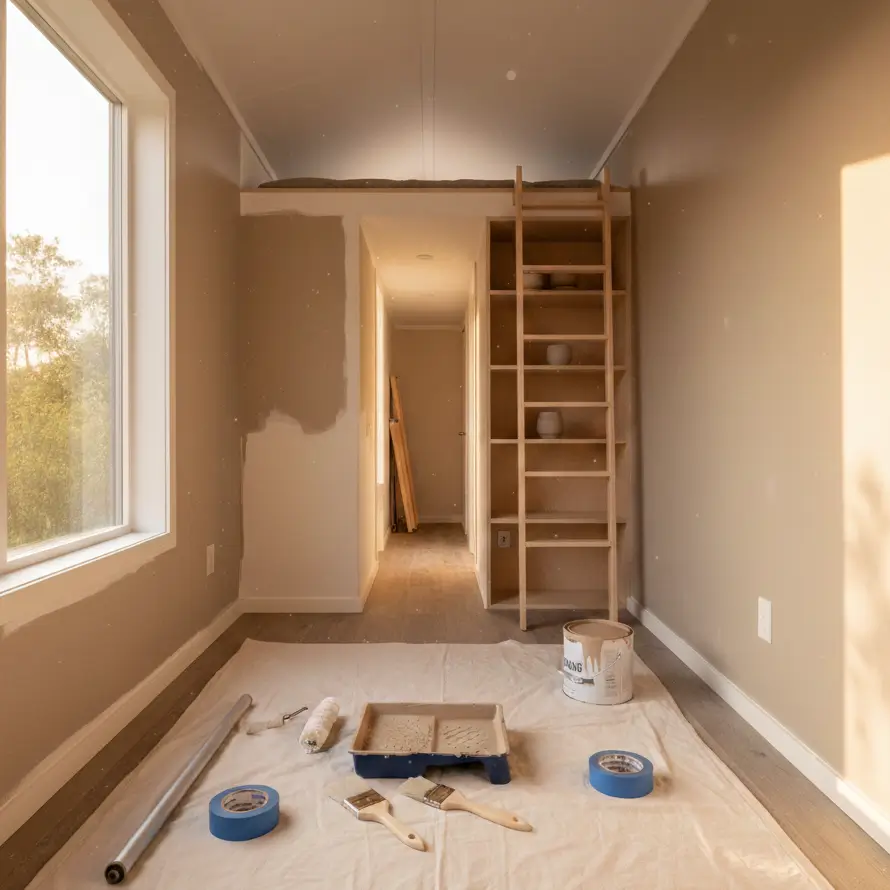
Standard 9-inch paint rollers weren’t built for 350-square-foot tiny houses. They bang into adjacent walls, leave overlap marks in 6-foot-wide rooms, and require paint trays that take up half your floor space. After painting three tiny houses and six small apartments over the past decade, I’ve learned that regular home improvement store paint kits create more problems than they solve in compact living situations.
a curated collection of mini rollers, angled brushes, and specialized tools designed for spaces under 600 square feet.
This guide covers the specific painting tools that work in tight corners, behind radiators, in narrow bathrooms, and along the awkward angles common to tiny house construction. You’ll find exact measurements, brand recommendations, and budget breakdowns ranging from a $25 starter kit to a $175 complete professional setup.
Whether you’re tackling your first tiny house decorating project or refreshing a rental apartment’s walls, the right compact tools cut your painting time in half and eliminate the frustrating mistakes that come from using oversized equipment in undersized rooms.
What Makes Regular Painting Tools Fail in Small Spaces?
Standard painting tools measure 9-18 inches wide, while tiny house walls often have only 6-12 inches of clearance between obstacles. A typical paint tray needs 14×16 inches of floor space, that’s 1.5 square feet of usable floor area in a room where every inch matters. Mini tools measuring 4-6 inches wide eliminate these spatial conflicts.
The math tells the story. A standard roller (9 inches wide) plus its frame (12 inches total) can’t maneuver in a 24-inch-wide hallway without scraping both walls. When I painted a 280-square-foot tiny house in Portland, my regular roller hit the ceiling fan, the loft railing, and the bathroom doorframe within the first fifteen minutes.
Most tiny houses feature:
- Ceiling heights of 7-10 feet (vs. 8-9 feet in standard homes)
- Wall segments interrupted every 4-6 feet by built-ins
- Corners spaced 3-8 feet apart (vs. 10-15 feet in standard rooms)
- Behind-toilet gaps of 2-4 inches
- Radiator clearances of 3-5 inches
These dimensions demand tools specifically sized for the space. Your tiny house layout determines which tools you’ll need most, loft bedrooms require different equipment than galley kitchens.
What doesn’t work in small spaces:
- Full-size roller frames (too wide for corners)
- Deep-well paint trays (tip over easily, take up floor space)
- Standard extension poles (6-12 feet hit loft ceilings)
- Wide painter’s tape dispensers (hard to control in tight areas)
Essential Mini Painting Tools for Tight Spaces: The Complete Kit
A complete small-space painting kit includes a 4-inch mini roller with foam and microfiber sleeves, a 2.5-inch angled brush, a compact paint tray (7×12 inches), and a 2-4 foot telescoping pole. This core setup handles 90% of tiny house painting projects and costs $45-85 depending on brand quality.
The Core Four Tools
1. Mini Roller (4-inch)
The workhorse of small-space painting. A 4-inch roller covers walls efficiently while fitting between obstacles.
- Best budget option: Wooster Mini-Koter frame + covers ($12-15)
- Best mid-range: Purdy Jumbo Mini roller kit ($20-25)
- Measurements: 4-inch width, 6-inch total frame length
- Sleeve types needed: Foam (smooth walls), microfiber (textured walls)
This size works perfectly with low-VOC paints, which matter more in enclosed tiny spaces where fumes concentrate.
2. Angled Brush (2-2.5 inch)
Essential for cutting in around ceilings, trim, and corners. The angle reaches into edges a flat brush can’t access.
- Best option: Wooster Shortcut 2-inch ($8-12)
- Why it works: Short handle (5 inches) provides better control in cramped positions
- Tip: Synthetic bristles work with all paint finishes for small spaces
3. Compact Paint Tray
Skip the standard 11×15-inch tray. In a 6-foot-wide bathroom, that tray blocks the entire walkway.
- Best option: Deep-well mini tray, 7×12 inches ($6-10)
- Alternative: Handheld paint pail with magnet strip ($15-20)
- Pro tip: The magnet holds your brush while you roll, keeping it off surfaces
4. Telescoping Mini Pole (2-4 feet)
Standard poles extend 6-12 feet, useless when your ceiling is 7.5 feet and your loft is 4 feet tall.
- Best option: Wooster Sherlock 2-4 foot pole ($18-25)
- Why this length: Reaches standard tiny house ceilings without bumping the surface above
Budget Breakdown
| Setup Level | Total Cost | What’s Included |
| Basic DIY | $25-40 | Mini roller, 2 sleeves, angled brush, plastic tray |
| Quality Standard | $45-85 | Brand-name roller, 4 sleeves, premium brush, deep-well tray, short pole |
| Complete Pro | $120-175 | All above + edge tools, pad painter, carrying caddy |
For rental apartment painting where you might not paint again for years, the basic kit works fine. If you’re building and finishing a tiny house, invest in the quality standard setup, you’ll use these tools repeatedly.
How to Paint Behind Radiators, Pipes, and Awkward Corners
Specialty tools solve the 2-6 inch gap problem. A radiator brush (2×6 inches, $8-12) reaches behind wall-mounted heaters, while a pad painter (3×4 inches, $10-15) covers spaces where rollers can’t rotate. For pipes, wrap a paint mitt ($12-18) around the surface for quick coverage.
The most frustrating moment in small-space painting comes when your roller physically won’t fit somewhere visible. Behind a baseboard heater. Around the toilet tank. Inside the 8-inch gap between your refrigerator alcove and the wall.
Tool-by-Problem Solutions
Behind radiators and baseboard heaters (2-4 inch gap):
- Radiator brush: Long handle (12-18 inches), narrow bristle head (2 inches wide)
- Pad painter: Flat profile slides into gaps, covers in single strokes
- Cost: $8-15 for either option
Around toilet tanks and pedestals:
- Mini roller with extension: The 4-inch roller fits behind standard tanks
- Angled brush for edges: Reaches the wall-to-floor junction
- Tip: Remove toilet tank lid for extra clearance, adds 3-4 inches
Inside closets and storage nooks:
- These spaces need the same paint preparation as main rooms
- Use a handheld work light (clip-on LED, $15-25) to spot missed areas
- The mini roller handles walls; switch to the 2-inch brush for shelving edges
Around pipes and conduits:
- Paint mitt: Fabric glove that wraps around cylindrical surfaces
- Works for exposed pipes 1-4 inches in diameter
- Coverage: 50 linear feet per mitt before replacing
This matters especially in tiny house bathroom designs where exposed plumbing is common and bathroom paint moisture solutions require complete coverage to prevent peeling.
Brush vs. Mini Roller vs. Compact Sprayer for Small Apartments
For spaces under 600 square feet, mini rollers offer the best speed-to-quality ratio for walls. Brushes remain essential for trim and cutting in. Compact sprayers (like the Wagner Flexio, $70-130) make sense only for empty units, overspray in furnished tiny spaces creates more prep work than time saved.
I tested all three methods in a 420-square-foot studio apartment renovation last spring. Here’s what the data showed:
| Criteria | Angled Brush | Mini Roller (4″) | Compact Sprayer |
| Best for | Trim, edges, corners | Wall surfaces | Empty rooms only |
| Coverage speed | 50 sq ft/hour | 150 sq ft/hour | 300 sq ft/hour |
| Prep time needed | 5 minutes | 10 minutes | 45-60 minutes |
| Cleanup time | 5 minutes | 10 minutes | 20-30 minutes |
| Finish quality | Good (brush marks possible) | Excellent | Professional |
| Works in furnished space? | Yes | Yes | No |
| Cost range | $8-20 | $12-25 | $70-150 |
| Storage size | 6×2×1 inches | 8×4×2 inches | 12×10×8 inches |
My recommendation by scenario:
- Furnished tiny house: Mini roller + angled brush. The sprayer overspray masks furniture even with plastic covering, not worth it in a 10×12-foot living area.
- Empty apartment before move-in: Sprayer for walls, brush for trim. The 45-minute prep time pays off when you’re covering 400+ square feet of empty walls.
- Single accent wall: Brush only. Setting up a roller or sprayer for a 6×8-foot wall wastes time on setup and cleanup.
- Narrow space paint solutions: Mini roller exclusively. Sprayers create bounce-back in hallways under 3 feet wide.
For comparison details on specific application methods, the spray vs. brush vs. roller guide covers technique differences in depth.
Best Budget-Friendly Small Space Painting Kits Under $100
Three kit tiers serve different needs. The $35 Basic (Wooster Mini-Koter set) handles occasional touch-ups. The $65 Standard (Purdy mixed kit + Shur-Line edger) covers full-room projects. The $95 Complete (brand-name tools + specialty items) equips you for any small-space situation including painting furniture and home decor.
Kit Recommendations by Budget
$35 Basic Kit (Occasional Use)
- Wooster Mini-Koter frame: $6
- 10-pack mini roller covers: $12
- Wooster Shortcut brush 2″: $8
- Plastic mini tray: $4
- Painter’s tape, 1 roll: $5
Best for: Touch-ups, single wall projects, renters who paint rarely
$65 Standard Kit (Full Room Projects)
- Purdy mini roller + frame: $15
- Microfiber + foam covers (4 each): $18
- Purdy XL angled brush 2.5″: $12
- Deep-well metal tray: $8
- Shur-Line edge painter: $12
Best for: Full tiny house painting, multiple rooms, regular DIY projects
This level kit handles proper paint preparation for small apartments and delivers professional-looking results.
$95 Complete Kit (Everything You’ll Need)
- All Standard kit items: $65
- Telescoping 2-4 ft pole: $18
- Radiator brush: $8
- Ladder-free edge tool: $12
- Canvas drop cloth (4×12 ft): $12
- Subtract overlaps
Best for: Tiny house builders, frequent redecorators, anyone painting multiple spaces
Where to Buy
Home Depot and Lowes stock most items. For the best selection of mini tools specifically, Sherwin-Williams carries professional-grade compact equipment. Amazon offers competitive prices on Wooster and Purdy products, these brands manufacture the tools commercial painters use in any size space.
All three kits fit inside a 12×8×6-inch plastic bin. After cleaning, your entire painting setup stores in a single container that slides under a tiny house bed or into a closet shelf.
Making Your Small Space Painting Project Succeed
The right tools eliminate the physical frustrations of painting compact spaces. A 4-inch mini roller costs $15 and saves hours of wrestling with oversized equipment that marks up your walls. A proper angled brush gets into corners your roller can’t reach. Specialty tools handle the weird gaps tiny houses create.
- Measure your tightest spots, behind radiators, around pipes, inside closets. Write down the gap widths.
- Match tool sizes to your measurements. If your tightest gap is 3 inches, a 4-inch roller won’t help there.
- You have lead paint concerns, cathedral ceilings over 12 feet, or extensive surface damage requiring paint problems and solutions beyond cosmetic coverage.
The Veniola.com guides on color selection for tiny houses and paint finishes pair with this tool guide. Once you have the right equipment, choosing the right paint becomes the next step in transforming your small space.
Compact living demands compact solutions. In painting, that means downsizing your tools, not your ambitions for how your walls will look.