
I remember standing in the middle of my first 450-square-foot studio in Chicago. The walls were “Landlord Beige”, a color that somehow looked like dirty sand in the morning and muddy gray at night. It felt temporary. It felt like a doctor’s waiting room. I wanted to paint it, but the terrifying clause in my lease about a “$500 per room restoration fee” paralyzed me.
If you’re reading this, you’re probably staring at similar beige (or sterile white) walls, wondering if it’s worth the risk.
Yes, you can paint a rental, but in small spaces, you rarely need to paint the entire wall.
By using strategic color blocking, reversible techniques, and knowing exactly how to calculate paint coverage for move-out day, you can customize your space without forfeiting your security deposit. In this guide, I’ll show you how to add personality to a 600-square-foot footprint for under $200, ensuring you get your money back when you hand over the keys.
The “Ask vs. Risk” Assessment: Reading Your Lease
Before we buy a single roller, we need to look at the paperwork. In my experience renting four different apartments, lease agreements usually fall into two categories regarding rental apartment painting.
1. The “Prior Written Consent” Clause
Most standard leases state you cannot alter the premises without written consent. This sounds scary, but it’s often a negotiation point.
- The Strategy: Email your landlord with a specific paint chip (stick to reputable brands). Offer to prime the walls back to white before you leave.
- The Small Space Leverage: Landlords of tiny units are often worried about sloppy work ruining trim. If you offer to paint only a specific accent wall (under 100 sq ft), they are more likely to agree than if you propose painting the whole unit black.
2. The “Restore to Original Condition” Clause
This is the golden ticket. It implies you can make changes as long as the apartment looks exactly the same when you leave.
- The Risk: You are betting on your ability to cover up your work. Dark colors like Navy or Forest Green might require 3 coats of primer to hide, costing you an extra $60 and 8 hours of labor during the stressful move-out week.
If you are unsure about the financial implications, it helps to run the numbers first. Check out our guide on paint budget cost analysis to see if the restoration costs fit your budget.
The 20% Rule: Strategic Zoning for Small Spaces
Instead of painting all four walls, paint “zones” to define functions in an open layout. Painting just 20% of the wall surface area (approx. 60-80 sq ft in a standard room) creates visual depth, costs less than $50 in materials, and takes less than 2 hours to repaint upon moving out.
In a small apartment, walls do double duty. The living room is often the office; the kitchen might be the hallway. Painting distinct shapes helps separate these mental spaces.
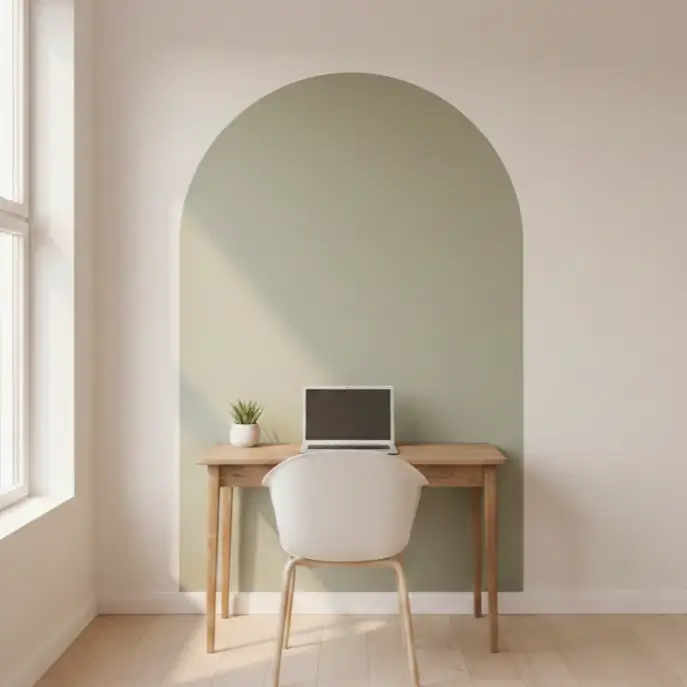
The “Zoom Arch”
If you work from home in a tight corner, painting an arch behind your desk creates a dedicated “office” feel.
- Dimensions: A standard arch is usually 4 feet wide by 6 feet tall.
- Coverage: This is roughly 22 square feet. You can do this with a sample pot (approx. 30 oz) or a single quart of paint.
- Cost: ~$25 for a quart of high-quality paint + $10 for tape.
The “Headboard” Block
In a tiny bedroom where a bulky headboard takes up 6 inches of precious floor depth, paint a rectangle directly on the wall.
- Dimensions: For a Queen bed, measure 62 inches wide by 40 inches high.
- Visual Trick: Extend the paint color 3 inches wider than the bed on each side to make the room feel wider.
Note on Fumes: In spaces under 500 sq ft, ventilation is critical. Standard paints can linger for days. Always opt for low VOC paint for tiny houses to keep your indoor air quality safe while sleeping in the same room you just painted.
The Liquid Starch Fabric Wall (100% Reversible)
For strict “no paint” leases, mix 1 cup of liquid starch with fabric to create a removable wallpaper effect. It covers a standard 8ft x 10ft wall for roughly $40 (depending on fabric cost), peels off in seconds leaving no residue, and requires zero sanding.
I tried this in a rental bathroom where the moisture would have peeled normal wallpaper. It held up for two years.
How to do it:
- Choose the Fabric: Use lightweight cotton (quilting cotton works best). Avoid heavy upholstery fabric, it’s too heavy for the starch to hold.
- Prep the Wall: Wipe down the surface. If you’re dealing with a kitchen or bath, check our guide on paint preparation for small apartments to ensure the surface is grease-free.
- Apply Starch: Roll liquid laundry starch (like Sta-Flo) onto the wall with a paint roller.
- Place Fabric: Smooth the fabric panels onto the wet wall. Use a smoothing tool (or a credit card) to push out bubbles.
- Seal It: Roll another layer of starch over the top of the fabric.
Removal: When you move out, sponge the wall with warm water. The fabric peels right off. Throw the fabric in the washing machine and use it for curtains in your next place.
Choosing Colors That Expand Space
Dark colors absorb light, making small rooms feel cozy but smaller. High Light Reflectance Value (LRV) colors (above 60) bounce light around, making a 10×10 room feel like a 12×12 room. Cool undertones recede visually, pushing walls “back.”
The Finish Matters
In a rental, walls are often imperfect. They have layers of old paint, patch marks, and bumps.
- Flat/Matte: Hides imperfections best but marks easily. Hard to clean.
- Eggshell: The sweet spot. Wipeable but doesn’t highlight every bump.
- Satin/Semi-Gloss: Too shiny for bad rental walls, unless you are brightening a dark apartment and need maximum light reflection.
Color Theory for Tight Quarters
If you are nervous about committing to a color, start with neutrals. However, “neutral” doesn’t mean boring. Warm greiges (grey+beige) work beautifully with the artificial lighting often found in apartments. See our list of neutral paint colors for small apartments for specific brand codes that work in windowless spaces.
The Exit Strategy: Painting It Back
To get your deposit back, you must prime dark colors before painting white. Plan for 2 days of work before your lease ends. One gallon of primer ($25) covers ~350 sq ft. Keep the original paint chip or a small jar of the original wall color for touch-ups.
This is where many renters fail. They try to paint white directly over navy blue on moving day. It won’t work. The blue will bleed through, and the landlord will charge you for a professional repaint.
Step-by-Step Restoration:
- Light Sanding: Run a sanding sponge over the edges of your painted zone to knock down the “ridge” of paint lines.
- Primer: Apply one coat of high-quality stain-blocking primer. Let it dry for at least 3 hours.
- Top Coat: Apply the original wall color.
- Pro Tip: If you don’t know the original color, chip a piece of paint off (about the size of a quarter) from an inconspicuous spot (like inside a closet or behind an outlet cover) and take it to the hardware store for a color match.
If you painted a bathroom or kitchen, check if you used specialty paints. Bathroom paint moisture solutions often require specific primers to adhere properly over semi-gloss finishes.
Tools You Actually Need (and What to Skip)
In a small apartment, you don’t have space to store a 10-piece painting kit for the next 5 years. Rent or buy minimal.
| Tool | Necessity | Small Space Note |
| Extension Pole | Skip | Unless you have 10ft+ ceilings, a step stool is fine for a small accent wall. |
| Short-Handled Brush | Buy | Crucial for tight corners and painting inside closets. See painting tools for tight spaces. |
| Mini Roller (4 inch) | Buy | Perfect for zoning and small walls. Wastes less paint; fits in the sink for cleaning. |
| Drop Cloth | DIY | Use old bedsheets or break down your moving boxes. Plastic creates slip hazards in tight rooms. |
Frequently Asked Questions
Can I use peel-and-stick wallpaper instead?
Yes, but be careful. Some “removable” papers can rip the drywall paper off if the landlord used cheap matte paint underneath. Always test a 6×6 inch square in a closet first.
What if I spill paint on the carpet?
Don’t panic. If it’s water-based latex paint (standard for walls), keep it wet. Blot, do not rub. Use warm water and dish soap. If it dries, you may need a specialized remover or a careful trim with scissors (risky!).
How much paint do I need for just one wall?
For a standard 8ft x 10ft wall (80 sq ft), a quart is usually enough for one coat, but you almost always need two coats. I recommend buying a gallon if the wall is over 50 sq ft just to be safe. You can check the math with our paint coverage calculation guide.
Closing Thoughts
Painting a rental is an act of claiming space. It says, “I live here, and I matter,” even if the lease is only for 12 months. By sticking to the 20% rule, painting zones, arches, or single accent walls, you keep the project affordable, the fumes manageable, and the move-out stress minimal.
Don’t settle for the beige box. Grab a quart of your favorite color, tape off a corner, and create a home that feels like you.
- Check your lease for the “restoration” clause.
- Measure a 4×6 ft zone behind your desk or bed.
- Visit the hardware store and buy one sample pot to test the color in your specific lighting.
For more inspiration on making tiny spaces functional, check out our guide on tiny house decorating basics.