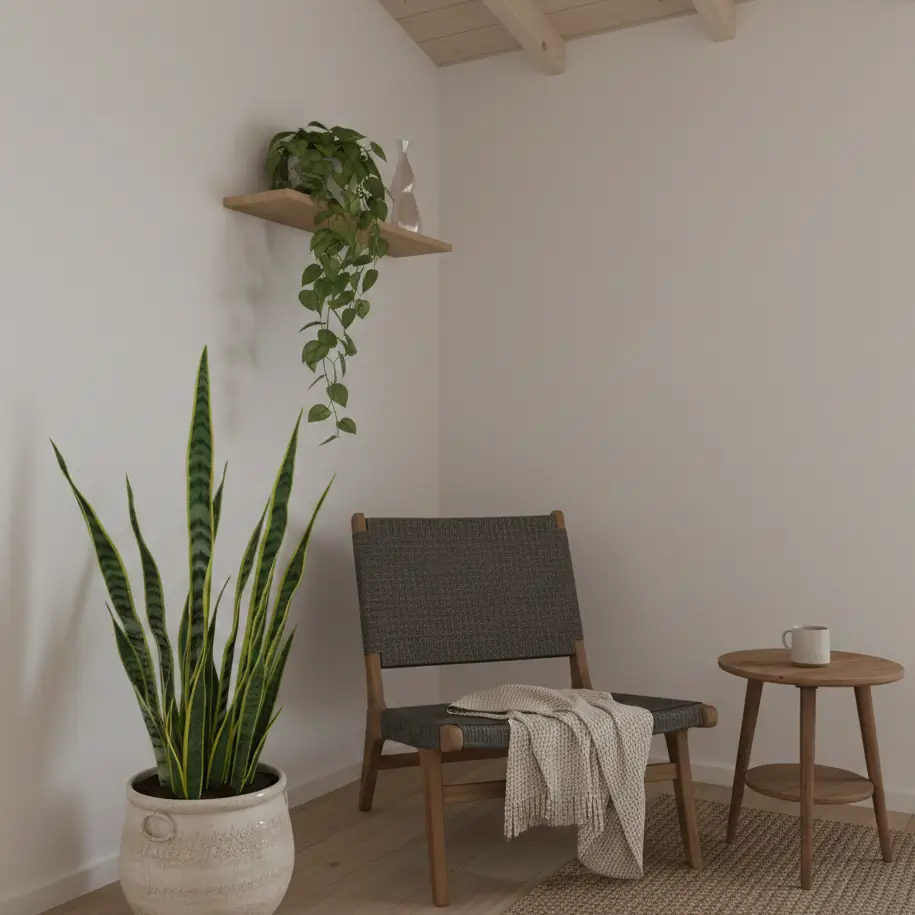
I once lived in a 350-square-foot basement studio in Seattle. It had one window, and it faced a brick wall. I desperately wanted greenery, but every “easy” plant I bought turned yellow and died within weeks. I thought I had a black thumb. It turned out, I just didn’t understand the physics of light in small spaces.
If you are living in a tiny house loft, a narrow apartment hallway, or a room where the sun rarely shines, you might think you’re doomed to plastic plants. You aren’t.
You don’t need a greenhouse. You need specific low light plant solutions tailored to square footage constraints.
In this guide, we aren’t just listing plants. We are looking at how to fit them into tight corners, how to measure light without expensive tools, and how to keep them alive when your airflow is limited. Whether you have $50 for a DIY hanging setup or $200 for a stylish stand, let’s bring some life into that dark corner.
What Does “Low Light” Actually Mean in a Tiny House?
Low light is defined as 25-75 foot-candles of illumination. Practically, if you can comfortably read a book at noon without turning on a lamp, you have medium light. If you have to squint or turn on a light to read text, that is low light. In a tiny house, low light zones are typically 4+ feet away from a north-facing window or in corners adjacent to windows.
The Foot-Candle Reality Check
When I first started styling small spaces, I realized “low light” is subjective. To a plant, light is food. In a small apartment, shadows are deeper because furniture obstructs light paths more easily than in an open-plan mansion.
- Deep Shade: A bathroom with no window or a sleeping loft corner. (Solution: Grow lights required).
- Low Light: 5-7 feet away from a window. (Solution: Snake plants, ZZ plants).
- Medium Light: 2-4 feet from a window. (Solution: Pothos, Philodendrons).
Pro Tip: Download a free “Lux Meter” app on your phone. It’s not lab-accurate, but it gives you a baseline. If it reads under 50 lux in your chosen spot at midday, you need a hardy plant or a bulb upgrade.
Top 5 “Unkillable” Plants for Compact Footprints
The best low light plants for small spaces utilize vertical growth or trailing vines to save floor space. The top contenders are the Snake Plant (vertical), ZZ Plant (bushy/hardy), Pothos (trailing), Cast Iron Plant (narrow/tall), and the Peace Lily (communicative). These species thrive in 50-100 foot-candles and tolerate irregular watering.
1. Snake Plant (Dracaena trifasciata)
Why it works in <400 sq ft: It grows straight up, not out.
You can squeeze a 6-inch pot into a narrow 8-inch gap between your sofa and the wall. Snake plants are practically indestructible. I’ve gone three weeks without watering mine, and it looked better than I did. Because they have a small root system, they don’t need massive pots that eat up floor space.
2. ZZ Plant (Zamioculcas zamiifolia)
Why it works: It reflects light.
The leaves are glossy and waxy, which actually helps bounce what little ambient light you have around the room. It grows slowly, meaning you won’t have to repot it (and find space for a bigger pot) for years.
3. Pothos (Epipremnum aureum)
Why it works: It uses “dead” air space.
Place this on top of your kitchen cabinets or on a high shelf. The vines trail down, adding greenery without taking up a single square inch of functional floor space.
- See more: Indoor plants for small apartments
4. Cast Iron Plant (Aspidistra elatior)
Why it works: It tolerates temperature fluctuations.
Tiny houses often have rapid temp shifts near doors or heaters. The Cast Iron plant handles drafts and temperature swings better than delicate tropicals. It usually grows 24-30 inches tall, making it a great floor plant.
5. Heartleaf Philodendron
Why it works: It’s softer than the Snake Plant.
If your aesthetic is more “boho” and less “modern architectural,” this trailing plant softens harsh corners. It’s incredibly forgiving of low light.
Vertical Styling: Zero-Footprint Gardening
To maximize space in a tiny home (under 400 sq ft), utilize walls and ceilings. Use tension rod shelving in window frames (adds 3-4 linear feet of storage), macramé ceiling hooks (uses zero floor space), or wall-mounted planters (creates living art). This approach keeps walkways clear while improving air quality.
The Tension Rod Hack
If you are renting an apartment or want to avoid drilling into your tiny house walls, tension rods are your best friend.
- Buy a sturdy tension rod (rated for 15+ lbs).
- Install it inside your window frame, halfway up.
- Hang lightweight plastic pots (ceramic is too heavy) using S-hooks.
This allows you to double your plant capacity in the one spot where light actually exists.
Wall-Mounted Pockets
Woolly pockets or felt wall planters are excellent for tiny house wall materials like shiplap or drywall. They sit flush against the wall, protruding only 4-6 inches. This is perfect for narrow hallways or the space above a toilet in tiny house bathroom design.
Shelf Placement Strategy
Don’t just put a plant on a table; the table is valuable real estate! Instead, look at the sides of your tiny house furniture. Can you mount a small clamp-shelf? Can you put a magnetic planter on the side of your fridge?
Hacking Light: Artificial Solutions for Dark Lofts
When natural light is insufficient (<25 foot-candles), use full-spectrum LED grow bulbs. Screw these into standard E26 lamp fixtures to disguise them as regular decor. For tiny spaces, strip lights mounted under cabinets (cost: $20-$40) provide light to counter-top plants without requiring extra fixtures.
The “Hidden” Grow Light
You don’t need those purple “blurple” lights that make your home look like a disco. Many brands (like GE or Soltech) make white light bulbs that fit standard lamps.
- The Swap: Take a standard desk lamp or clamp light.
- The Bulb: Replace the 60W LED with a Full-Spectrum Grow Bulb ($10-$30).
- The Result: You can now place a plant in a windowless bathroom or a dark loft corner.
Under-Cabinet Strips
In a tiny house kitchen, counter space is gold. If you have upper cabinets, stick adhesive LED grow strips underneath them. This allows you to grow small herbs (mint, basil) or small succulents right on the counter, utilizing the “dead space” under the cabinet while adding task lighting for cooking.
Budget Breakdown:
| Light Solution | Cost (Est.) | Best Application | Space Impact |
| Standard Grow Bulb | $10 – $25 | Desk lamps, floor lamps | Zero (uses existing fixtures) |
| LED Strip Lights | $20 – $45 | Under cabinets, shelving | Low (adheres to surfaces) |
| Pendant Grow Light | $120 – $200 | Dark corners, high ceilings | Medium (visual focal point) |
The “Less is More” Watering Rule
In low light conditions, plants photosynthesize slower and drink less water. Overwatering is the #1 killer of shade plants. Check soil moisture every 10-14 days. If the top 2 inches of soil are dry, water sparingly. Ensure pots have drainage holes to prevent root rot in stagnant air.
Why Shade Plants Rot
In a bright, hot room, a plant drinks water quickly. In a dark, cool corner of a tiny house, that water sits in the soil. If you water your Snake Plant every week on a schedule, you will kill it.
My Personal Rule: I check my low-light plants on the 1st and the 15th of the month. I stick my finger into the soil up to the second knuckle. If I feel any moisture, I wait. It is better to let them droop slightly (under-watered) than to turn them into mush (over-watered).
Managing Humidity and Airflow
Small spaces, especially those with tight tiny house insulation, can get humid. However, low airflow in corners encourages mold.
- Solution: Use a small USB fan for circulation if you have a dense cluster of plants.
- Pest Control: Dust leaves regularly. In low light, dust blocks the tiny amount of sun the plant gets.
- Related: Plant care fundamentals
Styling with Wood and Decor
Integrate plants with wood interior elements to create warmth. Use plant stands that match your flooring or cabinetry to reduce visual clutter. Light wood pots (birch, ash) brighten dark corners, while dark pots can make a space feel smaller.
Cohesive Design in Small Spaces
In a 1000+ sq ft apartment, you can mix and match styles. In 400 sq ft, visual clutter closes the walls in on you.
- Match your pots: Stick to one color palette (e.g., all white ceramic or all terracotta).
- Wood tones: If your tiny house flooring is light oak, use plant stands in a similar tone or a high-contrast black metal. Avoid mixing cherry wood stands with oak floors; it looks chaotic in a small room.
- Height variation: Use a stool or a narrow plant stand to raise a pot off the floor. This exposes more floor surface area, tricking the eye into thinking the room is larger.
- See more: Wood plant styling tips
Considerations for Pets and Kids
If you live in a tiny house with pets or children, floor plants are risky.
- Safety: Pothos and Snake Plants are toxic if ingested.
- The Fix: This is another reason to go vertical. Use tiny house storage solutions like high shelves to keep toxic plants out of reach.
- Safe Alternatives: If you need a pet-safe low light plant, look for the Spider Plant or Calathea (though Calatheas are fussy about water).
- Read more: Tiny house with pets
Synthesizing Your Green Strategy
Living in a small, low-light space doesn’t mean you are cut off from nature. It just means you have to be smarter about selection and placement.
The critical takeaway: Don’t fight your environment. If you have a dark corner, don’t buy a succulent that needs desert sun. Buy a Snake Plant that thrives in neglect. Use tension rods and walls to save your precious floor space.
- Measure your light: Download a Lux app and test your corners tomorrow at noon.
- Pick one plant: Start with a Snake Plant or ZZ plant (approx. $20-$40).
- Go vertical: If you are renting, order a tension rod for your window.
You can transform a sterile, dark box into a cozy, living sanctuary. It just takes one plant to start.
For more on optimizing every inch of your home, visit veniola.com.