
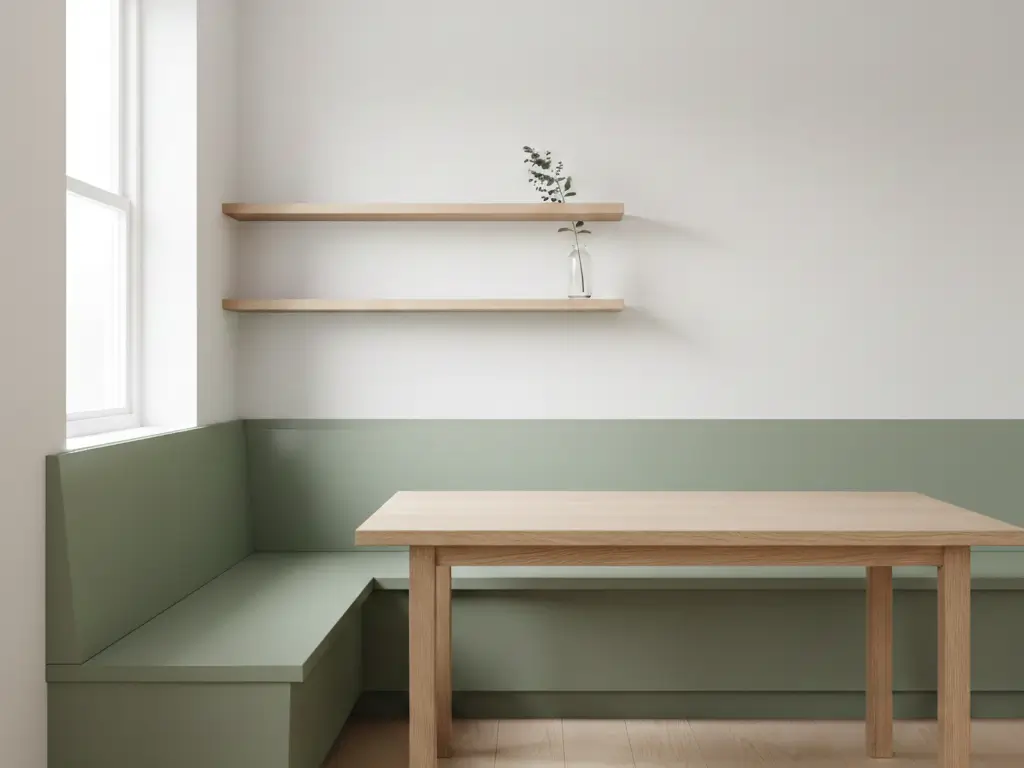
If you have ever opened a can of oil-based primer in a 400-square-foot studio, you know the panic. The fumes hit you instantly, there is nowhere for the smell to go, and you realize you have made a tactical error.
In a standard suburban home, painting wood is a weekend project done in the garage. In a tiny house or apartment, it is a logistical puzzle. You are living in your workspace. Furthermore, in small spaces, wood surfaces, whether built-ins, trim, or multipurpose furniture, endure double the wear and tear of a standard home. Your kitchen table is likely also your desk, your crafting station, and your food prep overflow.
This painting wood guide is designed specifically for the constraints of compact living. We aren’t just looking for color; we need extreme durability and zero-headache air quality. From a $50 thrift flip to a $500 kitchen cabinet overhaul, here is how to get a factory-finish look without choking on fumes.
Why Wood Painting is Different in 600 Sq Ft
In small spaces, painted wood requires higher durability (scrubbability) due to frequent contact and lower toxicity (Low-VOC) due to limited air volume. Standard latex paint often fails on high-traffic wood surfaces like cabinetry or dual-use tables. You need water-based alkyds or urethane-fortified acrylics that cure hard but wash up with water.
The “High-Touch” Reality
In a large home, you might walk past a baseboard or a cabinet door once a day. In a tiny house hallway that measures 36 inches wide, you probably brush against that woodwork fifty times a day.
Standard wall paint (even semi-gloss) stays somewhat soft. For wood in small spaces, you need a coating that cures into a hard shell. This is often called “blocking.” If your paint has poor blocking resistance, your painted cabinet doors will stick together and peel when you close them.
The Air Quality Equation
Air volume matters. A standard gallon of high-VOC paint can off-gas for weeks. In a bedroom with only 1000 cubic feet of air, those concentrations become hazardous quickly.
- Traditional Oil Paint: High durability, terrible fumes. Avoid indoors.
- Standard Latex: Low fumes, poor durability on wood.
- Water-Based Alkyd/Enamel: The sweet spot. It mimics the hardness of oil but cleans up with soap and water and has low VOCs (Volatile Organic Compounds).
Read more about selecting safe finishes in our low VOC paint guide for tiny houses.
Assessing Your Surface: What Are You Actually Painting?
Identifying your substrate determines your primer. Bare wood needs a tannin-blocking primer to prevent bleed-through. Previously painted wood requires cleaning and scuff-sanding. Laminate (fake wood) requires a bonding primer specifically designed to stick to slick, non-porous surfaces.
1. Bare Wood vs. Sealed Wood
Pour a tiny drop of water on the wood. Does it soak in and darken the wood (bare/porous)? Or does it bead up (sealed)?
- Bare Wood: Thirsty. It needs a primer that seals the grain. If you are working with knotty pine (common in tiny homes), the knots will bleed sap through the paint years later unless you use a shellac-based or high-hiding primer.
- Sealed Wood: Slippery. Paint will slide right off without abrasion (sanding) and a bonding primer.
2. The Laminate Trap
Many “wood” cabinets in rental apartments are actually thermofoil or melamine over particle board. You can paint these, but you cannot sand them down to “bare wood” because there isn’t any. For these, cleaning with a degreaser like TSP (Trisodium Phosphate) or a TSP-substitute is the most critical step.
See our comparison on wood materials in tiny houses to identify exactly what you are working with.
The Space-Saving Prep Workflow
To prep wood in an occupied apartment, minimize airborne dust. Use a “wet sanding” technique or a sander attached to a HEPA vacuum. clear a 4×4 foot “active zone” and move it as you work, rather than trying to empty the whole room. Total budget for prep materials: $40-$60.
Dust Control in Small Volumes
Dust is the enemy of a smooth finish, and in a studio apartment, sanding dust covers your bedsheets instantly.
The Wet-Sand Trick:
For existing finishes (not bare wood), you can use liquid sandpaper (deglosser) or wet-sand with a sponge. This creates a slurry instead of airborne dust.
- Dip a sanding sponge (220 grit) in water.
- Squeeze it out so it is damp, not dripping.
- Scrub the wood surface in a circular motion.
- Wipe away the sludge immediately with a microfiber cloth.
Repairing Imperfections:
If your tiny house has dings in the trim or holes in the cabinetry, use a water-based wood filler. Overfill slightly, let it dry (usually 30 minutes for small holes), and sand flush.
For a deep dive on tools that fit in drawers, check our guide on painting tools for tight spaces.
Step-by-Step: The Application Process
Clean with TSP, sand with 220-grit, wipe dust free. Apply 1 coat of high-quality bonding primer. Let dry 24 hours. Sand lightly. Apply 2 coats of water-based alkyd enamel, allowing 4-6 hours between coats. Use a 2-inch angled sash brush for corners and a 4-inch foam roller for flat surfaces to eliminate brush marks.
Step 1: Cleaning is 50% of the Job
Grease is invisible. In a small kitchen, cooking oils vaporize and settle on every wood surface within 15 feet. If you paint over grease, the paint will separate (creating “fisheyes”). Scrub everything with TSP substitute before you even look at a sandpaper sheet.
Step 2: Priming
Do not skip this. Primer is not just white paint; it is glue.
- Best for Apartments: Zinsser Bullseye 1-2-3 (Water-based, low odor).
- Best for Stains/Knots: Zinsser BIN Advanced Synthetic Shellac (White can, specifically the “Synthetic” version for lower odor than traditional shellac).
Application Tip: Don’t worry about the primer looking streaky. Its job is adhesion, not coverage.
Step 3: Painting Technique for Smoothness
You want that sprayed-on look without using a sprayer (which is impractical in a 500 sq ft apartment).
- The “Tipping Off” Method: Roll the paint on with a high-density foam roller to get it on the surface fast. Immediately follow up with a high-quality dry brush, lightly dragging it tip-first across the wet paint from one end to the other. This bursts the roller bubbles and lays the paint flat.
- Watch the Weather: If your tiny house is humid (>50% humidity) or hot (>80°F), paint dries too fast to level out. Add a product like Floetrol to water-based paint to slow down drying time and reduce brush marks.
Need help calculating how much paint to buy? Use our paint coverage calculation tool.
Durability & Topcoats: Do You Need Poly?
If you used a high-quality enamel (like Benjamin Moore Advance or Sherwin Williams Emerald Urethane), you usually do not need a topcoat for vertical surfaces (cabinets, trim). For horizontal surfaces (desks, dining tables), apply 2 coats of water-based Polycrylic for scratch resistance. Avoid oil-based Polyurethane as it yellows over time.
The “Cure Time” Warning
This is where small space dwellers struggle. Water-based alkyds feel dry to the touch in 2 hours, but they take 21 to 30 days to fully cure (reach maximum hardness).
- Days 1-3: Treat it like wet glass. Do not touch it.
- Days 4-20: You can use it gently, but do not place heavy objects on it. Do not scrub it.
- Day 30: Fully durable.
If you rush this and put your coffee maker back on the painted shelf on Day 3, the rubber feet will stick to the paint and pull it right off.
For more on protective finishes, read about painting over protective coatings.
Color Psychology for Wood in Small Spaces
Painting dark wood trim white can visually expand a room by 15-20%. However, painting lower cabinets a darker color anchors the room, while keeping upper cabinets light maintains airiness. Satin finishes reflect enough light to brighten a corner without highlighting surface imperfections like semi-gloss does.
The LRV Factor
Light Reflectance Value (LRV) measures how much light a color bounces back.
- Low Ceiling Fix: Paint crown molding the same color as the ceiling (usually flat white) to trick the eye into thinking the wall is 4 inches taller.
- Narrow Hallway: Paint the doors a dark charcoal or navy. It creates depth and makes the light walls look even further away by contrast.
Explore our specific palettes in neutral paint colors for small apartments.
Troubleshooting Common Small-Space Issues
If paint peels, it wasn’t cleaned well enough. If it feels sticky (blocking) weeks later, the humidity was likely too high during application, or layers were applied too thick. Sanding between coats is crucial for mechanical adhesion.
| Problem | Cause | The Fix |
| Brush Strokes Visible | Paint dried too fast; brush too stiff. | Sand smooth, add extender (Floetrol) to paint, recoat. |
| Bleed Through | Tannins coming through light paint. | Apply stain-blocking primer (shellac-based). |
| Peeling/Chipping | Surface was dirty or glossy. | Scrape loose paint, clean, sand, bond-prime, repaint. |
| Dust Nibs | Painting in dusty room. | Sand with brown paper bag (burnishing) for gentle smoothing. |
For detailed fixes, see paint problems and solutions.
Budget Breakdown: DIY vs. Pro
Is it worth hiring out?
- DIY Cost: $150 – $250. Includes 1 gallon premium paint ($70), primer ($25), high-quality brush ($20), roller/tray ($15), sandpaper/cleaning ($20).
- Professional Cost: $800 – $2,000+. Pros charge heavily for prep time, especially in furnished small apartments where they have to protect your belongings.
For a small space, the ROI (Return on Investment) of doing it yourself is massive. You save significantly, and you can control the schedule to work around your living situation.
Final Thoughts
Painting wood in a small home is less about the artistic stroke and more about the engineering of layers. It is about patience. If you respect the drying times and prioritize dust control, you can achieve a finish that looks like it came from a factory, even if it was painted in a 300-square-foot walk-up.
- If your building is pre-1978, buy a 3M Lead Check swab before sanding anything.
- Buy TSP substitute today and scrub your intended project. Let it dry overnight.
- Visit a paint store and ask specifically for “Waterborne Alkyd.”
For more on outfitting your space once the paint dries, browse our tiny house furniture guide.